
What Is the Role of the Tunica Albuginea in Male Sexual Function?
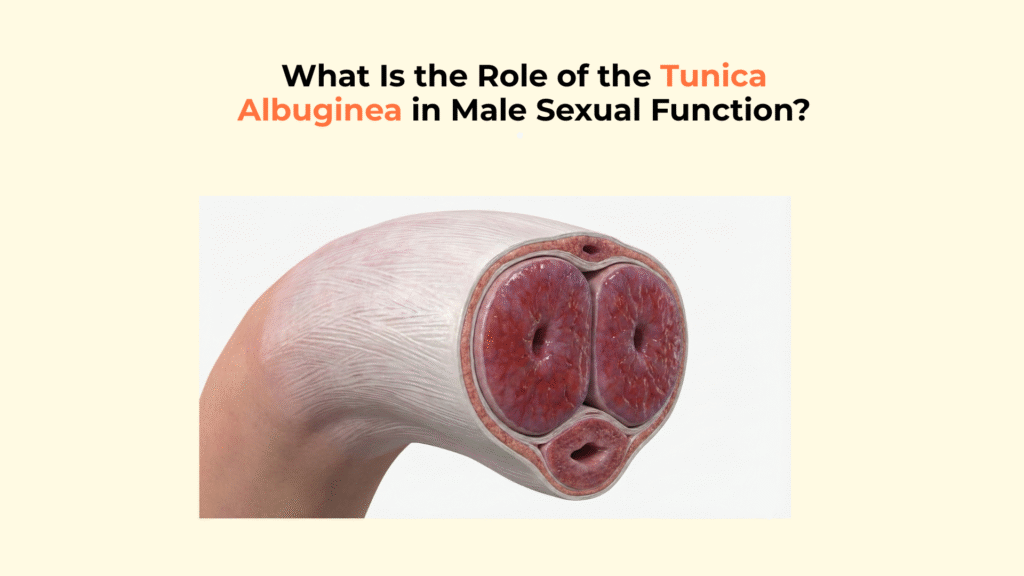
The primary role of the Tunica Albuginea in male sexual function is to act as a high-strength, non-distensible envelope that traps blood within the penis to generate the rigidity required for sexual intercourse, a process known as the veno-occlusive mechanism.
While arterial inflow initiates the process of tumescence, blood flow alone is insufficient for penetration. It is the specific biomechanical function of the Tunica Albuginea that converts a soft, vascular organ into a rigid structure capable of axial loading. This guide details the specific physiological roles of the Tunica Albuginea, including its function as a hydraulic container, its critical role in trapping blood, and how it provides structural stability during intercourse.
Important Medical Disclaimer: This information is for educational purposes only and is not a substitute for professional medical advice, diagnosis, or treatment. Consult with a qualified healthcare provider regarding any medical condition or concerns about your health.
Key Functional Roles: Tunica Albuginea
- The Hydraulic Container: It acts as a rigid casing that converts blood volume into high intracavernosal pressure.
- The Passive Valve: It is the backstop for the veno-occlusive mechanism, trapping blood by compressing veins.
- Axial Stability: Its fiber orientation prevents the erect penis from buckling under pressure during intercourse.
- Protection: It shields the delicate erectile tissue and nerves from mechanical trauma.
- The Limit: It defines the maximum size and shape of the erection.
What Is the Primary Physiological Role of the Tunica Albuginea?
The primary physiological role of the Tunica Albuginea is “Container Mechanics,” serving as a non-distensible envelope that converts fluid volume into mechanical stiffness. While the corpora cavernosa (the sponge-like erectile tissue) accepts the blood, without the containment provided by the tunica, the penis would merely expand in size without achieving rigidity.
The Role of “Container Mechanics” (Hydraulics)
Functionally, the Tunica Albuginea acts as a constraint that contains the rising blood pressure within the corpora cavernosa, thereby converting fluid pressure into rigid mechanical stiffness.
To understand this, we must define the term non-distensible. Unlike a balloon, which continues to stretch as you add air, the tunica albuginea has a specific limit to its compliance. Compare it to the casing of a tire. The air (blood) provides the pressure, but the casing (tunica) determines the shape and hardness. If the casing were infinitely stretchy, the tire would never become hard enough to support a vehicle.
This containment function is vital for urological health. It allows intracavernosal pressure to rise dramatically, moving from a resting state of approximately 10 mmHg to an erect state of nearly 100 mmHg (or higher during contraction of the pelvic floor muscles). Without this high-pressure containment, sexual function is impossible. For further reading on penile hemodynamics, see this study: Physiology of Penile Erection and Pathophysiology of Erectile Dysfunction.
How Does the Tunica Albuginea Play a Critical Role in the Veno-Occlusive Mechanism?
The Tunica Albuginea plays a critical, passive role in the veno-occlusive mechanism by providing the rigid surface against which draining veins are compressed to stop blood outflow. This is arguably the most misunderstood aspect of erection mechanics; the blood is not held in by sphincters, but by compression against the tunica wall.
The Role of the “Passive Valve”
In this mechanism, the Tunica Albuginea does not actively contract but acts as a “passive valve” or backboard. The physiological sequence relies on the interaction between the expanding tissue and the stationary tunica:
- Expansion: The smooth muscle within the corpora cavernosa relaxes and fills with blood.
- Compression: As these sinusoids expand, they push outward toward the tunica albuginea.
- Occlusion: The emissary veins, which drain blood from the penis, run between the sinusoids and the tunica. The expansion traps these veins against the inner wall of the tunica albuginea.
- Result: This compression stops venous outflow, maintaining the erection.
This interaction demonstrates a vital semantic triple of erection physiology: The tunica’s rigidity (Entity) provides the necessary resistance for vein compression (Action), creating the maintenance of the erection (Result).
Failure Mode: The Risk of Venous Leak
If the Tunica Albuginea is too compliant (stretchy) or damaged, the veins are not fully compressed, leading to a condition known as Venous Leak (Veno-Occlusive Dysfunction).
In this pathological state, the containment mechanism fails. Despite adequate arterial inflow, blood escapes through the emissary veins as fast as it enters. Consequently, the intracavernosal pressure never reaches the levels required for rigidity, resulting in Erectile Dysfunction. This highlights that the role of the tunica albuginea is not just structural, but essential to hemodynamic function. (See also: A Complete Guide to Penis Anatomy)
What Is the Structural Role of the Tunica Albuginea Beyond Erection?
Beyond creating an erection, the structural role of the Tunica Albuginea is to provide axial stability to prevent buckling during intercourse and to offer anatomical protection for internal tissues. An erection must be more than just pressurized; it must be mechanically stable enough to withstand external forces.
The Role of “Axial Stability” (Preventing Buckling)
During intercourse, the penis is subjected to axial forces (pushing), and the Tunica Albuginea prevents it from bending or collapsing. This stability is derived largely from the arrangement of collagen fibers within the tunica’s bilaminar structure.
Specifically, the Outer Longitudinal Layer of the tunica consists of fibers running along the length of the penis. When pressurized, this arrangement creates a stiff column effect, preventing the penis from buckling or bending under pressure. Without this specific fiber orientation, the penis might achieve girth but would lack the column strength necessary for penetration.
The Role of “Anatomical Protection”
The Tunica Albuginea functions as a tough shield, protecting the delicate erectile tissue (sinusoids) and the critical neurovascular bundles from mechanical trauma.
During the high friction and pressure of sexual activity, internal tissues are vulnerable. The tunica albuginea encases the corpora cavernosa, while also providing a groove for the deep dorsal vein, arteries, and dorsal nerves that run along its surface. This shielding ensures that mechanical stress is distributed across the sheath rather than impacting the sensitive nerves or rupturing the vascular sinusoids.
How Does the Role of the Tunica Albuginea Change with Elasticity Ratios?
The functional role of the Tunica Albuginea is dictated by its specific balance of collagen and elastin, allowing it to be flexible when flaccid but rigid when erect.
The Collagen-Elastin Balance
The Tunica Albuginea is composed predominantly of Collagen Type I (for strength) and a smaller amount of elastin (for stretch).
- Elastin (~5%): This small percentage is crucial. It allows the penis to remain flaccid, flexible, and comfortable within clothing. It enables the tissue to retract after an erection subsides.
- Collagen (~95%): The high density of collagen provides the “hard limit” to expansion. It ensures that once the physiological limit is reached, the penis becomes rigid rather than continuing to balloon outward.
Pathology can disrupt this balance. In Peyronie’s Disease, the role shifts from “flexible container” to “rigid tether” due to the formation of non-elastic scar tissue (plaque). This scar tissue does not stretch during tumescence, causing the penis to curve or bend toward the lesion, often making sexual function difficult. For more on the pathology of collagen disorders, refer to: Peyronie’s disease: A review of etiology, diagnosis, and management.
Summary and Resources
[Checklist] Summary of Functional Roles
- Hydraulics: Does it contain pressure to create rigidity?
- Hemodynamics: Does it successfully trap emissary veins to stop outflow (Veno-Occlusive Mechanism)?
- Geometry: Does it define the cylinder shape and limit expansion?
- Protection: Does it shield the neurovascular bundle?
- Integrity: Does it withstand high intracavernosal pressure without rupture?
Glossary of Physiological Terms
| Term | Definition |
|---|---|
| Tunica Albuginea | The fibrous sheath surrounding the corpora cavernosa. |
| Veno-Occlusive Mechanism | The process where veins are compressed against the tunica albuginea to trap blood and maintain an erection. |
| Intracavernosal Pressure | The blood pressure within the erectile tissue; high pressure equates to hardness. |
| Axial Stability | The ability of the erect penis to resist bending or buckling when pushed against. |
| Emissary Veins | Veins that pass through the tunica albuginea to drain blood from the erectile tissue. |
Conclusion
In conclusion, the Tunica Albuginea is not a passive covering but an active biomechanical component essential for sexual function, responsible for converting blood flow into the rigidity and stability required for intercourse. By functioning simultaneously as a high-pressure container and a valve for the veno-occlusive mechanism, it ensures the physical integrity of the erection.
At factbasedurology, we believe that understanding the physics of your body is the first step to mastering your health. The Tunica Albuginea is the unsung engineer of male sexual function.
External Scientific Sources
Explore Related Topics
Tunica Albuginea Structure
Deep dive into the bi-layered anatomy and collagen composition.
Corpora Cavernosa
Understand the erectile chambers that fill against the Tunica.
Flaccid vs. Erect Blood Flow
How hemodynamics change to create pressure.
Peyronie’s Disease
What happens when the Tunica Albuginea develops scar tissue.
3 Responses