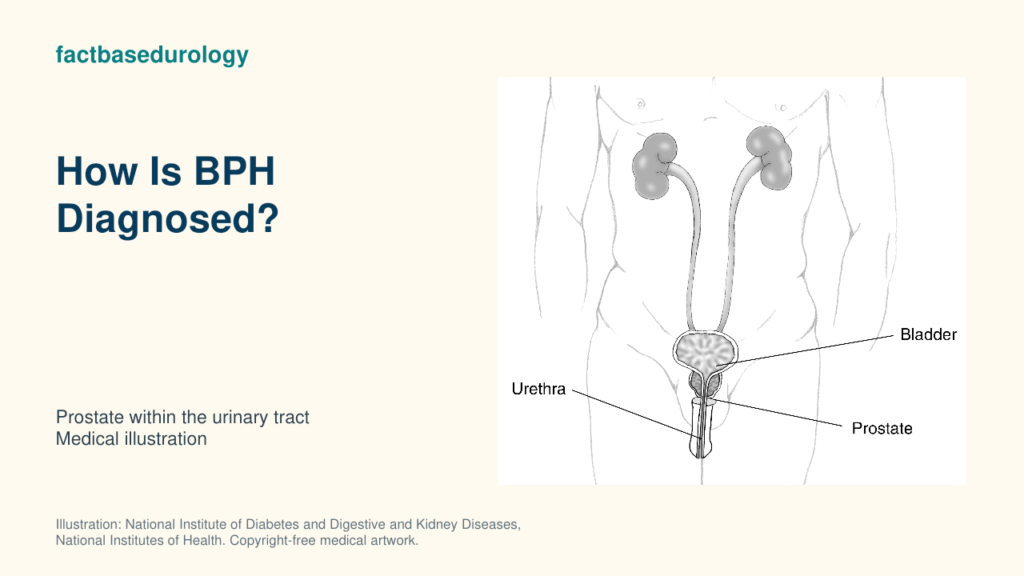
Doctors evaluate suspected benign prostatic hyperplasia (BPH) with symptom assessment, medical history, examination, urinalysis and selected urinary tests; no single clinical test proves that BPH causes urinary symptoms.
01. Benign Prostatic Hyperplasia: Diagnostic Evaluation and Confirmation
BPH evaluation combines urinary symptoms, medical history, prostate examination, urinalysis and selected tests to identify prostate-related problems and competing causes of male lower urinary tract symptoms.
The purpose of evaluation is not simply to determine whether the prostate is large. A clinician also needs to determine whether the urinary symptoms are likely to be related to the prostate and whether another bladder, urethral, neurological or medical condition could explain them.
For the broader disease overview, see Benign Prostatic Hyperplasia and Enlarged Prostate .
Which history and examination findings are relevant to benign prostatic hyperplasia?
BPH assessment reviews symptom duration, severity, medicines, previous urinary procedures and relevant illnesses, then examines the abdomen and prostate for findings that change the diagnostic plan. A clinician asks which symptoms are present, how long they have been occurring, whether they are worsening and how much they interfere with sleep or daily activities.
Important urinary symptoms include:
- difficulty starting urination;
- a weak, slow or intermittent urinary stream;
- straining to urinate;
- a feeling of incomplete bladder emptying;
- urinary frequency;
- urgency;
- nighttime urination;
- urinary leakage;
- pain or burning during urination;
- blood in the urine;
- and previous episodes of urinary retention.
Medicines, previous urinary procedures, neurological disorders, diabetes, urinary infections and other conditions are also reviewed because they can produce or worsen similar symptoms.
A symptom questionnaire may be used to document severity. The International Prostate Symptom Score (IPSS) is commonly used to measure urinary symptom burden and quality-of-life impact. The score describes symptoms but does not diagnose BPH.
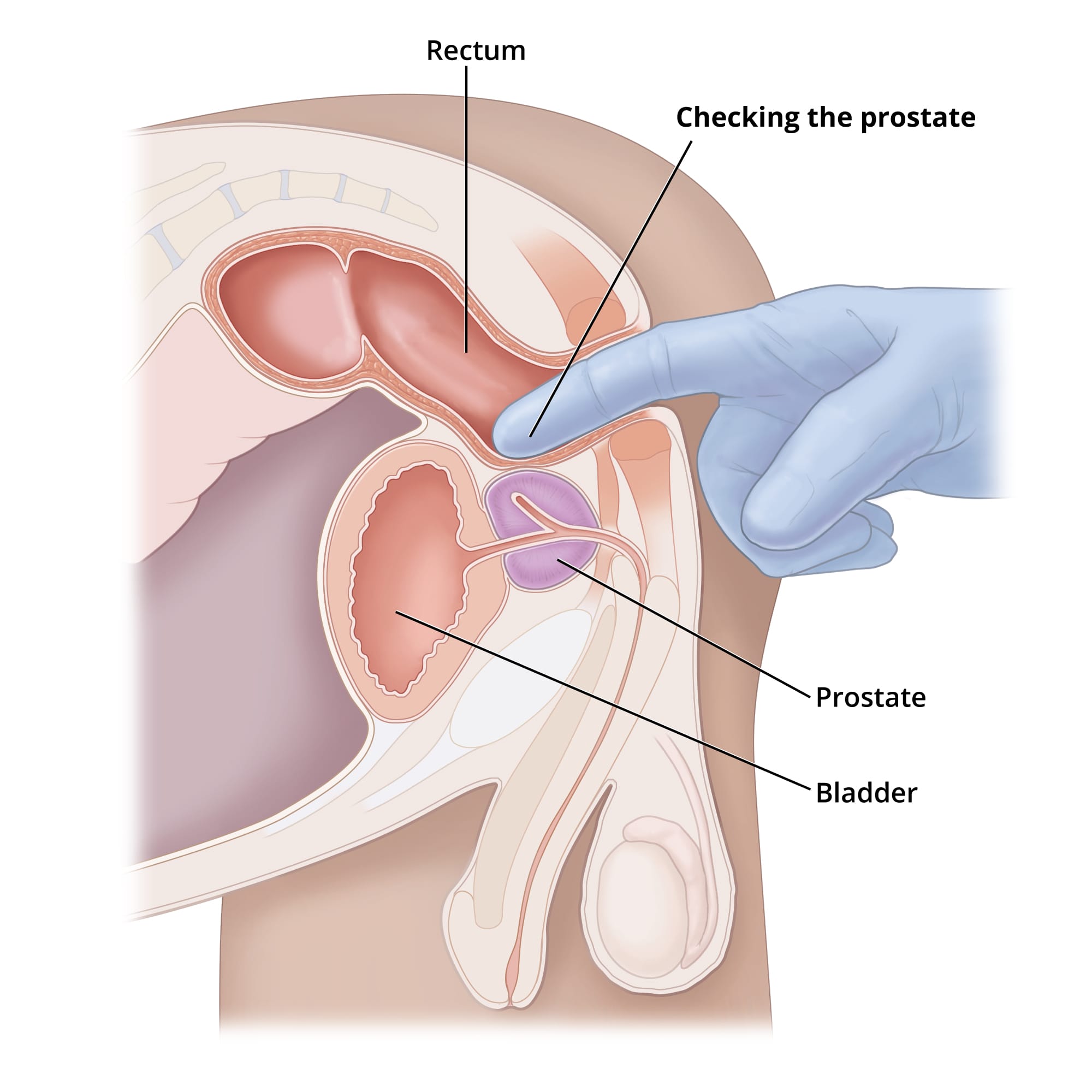
Physical examination may include abdominal examination, neurological assessment when relevant and a digital rectal examination (DRE) .
During DRE, the clinician assesses the portion of the prostate that can be felt through the rectum. The examination can provide an estimate of prostate size and information about consistency or abnormal areas, but it does not precisely measure prostate volume or determine whether obstruction is present.
Which tests are used to evaluate benign prostatic hyperplasia?
BPH evaluation uses urinalysis, prostate examination and selected PSA, urinary-flow, residual-urine or ultrasound measurements; the tests are chosen according to symptoms and treatment decisions. Their usefulness depends on the patient’s symptoms, examination findings and treatment decisions being considered.
| Assessment | What it helps evaluate | Important limitation |
|---|---|---|
| Medical history and symptom assessment | Pattern, severity and impact of urinary symptoms | Symptoms do not identify the anatomical cause by themselves |
| Digital rectal examination | Approximate prostate size and palpable abnormalities | Does not precisely measure prostate volume or prove obstruction |
| Urinalysis | Infection, blood, glucose and other urinary abnormalities | Does not diagnose BPH |
| PSA blood test | May contribute to prostate cancer assessment and treatment planning | An abnormal PSA is not specific for BPH or cancer |
| Post-void residual | Amount of urine remaining after urination | Does not identify why emptying is incomplete |
| Uroflowmetry | Urinary-flow rate and flow pattern | Reduced flow can result from obstruction or weak bladder contraction |
| Ultrasound | Prostate size, bladder findings and selected urinary anatomy | Prostate enlargement alone does not prove functional obstruction |
Urinalysis is commonly used early in the evaluation because urinary infection, blood or other abnormalities can change the diagnostic approach.
PSA testing may be useful when prostate cancer assessment would influence management or when information related to prostate size would affect treatment planning. PSA should not be interpreted as a direct test for BPH.
A post-void residual (PVR) measures how much urine remains in the bladder after urination.
Uroflowmetry measures urinary-flow characteristics. Reduced flow may occur with bladder-outlet obstruction, but it can also occur when bladder contraction is weak.
02. How Is Benign Prostatic Hyperplasia Diagnosed?
Doctors evaluate suspected BPH by combining symptoms, examination and selected urinary tests, excluding other causes and distinguishing prostate enlargement from obstruction; tissue examination confirms histological hyperplasia.
Clinicians therefore consider several questions together:
- Are lower urinary tract symptoms present?
- How severe and bothersome are the symptoms?
- Is the prostate enlarged?
- Is urinary flow reduced?
- Is bladder emptying impaired?
- Could another condition explain the symptoms?
- Are there findings that require prostate cancer or specialist evaluation?
Which conditions can mimic benign prostatic hyperplasia?
Urinary infection, prostatitis, urethral stricture, weak bladder contraction, overactive bladder, neurological disease, bladder stones and urinary cancers can produce symptoms that resemble BPH. This is why urinary symptoms in an older man should not automatically be attributed to prostate enlargement.
- Urinary tract infection: can cause urgency, frequency and painful urination.
- Prostatitis: may cause urinary symptoms together with pelvic discomfort.
- Urethral stricture: can cause weak flow, straining and incomplete emptying.
- Detrusor underactivity: weak bladder contraction can produce slow flow and residual urine.
- Overactive bladder: commonly causes urgency and frequency.
- Neurological bladder dysfunction: may alter bladder contraction or outlet coordination.
- Bladder stones: may contribute to urinary irritation or interrupted flow.
- Medication effects: some medicines can worsen bladder emptying.
- Prostate or bladder cancer: can sometimes present with urinary symptoms and require separate evaluation.
For urinary symptoms outside the prostate context, see Male Urinary Health .
What findings help separate benign prostatic hyperplasia from related prostate conditions?
A smoothly enlarged prostate with progressive voiding symptoms supports a benign prostate-related explanation, while blood in urine, abnormal examination, concerning PSA or neurological findings require assessment beyond uncomplicated BPH. Instead, clinicians look for patterns.
A smoothly enlarged prostate together with progressive voiding symptoms may support a benign prostate-related explanation. Objective evidence of impaired flow or emptying can add further information.
Some findings require additional investigation rather than assuming uncomplicated BPH, including:
- blood in the urine;
- recurrent urinary infections;
- a distinctly abnormal prostate examination;
- PSA findings requiring prostate cancer assessment;
- severe or unexplained pelvic pain;
- suspected urethral narrowing;
- neurological abnormalities;
- large or increasing residual urine;
- kidney abnormalities;
- and recurrent urinary retention.
03. Benign Prostatic Hyperplasia: Tests, Differential Diagnosis and Diagnostic Limits
BPH tests measure symptoms, prostate anatomy, cancer-related risk, urinary flow or residual urine; each result answers a different question and requires interpretation alongside the other findings.
Symptoms describe the patient’s experience. Prostate examination describes palpable anatomy. PSA provides information relevant to prostate assessment. Uroflowmetry measures flow. Post-void residual assesses bladder emptying. Imaging provides anatomical information.
These findings should be interpreted together.
Which test results are supportive rather than diagnostic?
Prostate enlargement, high IPSS, elevated PSA, low urinary flow and high residual urine support particular findings during BPH assessment, but none alone proves that BPH causes the symptoms.
| Finding | What it may support | What it cannot prove by itself |
|---|---|---|
| High IPSS score | Significant urinary symptom burden | That symptoms are caused by BPH |
| Enlarged prostate on examination | Benign prostate enlargement may be present | That urinary obstruction is present |
| Elevated PSA | Need for appropriate prostate assessment | BPH or prostate cancer by itself |
| Low urinary flow | Impaired urinary emptying may be present | Whether the cause is obstruction or weak bladder contraction |
| Elevated post-void residual | Incomplete bladder emptying | That the prostate is responsible |
| Large prostate on ultrasound | Objective prostate enlargement | That symptoms or obstruction must be severe |
What can a single test not prove about benign prostatic hyperplasia?
A single symptom score, prostate measurement, PSA result, flow test or residual-urine measurement cannot establish that BPH causes bladder-outlet obstruction.
One particularly important distinction is between urinary flow and bladder pressure.
Reduced flow can occur because the urinary outlet is obstructed, because the bladder contraction is weak, or because both mechanisms are present.
When that distinction matters clinically, pressure-flow urodynamic testing may be considered. It is not routinely required for every man with uncomplicated lower urinary tract symptoms.
04. Which Findings Change the Next Step After Evaluating Benign Prostatic Hyperplasia?
BPH follow-up changes with symptom burden, retention, recurrent infection, abnormal prostate findings, concerning PSA, increasing residual urine or kidney abnormalities; complications and diagnostic uncertainty warrant additional assessment.
A man with mild symptoms and no important complications may need only monitoring. More bothersome symptoms may lead to discussion of medicines or other treatment. Evidence of significant obstruction, retention or urinary complications may justify specialist assessment or procedural treatment.
When is imaging, biopsy or specialist assessment considered?
Additional imaging or specialist testing is considered when BPH assessment reveals complications, uncertain anatomy or unexplained emptying problems; prostate biopsy addresses suspected cancer rather than routine BPH diagnosis.
Cystoscopy may be considered when there is concern about urethral narrowing, bladder disease, blood in the urine or when direct anatomical assessment would change a planned procedure.
Urodynamic testing may be considered when clinicians need to distinguish bladder-outlet obstruction from impaired bladder contraction.
Prostate biopsy is not a routine test used to diagnose BPH. Biopsy is performed when prostate cancer evaluation indicates that tissue sampling is appropriate.
Urological assessment becomes particularly important with:
- recurrent urinary retention;
- recurrent urinary tract infections;
- visible or unexplained blood in the urine;
- suspected urethral stricture;
- abnormal prostate findings;
- PSA findings requiring additional assessment;
- substantial or increasing residual urine;
- kidney or upper urinary tract abnormalities;
- or symptoms that remain troublesome despite treatment.
How does the diagnosis of benign prostatic hyperplasia change treatment or follow-up?
BPH evaluation guides monitoring for mild symptoms, medicines for bothersome symptoms and further testing or procedures for significant obstruction, retention or recurrent urinary complications.
Men with mild symptoms may be monitored with periodic reassessment. Men with bothersome symptoms may consider medical treatment.
When important obstruction, urinary retention, recurrent complications or persistent symptoms are present, additional anatomical or functional testing may help guide procedural or surgical treatment.
The previous article explains How Can BPH Cause Urinary Retention? Acute and Chronic Bladder Outlet Obstruction .
The next diagnostic guide explains What Is the IPSS? How the International Prostate Symptom Score Measures Male LUTS .
Summary
BPH is evaluated by combining urinary symptoms, medical history, physical examination and selected tests rather than relying on a single diagnostic result. Urinalysis helps identify alternative urinary causes, while DRE provides information about the prostate.
PSA may be useful when prostate cancer assessment or treatment planning makes the result relevant. Uroflowmetry and post-void residual measurement provide objective information about urinary flow and bladder emptying, but neither test alone proves prostate obstruction.
Additional imaging, cystoscopy or urodynamic testing is generally reserved for situations in which anatomy, complications or the cause of impaired emptying requires further clarification.
Educational information only. The appropriate diagnostic evaluation depends on individual symptoms, medical history and examination findings.
Watch: BPH diagnosis
FactBasedUrology explains how symptoms, prostate examination and urinary tests contribute to BPH assessment in this educational video.