How Can BPH Cause Urinary Hesitancy? Bladder Outlet Resistance and Delayed Flow Initiation
Urinary hesitancy is a delay between being ready to urinate and the start of urine flow. It is a voiding symptom, not a diagnosis.
Urine flow starts only when a coordinated sequence succeeds
The International Continence Society defines hesitancy as difficulty initiating urination that produces a delay after a person is ready to void. Normal initiation requires a coordinated switch from storage to emptying—not merely a “strong bladder.”
How does BPH delay the start of urination?
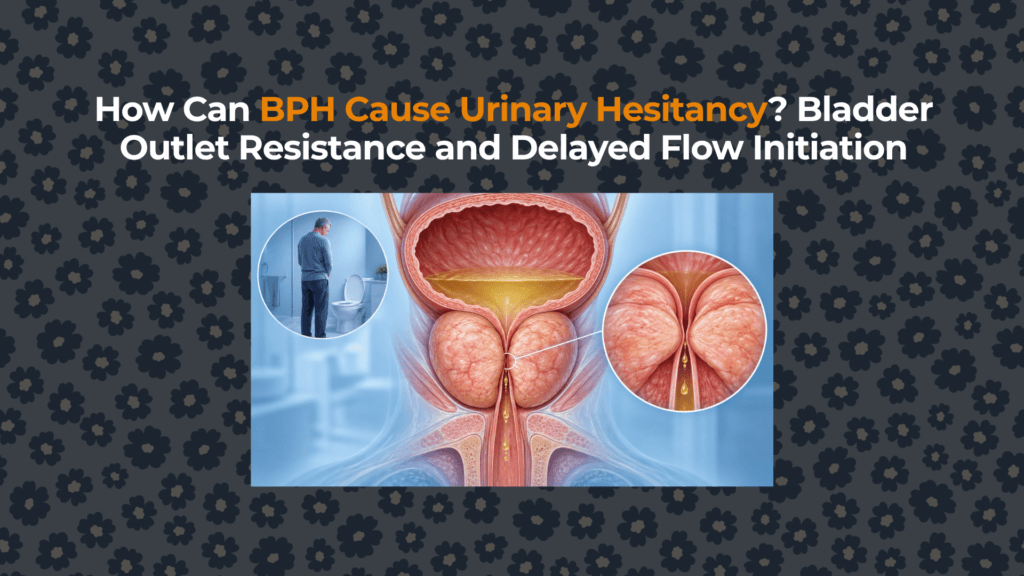
BPH develops mainly in the transition zone around the proximal urethra. Enlargement can narrow or deform the outlet, while alpha-adrenergic smooth-muscle tone adds a reversible dynamic component. The BPH hub separates histologic growth, enlargement and functional obstruction.
| Mechanism | What changes | Possible effect | Critical limit |
|---|---|---|---|
| Static resistance | Periurethral tissue enlarges or protrudes | More pressure needed to open the outlet | Size correlates imperfectly with symptoms |
| Dynamic resistance | Prostate/bladder-neck smooth-muscle tone rises | Outlet opening is delayed | Tone cannot be inferred from delay alone |
| Bladder compensation | Detrusor generates higher pressure | Flow eventually begins | High effort is not visible without pressure testing |
| Decompensation | Contraction becomes insufficient or short | Delay, weak flow or residual urine | May reflect detrusor underactivity, not BPH |
Hesitancy is not the same as weak stream or retention
| Term | What the person notices | What it cannot establish |
|---|---|---|
| Hesitancy | Delay before flow starts | Why the delay occurred |
| Weak stream | Reduced perceived force during flow | Obstruction versus weak bladder contraction |
| Intermittency | Flow stops and restarts | The site or cause of resistance |
| Straining | Abdominal effort used to initiate/maintain flow | Whether detrusor pressure is adequate |
| Urinary retention | Inability or incomplete ability to empty | Cause without evaluation |
Why can two different mechanisms look identical?
A delay can reflect excessive outlet resistance, insufficient detrusor force, or both. Pelvic-floor non-relaxation, urethral stricture, constipation, pain, anxiety/privacy conditions, diabetic or neurologic dysfunction, and medicines such as decongestants or drugs with anticholinergic effects can contribute. Hesitancy therefore cannot be used as a prostate-size test.
Which tests identify the dominant mechanism?
| Evidence layer | What it adds | Boundary |
|---|---|---|
| History + medicine review | Onset, setting, pain, neurologic and drug context | Cannot prove obstruction |
| Urinalysis | Infection, blood or metabolic clues | Normal results do not confirm BPH |
| Post-void residual | Urine remaining after voiding | May rise with obstruction or weak contraction |
| Uroflowmetry | Qmax, voided volume and curve shape | Preferably interpret with voided volume >150 mL; low flow is not cause-specific |
| Prostate/outlet imaging | Volume, configuration and protrusion | Anatomy does not equal functional obstruction |
| Pressure–flow study | Detrusor pressure paired with flow | Used selectively when mechanism matters |
The weak-stream guide explains objective flow limitations. The preceding BPH–urgency article covers a storage symptom; the next guide examines straining to urinate.
Will BPH treatment remove hesitancy?
It may when prostate-linked outlet resistance is dominant. Alpha blockers reduce dynamic smooth-muscle tone; 5-alpha-reductase inhibitors reduce progression risk in selected enlarged glands over months; procedures reduce anatomical resistance. Persistent hesitancy after outlet treatment should prompt reconsideration of bladder contractility, urethral narrowing, pelvic-floor coordination, medicines and neurologic causes. Symptom improvement is evidence of response—not retrospective proof of the original mechanism.
When does delayed flow require urgent care?
Evidence synthesis
BPH can delay urine-flow initiation by increasing static and dynamic outlet resistance, but hesitancy remains a non-specific symptom. The clinically useful question is whether the delay comes from resistance, inadequate bladder force, failed outlet relaxation or a mixed mechanism. History, medication review, urinalysis, PVR and properly interpreted uroflow provide layers of evidence; selected pressure–flow testing separates obstruction from detrusor underactivity.
Educational information only. Individual diagnosis and treatment require qualified clinical assessment.