How Can an Enlarged Prostate Cause a Weak Urine Stream? Prostatic Obstruction Explained
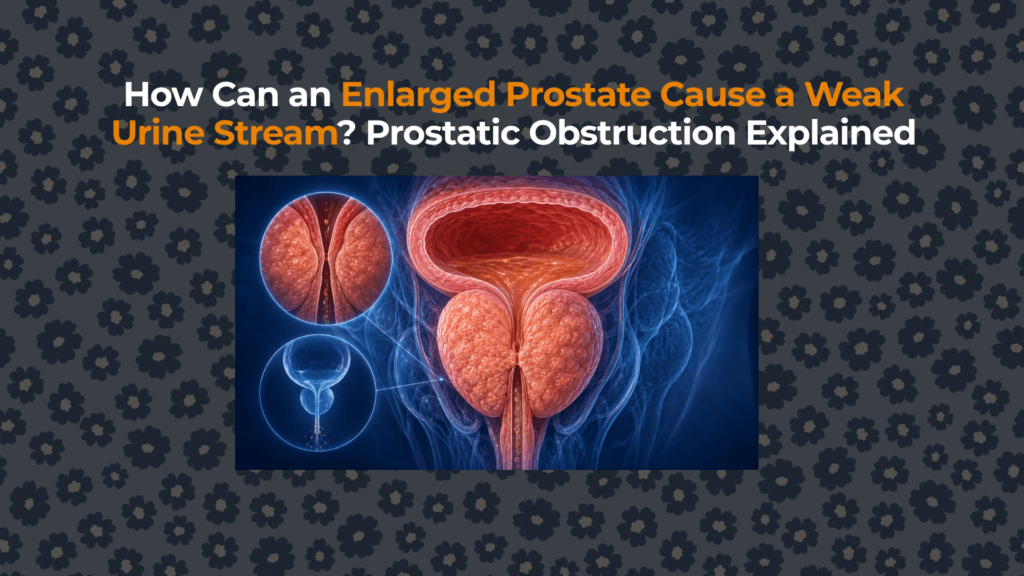
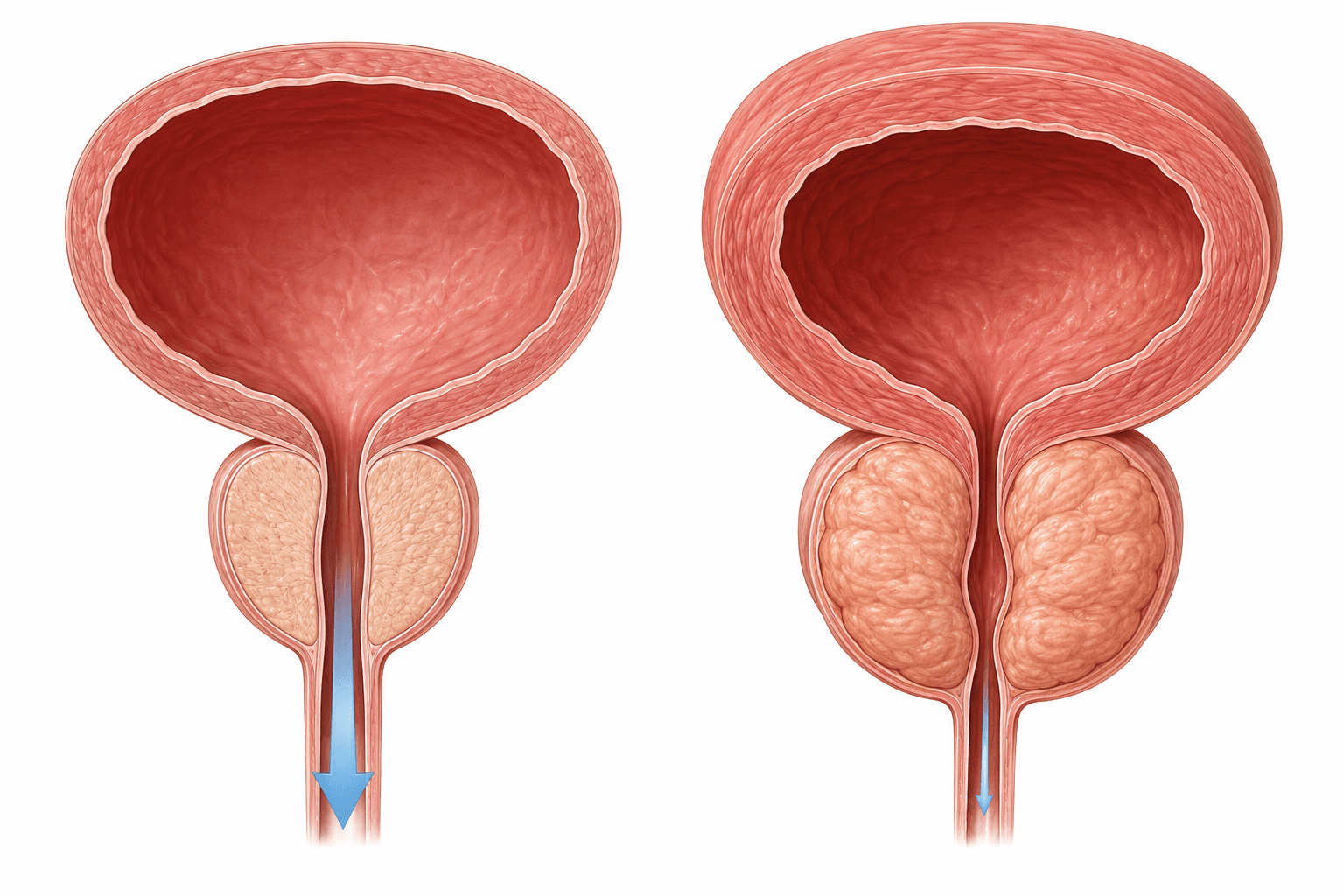
The prostate surrounds the first segment of urethra below the bladder. Benign growth can reduce that channel’s functional opening, while prostate and bladder-neck smooth muscle can add dynamic resistance. The bladder initially compensates by contracting harder; the stream becomes weak when the pressure generated cannot overcome outlet resistance.
From prostate growth to reduced flow: the causal chain
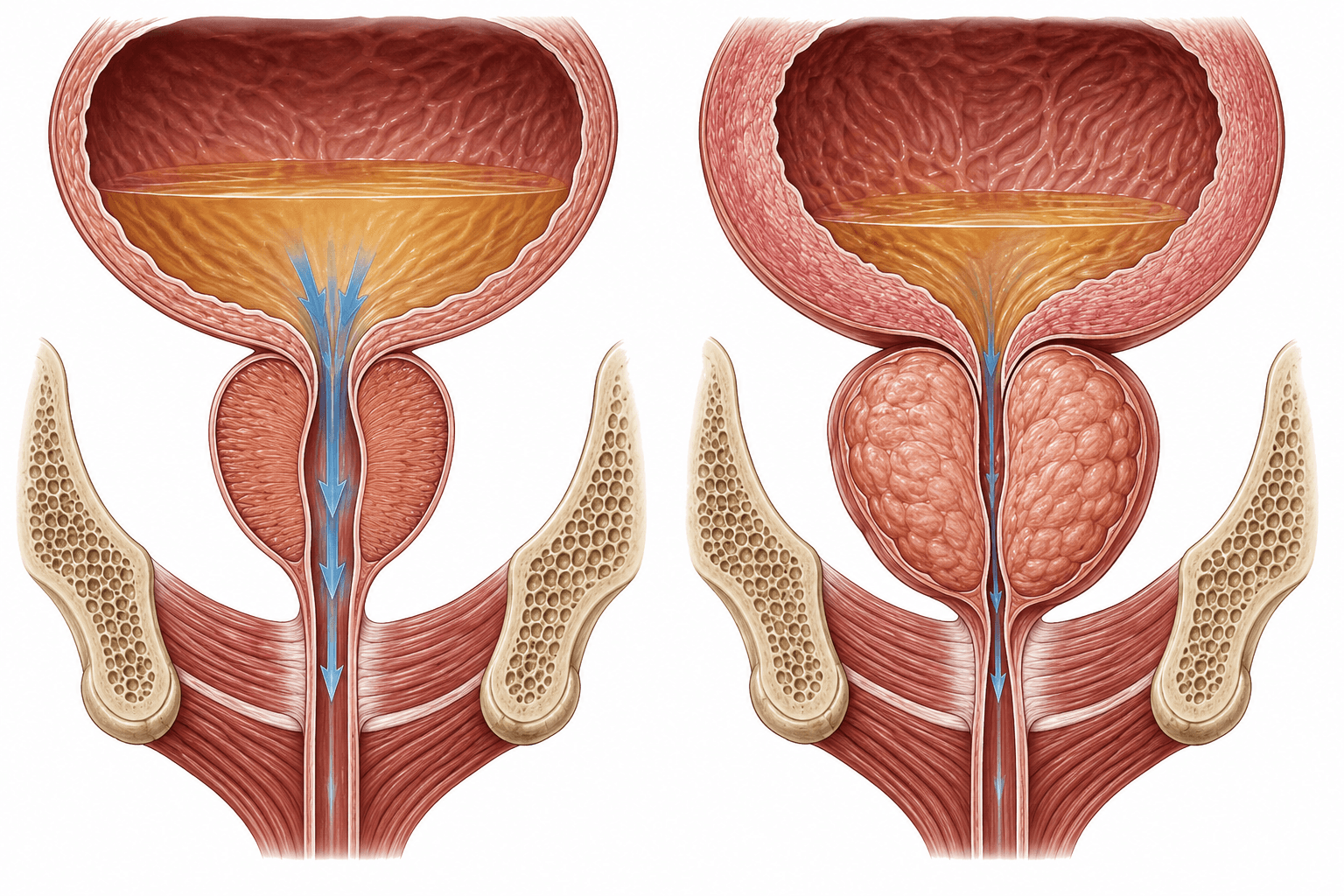
BPH begins as non-cancerous cellular growth, mainly in the transition zone around the prostatic urethra. Its clinical effect depends less on total grams of tissue than on where that tissue grows, the geometry of the bladder outlet and the tone of local smooth muscle.
Static and dynamic resistance are different
| Component | Mechanism | What can modify it | What it does not establish |
|---|---|---|---|
| Static | Tissue bulk, median-lobe protrusion and outlet geometry reduce the effective lumen | 5-alpha-reductase inhibitors over months; tissue-removing or channel-widening procedures | A large gland is not automatically obstructed |
| Dynamic | Alpha-adrenergic smooth-muscle tone in prostate and bladder neck raises resistance | Alpha blockers can relax tone relatively quickly | Symptom improvement does not measure gland shrinkage |
| Bladder response | Detrusor pressure rises to preserve emptying against resistance | Duration of obstruction, age, neurologic and metabolic health | High pressure cannot be inferred from stream appearance |
Why the bladder can hide obstruction—until it cannot
Early in obstruction, detrusor muscle can generate higher pressure and preserve an apparently adequate stream. Over time, remodeling may include increased wall thickness and altered compliance. Some bladders later contract less effectively, so obstruction and detrusor underactivity may coexist. This is why a man can have a modestly enlarged prostate with major difficulty, or a large prostate with little difficulty; NIDDK explicitly notes that symptom severity is not directly determined by prostate size.
What does a “weak stream” mean on testing?
A symptom description is subjective. Uroflowmetry records urine volume against time and reports maximum flow (Qmax), average flow, voided volume and curve shape. The EAU recommends interpreting these together and obtaining a voided volume above 150 mL when possible; a low-volume void can look falsely weak. Abnormal or unrepresentative tests often need repeating.
Thresholds change sensitivity and specificity
| EAU-reported Qmax threshold | Sensitivity for BOO | Specificity | PPV | Interpretation |
|---|---|---|---|---|
| 10 mL/s | 47% | 70% | 70% | More specific, but misses many obstructed men |
| 15 mL/s | 82% | 38% | 67% | More sensitive, but many low results are not obstruction |
Even Qmax above 15 mL/s does not exclude obstruction because the bladder may compensate with higher pressure. Conversely, low Qmax does not prove obstruction.
One weak stream, several possible mechanisms
| Mechanism | Pressure–flow logic | Clues that may redirect testing | How it is distinguished |
|---|---|---|---|
| Benign prostatic obstruction | Higher detrusor pressure with reduced flow | Age-associated LUTS, enlarged/reshaped outlet, intravesical protrusion | Clinical assessment; pressure–flow if uncertainty matters |
| Detrusor underactivity | Low pressure and low flow | Diabetes, neurologic disease, longstanding retention, large residual | Pressure–flow study—not flow rate alone |
| Urethral stricture | Resistance lies distal to the prostate | Prior instrumentation, trauma, infection; spraying or progressive narrowing | Cystoscopy or urethral imaging when indicated |
| Underfilled bladder/test artifact | Too little driving volume for representative flow | Voided volume below 150 mL or atypical test void | Repeat uroflow at representative volume |
| Medicines/neurologic dysfunction | Outlet tone or bladder activation changes | New drug exposure, sensory/motor symptoms | Medication and neurologic review; targeted testing |
How clinicians test whether the prostate is actually obstructing flow
Evaluation usually starts with history, medication review, examination and urinalysis. Symptom scores measure burden, not mechanism. Uroflowmetry adds an objective flow trace; post-void residual (PVR) estimates what remains. A PVR of 50 mL has limited accuracy for obstruction in EAU data (PPV 63%, NPV 52%), because residual urine can result from obstruction or poor detrusor function.
Prostate imaging can show volume and configuration. Intravesical prostatic protrusion may add predictive information, but anatomy still does not directly measure voiding pressure. Cystoscopy evaluates the lumen when stricture, bleeding or anatomy matters.
Pressure–flow testing separates resistance from weak power
When diagnostic uncertainty could change an invasive treatment decision, urodynamic pressure–flow testing can distinguish high-pressure/low-flow obstruction from low-pressure/low-flow detrusor underactivity. The EAU defines the bladder outlet obstruction index (BOOI) as pdetQmax − 2 × Qmax: above 40 is obstructed, 20–40 equivocal and below 20 unobstructed. The bladder contractility index (BCI) is pdetQmax + 5 × Qmax; below 100 indicates weak contractility. These indices require properly measured invasive pressures and are not home calculations.
Would BPH treatment strengthen the stream?
It may—when prostatic resistance is an important cause. Alpha blockers reduce dynamic smooth-muscle tone. 5-alpha-reductase inhibitors gradually reduce progression risk and prostate volume in appropriately selected enlarged glands. Procedures remove tissue or widen the channel. Improvement after treatment supports a reversible outlet component, but response varies when bladder underactivity or another lesion coexists. The distinction between histologic BPH, enlargement and measured obstruction is developed in BPH versus benign prostatic obstruction.
When is weak flow urgent?
Evidence synthesis
Prostate enlargement can weaken urine flow through static tissue geometry and dynamic smooth-muscle tone at the bladder outlet. The bladder may compensate with higher pressure, so neither gland size nor stream strength alone identifies obstruction. Uroflowmetry quantifies the result but cannot identify the cause; representative voided volume, curve shape and repeated measurements matter. When treatment depends on knowing the mechanism, pressure–flow testing distinguishes prostatic/outlet resistance from detrusor underactivity.
Educational information only. Individual diagnosis and treatment require a qualified clinician.
Evidence sources
- EAU Guidelines: Diagnostic Evaluation of Non-neurogenic Male LUTS.
- American Urological Association: BPH Guideline (2026).
- NIDDK: Enlarged Prostate (Benign Prostatic Hyperplasia).
- NIDDK: Symptoms and Causes of Urinary Retention.
- International Continence Society–aligned review: voiding dysfunction, obstruction and detrusor underactivity.