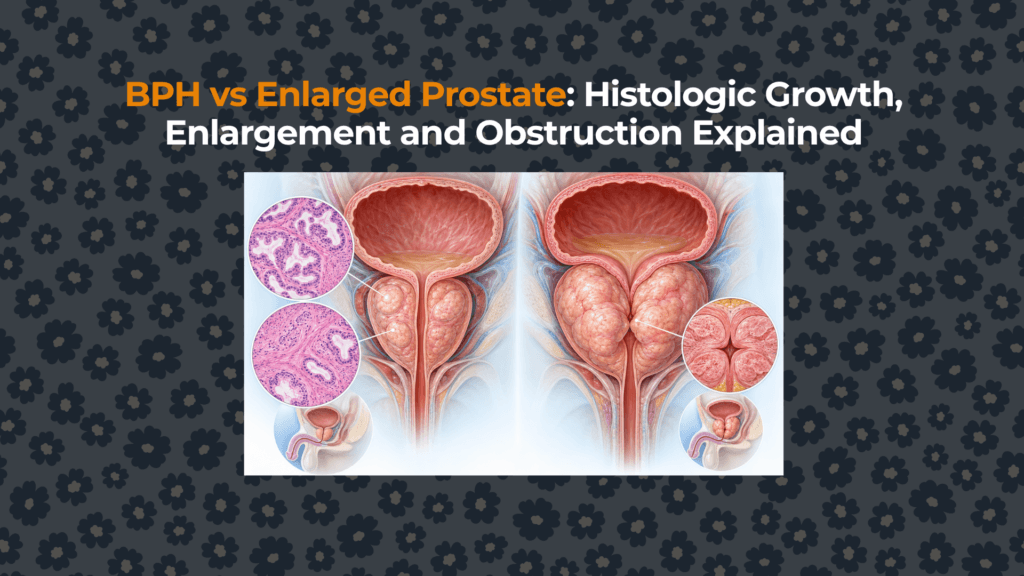
BPH vs Enlarged Prostate: What Is the Difference?
BPH and prostate enlargement often travel together, but they describe different attributes measured in different ways.
01. What is the shortest accurate difference?
| Attribute | BPH | Enlarged prostate/BPE |
|---|---|---|
| Entity type | Tissue process | Anatomical state |
| Defining feature | Benign stromal and epithelial hyperplasia | Increased gland volume or estimated size |
| Measured by | Histology | DRE estimate, ultrasound or MRI |
| Typical unit | Qualitative microscopic diagnosis | mL/cc, dimensions or approximate grams |
| Proves symptoms? | No | No |
| Proves obstruction? | No | No |
The histology-first BPH definition explains the cellular process. This page owns the comparison.
02. BPH Is Reserved for a Histologic Pattern
EAU terminology reserves BPH for the characteristic benign proliferation of glandular and stromal components. Hyperplasia means increased cell number, not simply a larger organ. Tissue removed during resection, enucleation or surgery can establish that pattern. Most men evaluated for urinary symptoms do not need a biopsy merely to prove BPH; clinicians often use a practical label such as LUTS/BPH while recognizing that it is an attribution, not direct microscopy.
03. How is an enlarged prostate identified?
Enlargement is estimated by digital rectal examination or measured with ultrasound or MRI. Imaging commonly calculates volume from width × height × length × 0.52 or uses segmentation. The result depends on modality, selected planes and gland shape. A number above a young-adult reference means the gland is larger than that reference; it does not supply a microscopic diagnosis.
Use the prostate-volume measurement guide for acquisition uncertainty and the normal-size article for reference distributions.
04. Histologic BPH and Enlargement Overlap Imperfectly
Berry and colleagues synthesized more than 1,000 prostates from 10 studies. Histologic BPH affected about 50% of men aged 51–60, yet gross enlargement is reported less often than microscopic hyperplasia. Their analysis found an average prostate weight of 33 ± 16 g among autopsy glands recognized to contain BPH, and only 4% of prostates in men older than 70 exceeded 100 g. Common microscopic disease therefore does not imply dramatic enlargement.
05. Can a prostate be enlarged without proven BPH?
Yes. Imaging can demonstrate increased volume, but it cannot directly count stromal and epithelial cells. Age-related zonal growth, inflammation, cystic change, edema or individual anatomy can affect size. In routine practice, symmetrical transition-zone enlargement in an older man may be attributed to benign prostate disease, but the evidentiary claim remains anatomical unless tissue is examined.
06. A Small or Modest Prostate Can Still Contain BPH
Microscopic nodules can be present before they produce conspicuous whole-gland enlargement. Nodule position and outlet geometry can matter more than total volume. A median lobe projecting into the bladder may affect the outlet differently from lateral growth directed outward. This is why “not enlarged” on one examination cannot exclude histologic BPH or a prostate-related mechanism.
07. Do BPH or Enlargement Prove Urinary Obstruction?
No. Benign prostatic obstruction (BPO) is a functional claim about outlet resistance attributed to the prostate. Low urine flow may also result from impaired bladder contraction or urethral narrowing; a large prostate may not obstruct. Pressure–flow urodynamics is the reference method when proving obstruction is necessary, though it is reserved for selected clinical decisions rather than every uncomplicated case.
The next comparison, BPH versus benign prostatic obstruction, owns that functional distinction.
08. Prostate Size and Symptom Burden Are Separate Variables
Lower urinary tract symptoms include storage, voiding and post-micturition complaints. They may arise from bladder overactivity, nocturnal polyuria, infection, neurologic disease, medicines, urethral stricture or impaired detrusor contraction. Neither histologic BPH nor enlargement identifies symptom severity. The size–symptom evidence explains the weak individual-level relationship.
09. Which Finding Changes Treatment Decisions?
| Decision | Relevant evidence | Why the label alone is insufficient |
|---|---|---|
| Watchful waiting | Low bother, stable findings, no complication | Neither BPH nor size measures quality-of-life impact |
| Alpha blocker | Bothersome LUTS plausibly related to outlet tone | Drug can help without shrinking the gland |
| 5-alpha-reductase inhibitor | Demonstrated enlargement/progression-risk phenotype | Histologic BPH alone does not quantify treatment response |
| Procedure selection | Volume, shape, median lobe, obstruction, goals and risk | Same volume can have different anatomy |
Guideline volume thresholds are treatment-context tools, not universal borders between normal and abnormal.
How should the two terms be used?
Use BPH for the benign cellular process and BPE/enlarged prostate for increased anatomical size. If symptoms are present, name LUTS. If the prostate is shown to obstruct the outlet, name BPO. This vocabulary prevents a measurement from becoming an unsupported diagnosis.