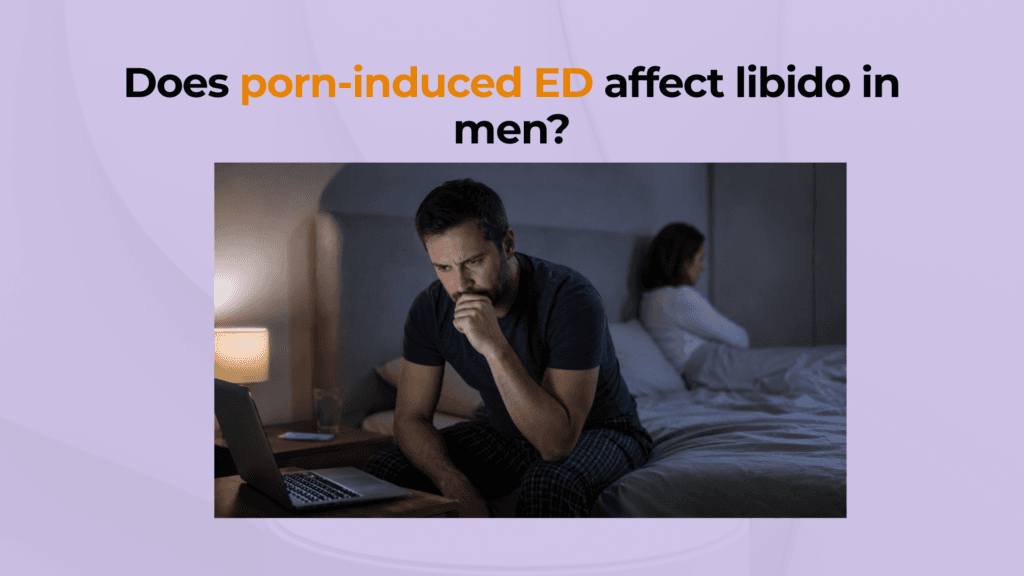
Does Porn-Induced ED Affect Libido in Men?
Overview
Important Medical/Safety Disclaimer
Erectile dysfunction (ED) and libido changes can signal underlying health conditions such as cardiovascular disease or hormonal imbalances. Users experiencing persistent symptoms should consult a healthcare provider immediately. Understanding Erectile Dysfunction.
Porn-induced erectile dysfunction may contribute to decreased male libido through altered neural reward pathways and conditioned arousal responses, though clinical consensus remains evolving and multifactorial causes of ED require professional evaluation.
For many modern men, understanding the connection between sexual performance and mental imagery has become increasingly complex. While the term “Porn-Induced Erectile Dysfunction” (PIED) is widely used in online communities, clinical understanding of how artificial sexual media influences natural desire remains an active area of research.
This guide analyzes the proposed mechanisms, distinguishing between psychological habituation and physiological dysfunction, to help you understand when behavioral changes might be sufficient and when medical intervention is necessary.
What Is Porn-Induced ED and How Does It Relate to Male Libido?
Porn-induced ED refers to difficulty achieving erection with a partner despite normal response during solitary pornography use, a phenomenon some researchers suggest may impact overall male libido levels. Porn-induced ED represents a specific subset of psychogenic erectile dysfunction where the disconnect is primarily between fantasy and physical reality.
Clinically, it is crucial to distinguish between libido (sexual drive or desire) and erection (physiological arousal). While they often work together, they utilize different neural pathways.
A man may experience high libido (a strong mental desire) but fail to achieve an erection due to conditioned response failures. Conversely, he may have a functional erection when viewing specific triggers but no spontaneous desire for his partner.
Proposed Mechanisms Behind PIED and Libido Changes
Proposed mechanisms behind PIED involve neuroplastic adaptations in brain reward pathways that may alter natural arousal thresholds and subsequently influence male libido responses.
1. Dopamine Desensitization
The brain’s primary reward chemical, dopamine, drives motivation and arousal. Repeated exposure to novel, high-intensity visual stimuli (often found in adult media) floods the system with supraphysiological amounts of dopamine. Over time, the brain attempts to protect itself by reducing the number of dopamine receptors—a process called downregulation. This raises the “threshold” required to feel aroused, making normal intimacy seem less stimulating compared to the digital alternative.
2. Contextual Conditioning
The brain is excellent at learning associations. If sexual gratification is repeatedly paired with a computer screen, keyboard, or specific camera angles, those specific elements become the “key” to initiating arousal. This creates a conditioning effect similar to Pavlovian responses. When the physical reality of a real-world partner does not match these hyper-specific, often fantastical digital cues, the brain fails to switch gears efficiently.
Factors That Influence Libido Beyond Pornography Exposure
Multiple factors beyond pornography consumption significantly influence male libido including stress levels, hormonal balance, physical health status, and relationship quality.
| Symptom/Pattern | Possible PIED Indicator | Alternative Explanations | Action Recommendation |
|---|---|---|---|
| Erection difficulty with partner only | Moderate indication | Performance anxiety, relationship stress | Consider behavioral changes first |
| Erection difficulty with any stimulus | Lower PIED likelihood | Physical health, medication side effects | Seek medical evaluation promptly |
| Decreased interest in all intimacy | Variable | Depression, hormonal imbalance | Consult mental health professional |
| Recent increase in pornography use | Correlation noted | Stress coping mechanism | Evaluate usage patterns objectively |
Clinical Self-Assessment Checklist
- [ ] Verify Duration: Symptoms persisting beyond several weeks warrant evaluation.
- [ ] Normalize Variability: Sexual function naturally fluctuates throughout life; occasional lapses are common.
- [ ] Consult Professional: Persistent concerns benefit from expert assessment to rule out organic causes.
Synthesis and Recovery Outlook
The link between pornography consumption and libido is likely mediated by neuroplasticity—the brain’s ability to reorganize itself by forming new neural connections. Because this process is plastic, it is reversible.
Clinical observations suggest that sexual function often recovers with behavioral modifications, particularly through a period of abstinence or reduction known as “rebooting,” allowing dopamine receptor density to normalize.
However, because ED is multifactorial, relying solely on behavioral changes without addressing underlying stressors or medical issues can delay necessary treatment. Finding a Sexual Health Specialist Consultation.
References & Evidence Base
- Wéry A., et al. (2019) “Problematic pornography use: Where we stand?” Clinical Psychology Review.
- Kühn S., et al. (2019) “Neural correlates of problem pornography viewing.” Addiction Biology.
- American Urological Association (2018) “Male Erectile Dysfunction: Guideline on Management.”
Note: Information presented is for educational purposes only and does not constitute medical advice. Please consult with a qualified healthcare provider for diagnosis and treatment.