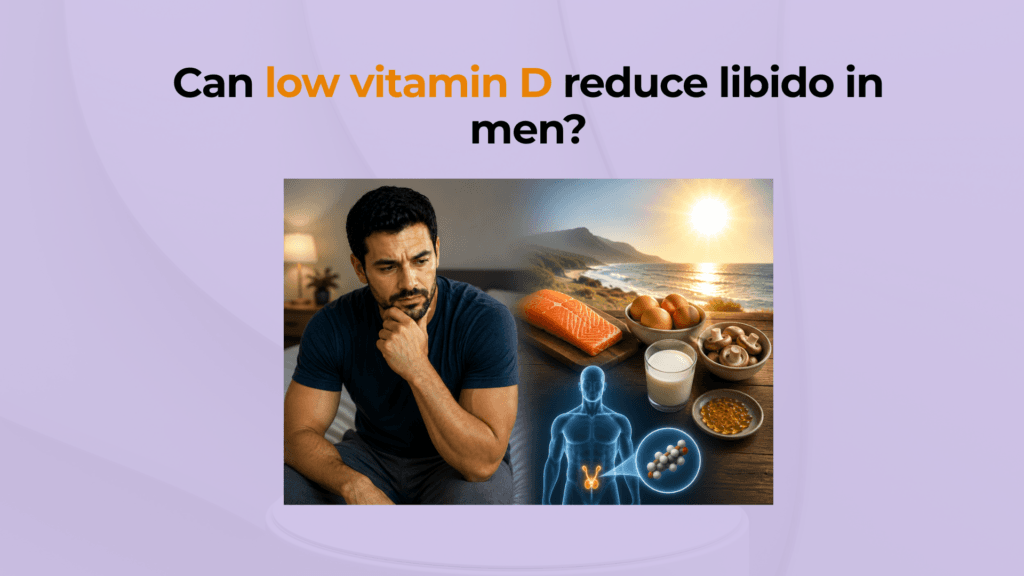
Can Low Vitamin D Reduce Libido in Men?
Low vitamin D may contribute to low libido in some men, especially when deficiency coexists with fatigue, low mood, poor sleep, low testosterone, vascular risk, or erectile-confidence problems. But vitamin D is not a universal libido switch. Correcting deficiency may help the biological conditions that support sexual desire; taking extra vitamin D when levels are already normal is not a proven way to raise libido.
Low vitamin D can be one contributor to reduced male libido, but mostly as an indirect factor. It may influence testosterone biology, endothelial function, inflammation, energy, mood, and general metabolic health. The strongest practical step is not blind supplementation; it is checking vitamin D status when deficiency is clinically plausible, correcting confirmed deficiency safely, and investigating other libido causes at the same time.
How can low vitamin D affect male libido?
Low vitamin D may affect male libido through four linked systems: endocrine signaling, vascular function, energy metabolism, and mood. Sexual desire is not produced by one nutrient alone. It depends on testosterone support, sleep, mental state, relationship safety, blood flow, nervous-system arousal, and overall health.
This is why vitamin D should be framed as a possible supporting condition, not as the single cause of low desire. A man with fatigue, low sun exposure, low mood, obesity, darker skin, malabsorption risk, limited diet, or chronic illness may reasonably discuss vitamin D testing with a clinician. But if libido is low with erection changes, loss of morning erections, depression, medication changes, diabetes symptoms, or major stress, low libido labs should look beyond vitamin D alone.
Vitamin D receptors are found in several tissues, and vitamin D status has been studied in relation to testosterone. The evidence is mixed, so this should be written as support, not guaranteed hormone restoration.
Vitamin D deficiency is associated with vascular and inflammatory changes that may affect erectile confidence, which can feed back into desire.
Deficiency can coexist with fatigue, low mood, musculoskeletal discomfort, and reduced activity, all of which may lower sexual motivation.
More is not always better. High-dose supplementation without monitoring can cause hypercalcemia and kidney-related harm.
What is the vitamin D pathway from sunlight to sexual-health support?
Vitamin D becomes biologically active through a staged pathway. Skin exposure or dietary intake provides vitamin D. The liver converts it into 25-hydroxyvitamin D [25(OH)D], which is the main blood marker used to assess vitamin D status. The kidney and some other tissues then convert it into the active hormone form, 1,25-dihydroxyvitamin D, also called calcitriol.
Calcitriol binds to vitamin D receptors and influences gene expression in many tissues. For libido, the relevant concept is not “vitamin D directly creates desire.” The better semantic chain is: vitamin D status supports endocrine, vascular, immune, and energy systems that create better conditions for sexual desire.
Does vitamin D affect testosterone and blood flow?
Vitamin D may relate to testosterone and blood flow, but the article must separate biological plausibility from proven clinical effect. Some research suggests that vitamin D supplementation might raise testosterone in deficient or overweight men, while other randomized evidence found no testosterone increase in healthy men with normal baseline testosterone. Therefore, the safer claim is: vitamin D correction may support testosterone biology in some deficient men, but it is not a universal testosterone booster.
The vascular pathway is also relevant. Erections depend on endothelial nitric oxide signaling and pelvic blood flow. Low vitamin D is associated with inflammation and endothelial dysfunction in several contexts, but association does not prove that vitamin D alone fixes erectile function. If erection confidence is part of the libido problem, libido and erectile function should be evaluated together.
What does the evidence say about vitamin D, testosterone, and sexual function?
The evidence is suggestive but not strong enough for universal claims. A 2011 randomized trial reported that vitamin D supplementation might increase testosterone in overweight men participating in a weight-reduction program. However, a later randomized trial in healthy middle-aged men found no testosterone increase when baseline testosterone was normal. This means the old article sentence “correcting deficiency can reverse libido loss” is too strong.
For erectile and sexual function, reviews often find an association between low vitamin D and erectile dysfunction or poorer sexual function, but much of the evidence is observational and can be confounded by obesity, inactivity, diabetes risk, cardiovascular disease, depression, and age. A strong article should say “may contribute” and “may be worth testing when deficiency is plausible,” not “vitamin D deficiency is the main cause.”
| Evidence question | What the article can safely say | What to avoid saying |
|---|---|---|
| Does low vitamin D lower libido? | It may contribute in some deficient men through fatigue, mood, testosterone support, vascular health, or metabolic risk. | “Low vitamin D is the direct cause of low libido.” |
| Does vitamin D raise testosterone? | Possibly in selected deficient or high-risk men; not reliably in healthy men with normal baseline testosterone. | “Vitamin D supplementation boosts testosterone in men.” |
| Does vitamin D fix erectile function? | Low vitamin D is associated with ED in some studies, but ED is usually multi-factorial and requires vascular, metabolic, hormonal, and psychological assessment. | “Vitamin D cures erectile dysfunction.” |
| Should all men test vitamin D? | Routine testing is not recommended for all healthy adults without indications; testing is more reasonable when risk factors or symptoms suggest deficiency. | “Every man with low libido must test vitamin D first.” |
What this means for men with low libido
Vitamin D deficiency may weaken some of the body conditions that support sexual desire, including energy, mood, vascular health, and hormone balance. But it should not be treated as a guaranteed libido-reversal treatment. If symptoms suggest low testosterone—such as low morning erections, reduced muscle strength, persistent fatigue, or loss of sexual thoughts—low testosterone and libido should be evaluated directly instead of assuming vitamin D is the main cause.
How should men test and correct vitamin D safely?
The main lab marker is serum 25-hydroxyvitamin D [25(OH)D]. But target ranges vary between organizations and labs. The National Institutes of Health notes that 20 ng/mL or more is sufficient for most people, while deficiency risk rises at very low levels. Some clinical practices use different thresholds, such as less than 20 ng/mL for deficiency. Because ranges vary, men should interpret results with a clinician instead of self-diagnosing from a single number.
| 25(OH)D result | Evidence-safe interpretation | Action language for the article |
|---|---|---|
| < 12 ng/mL | Higher risk of deficiency by NIH/FNB framing. | Discuss treatment with a clinician, especially if symptoms or risk factors are present. |
| 12–19 ng/mL | May be inadequate for some people. | Consider clinician-guided correction and retesting based on context. |
| 20 ng/mL or more | Generally sufficient for most people by NIH/FNB framing. | Do not promise libido improvement from extra supplementation if already sufficient. |
| Very high levels | High supplement intake can raise calcium and toxicity risk. | Avoid megadosing; check calcium and kidney risk if levels are high. |
Practical testing and correction checklist
- Check risk context: low sun exposure, fatigue, low mood, poor diet, malabsorption risk, obesity, darker skin, chronic illness, or limited outdoor activity may make deficiency more plausible.
- Use the right marker: ask about serum 25-hydroxyvitamin D [25(OH)D], not active calcitriol, for routine status assessment unless a clinician has a specific reason.
- Correct deficiency safely: use a clinician-guided dose when deficient and retest as advised instead of assuming more vitamin D means more libido.
- Avoid unsupervised megadosing: long-term high-dose vitamin D can raise calcium and increase kidney-related risk.
- Investigate competing causes: review sleep, depression, medications, diabetes risk, cardiovascular health, relationship stress, and testosterone testing when symptoms suggest a broader problem.
FAQ: Vitamin D and male libido
Can low vitamin D reduce libido in men?
Yes, low vitamin D may contribute to low libido in some men, especially when deficiency is paired with fatigue, low mood, low testosterone, poor vascular health, or chronic illness. It should not be treated as the only possible cause.
Does vitamin D raise testosterone?
Vitamin D may support testosterone biology in selected deficient men, but randomized evidence is mixed. It does not reliably raise testosterone in healthy men who already have normal vitamin D and normal baseline testosterone.
Can vitamin D improve erectile function?
Low vitamin D is associated with erectile dysfunction in some studies, but ED is multi-factorial. Blood pressure, diabetes risk, physical activity, vascular health, testosterone, medication effects, and anxiety may matter more than vitamin D alone.
Should I take vitamin D without testing?
Many people take standard recommended intakes safely, but high-dose correction should not be guessed. If libido is low and deficiency is plausible, testing and clinician-guided correction is safer than blind megadosing.
Can too much vitamin D be dangerous?
Yes. Excess vitamin D from supplements can cause high calcium, nausea, weakness, confusion, kidney stones, kidney injury, soft-tissue calcification, and heart rhythm problems. Long-term high-dose use should be medically supervised.
References
- National Institutes of Health Office of Dietary Supplements. Vitamin D: Health Professional Fact Sheet. Updated 2025.
- Demay MB, et al. Vitamin D for the Prevention of Disease: An Endocrine Society Clinical Practice Guideline. 2024.
- Pilz S, et al. Effect of vitamin D supplementation on testosterone levels in men. Hormone and Metabolic Research. 2011.
- Lerchbaum E, et al. Vitamin D and Testosterone in Healthy Men: A Randomized Controlled Trial. Journal of Clinical Endocrinology & Metabolism. 2017.
- Odetayo AF, et al. Vitamin D in male sexual functions: unwrapping the sunshine vitamin. 2025.
- Canguven O, et al. Vitamin D and Male Erectile Function: An Updated Review. 2020.
- Mayo Clinic. Vitamin D: Safety and side effects. Updated 2025.