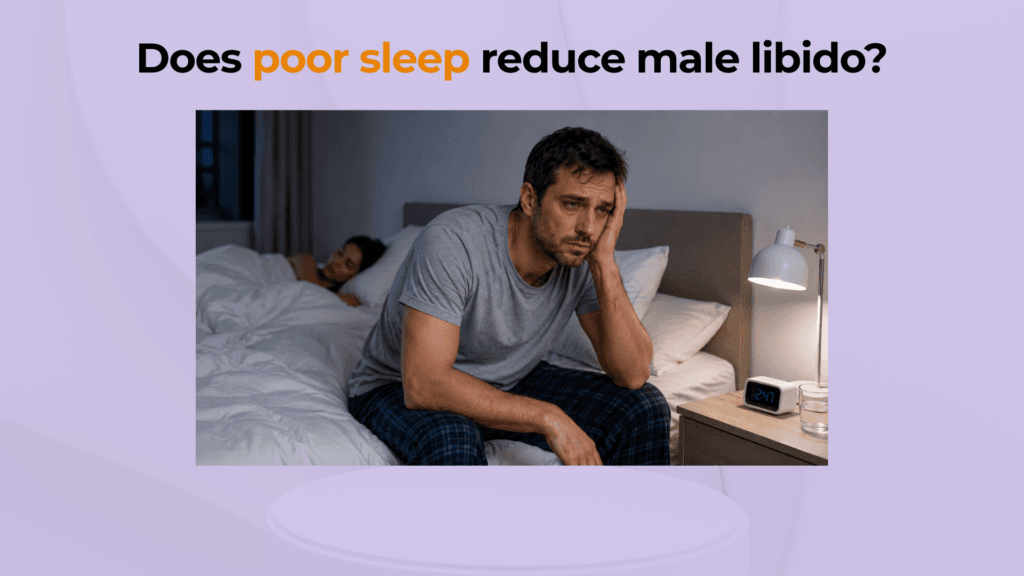
Does Poor Sleep Reduce Male Libido?
Poor sleep is associated with lower male libido, but sleep loss does not reduce every man’s desire or testosterone in the same way. Hormone experiments do not establish a percentage reduction in sexual interest.
Male libido is the motivation for sexual activity. Sleep deprivation describes insufficient sleep; poor sleep quality also includes repeated awakenings and unrefreshing sleep. Low desire, erectile difficulty, and daytime fatigue are separate symptoms.
What does sleep deprivation research actually measure?
Sleep deprivation studies often measure testosterone rather than male libido. Their results establish hormone changes under specific protocols, not a universal loss of sexual interest.
| Evidence | Finding | Libido limitation |
|---|---|---|
| 2011 laboratory study: 10 healthy young men | Daytime testosterone fell approximately 10–15% after restricted sleep. | Did not quantify a 10–15% decline in desire. |
| 2021 meta-analysis: 18 studies, 252 men | Total sleep deprivation reduced testosterone; short-term partial deprivation had no significant pooled effect. | Measured hormones, not a libido treatment response. |
| 2019 randomized studies of short sleep | Did not identify an adverse testosterone effect under their protocols. | Do not establish that short sleep never affects sexual interest. |
Different sleep schedules, measurement times, and participants limit direct comparisons. [1] [2] [3]
What does the 10–15% testosterone result mean for libido?
The 10–15% result describes lower daytime testosterone in a small sleep-restriction experiment; it does not describe male libido loss or accelerated aging.
The 2011 study included 10 healthy young men. Three laboratory nights with 10-hour bedtimes preceded eight nights with 5-hour bedtimes. The restricted condition therefore followed the rested condition rather than a randomized order. Researchers reported lower daytime testosterone and reduced vigor. [1]
This design does not establish the effect of one short night, permanent testosterone deficiency, or a predictable recovery period. A man’s sexual interest cannot be calculated from this hormone percentage.
Does every form of sleep loss lower testosterone?
Sleep loss does not produce a consistent testosterone reduction across all experimental conditions, so male libido should not be attributed automatically to a hormone decline.
The 2021 meta-analysis reported a standardized mean difference of −0.22 for short-term partial sleep deprivation, with a 95% confidence interval of −0.50 to 0.06. That interval included no effect. Total sleep deprivation showed a reduction: −0.64, with a 95% confidence interval of −0.87 to −0.42. These standardized differences are not percentages. [2]
Smith and colleagues’ 2019 randomized studies also reported no adverse testosterone effect under their acute and chronic short-sleep protocols. Their paper appeared in Sleep Health, not Andrology. [3]
Can poor sleep affect libido without low testosterone?
Poor sleep and low male libido can coexist without documented testosterone deficiency. Sexual interest, sleep symptoms, mood, and hormone levels need separate assessment.
A 2025 observational study of men seeking sexual-dysfunction care linked poor sleep quality with lower desire and more depressive symptoms. It did not demonstrate that testosterone explained the association or that sleep treatment restored desire. [4]
Feeling too tired for sex describes a symptom, not a diagnosis of low testosterone. See testosterone and male libido for the difference between symptoms and confirmed deficiency.
How should men distinguish insufficient sleep from insomnia?
Sleep-related low male libido requires a distinction between limited sleep opportunity and difficulty sleeping despite that opportunity.
- Describe restricted sleep opportunity when work, caregiving, or late activities leave too little time for sleep.
- Describe sleep difficulty when falling asleep or staying asleep remains difficult despite time in bed.
- Describe fragmented sleep when repeated awakenings interrupt rest.
- Describe daytime impairment when sleepiness affects concentration or daily activities.
These descriptions organize the history rather than establish a diagnosis. The dedicated insomnia and libido guide explains persistent sleep difficulty and treatment.
What helps assess low libido alongside poor sleep?
Assessment of low male libido alongside poor sleep begins with the timing and pattern of both symptoms. A clinician needs more than the number of hours spent in bed.
- Record sleep opportunity, awakenings, and daytime sleepiness.
- Record desire separately from erection difficulty and sexual frequency.
- Describe whether low desire began before or after the sleep problem.
- Review relevant medications, mood changes, alcohol use, and medical symptoms.
- Discuss persistent or distressing symptoms with a healthcare professional.
A pattern that improves on well-rested days is useful history, but it does not prove sleep is the only cause. A symptom record also helps identify changes that precede both poor sleep and low desire.
Does recovering sleep guarantee normal libido?
Recovering sleep does not guarantee normal male libido, and the cited experiments do not establish a fixed sexual-recovery deadline.
CDC recommends at least 7 hours of daily sleep for adults aged 18–60. That is general health guidance, not a validated libido treatment dose. [5] Persistent low desire warrants assessment even after sleep improves. See better sleep and male libido for practical tracking and sleep-quality advice.
Sources for poor sleep and male libido
- Leproult and Van Cauter. Effect of one week of sleep restriction on testosterone. JAMA, 2011.
- Su et al. Partial and total sleep deprivation and testosterone. Sleep Medicine, 2021.
- Smith et al. Randomized studies of acute and chronic short sleep. Sleep Health, 2019.
- Eker et al. Sleep quality and sexual dysfunction. Journal of Men’s Health, 2025.
- CDC. About Sleep.