
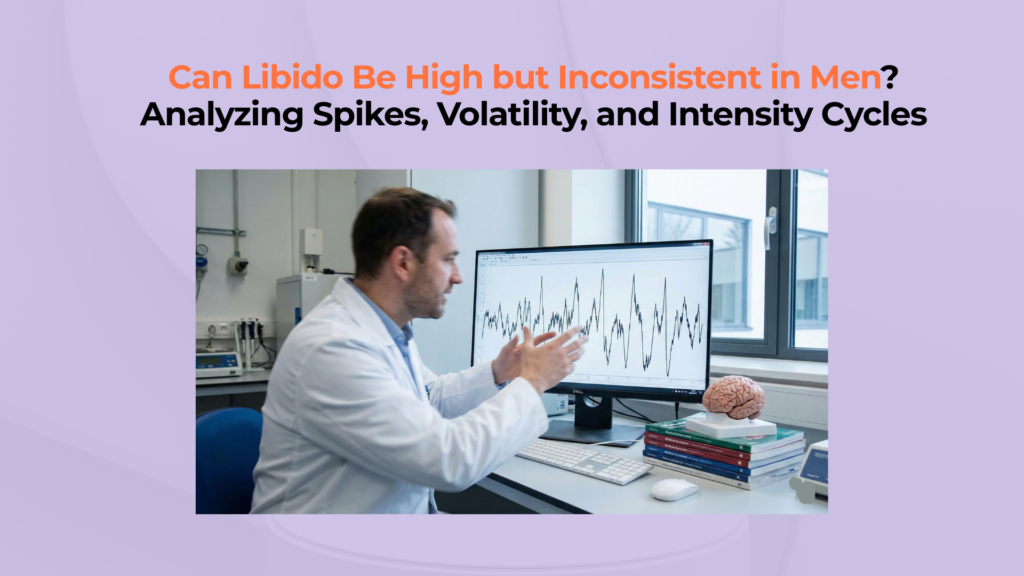
Yes, libido can be high but inconsistent, a state often defined by the Peak-and-Valley Phenomenon where intense sexual desire alternates with sudden drops in interest [HI1]. Clinically, this is a high-amplitude form of libido variability rather than a constant baseline. This volatility reflects a highly reactive neuro-hormonal system.
This pattern often reflects strong “gas” (a dopamine-driven reward surge) interacting with androgen “gain” (the testosterone–libido axis), combined with sensitive “brakes” (Sexual Inhibition System) that react quickly to stress or fatigue [HI4] [HI3].
Important Medical Disclaimer
This guide is for educational purposes only. While fluctuation is common, extreme volatility that causes distress—or sudden major changes alongside sleep problems, anxiety, or medication changes—should be discussed with a healthcare provider.
Inconsistent High Libido: At a Glance
- ● The Pattern: Peaks and valleys (Intensity cycles).
- ● The Mechanism: High reward “gas” + sensitive inhibition “brakes.”
- ● The Trigger: Stress load + poor sleep + habituation.
- ● The Fix: Stabilize sleep/circadian rhythm + manage novelty.
What Does It Mean to Have a High but Inconsistent Libido?
A high but inconsistent libido means the capacity for strong desire is present, but it is frequently interrupted by acute inhibition, fatigue, or reward habituation rather than being steadily accessible [HI1] [HI4].
Defining the “Peak-and-Valley” Phenomenon
The “Peak-and-Valley” phenomenon describes cycles of intense desire followed by abrupt drops, despite a generally high capacity for sexual motivation [HI1]. This validates the experience of men who feel they have “too much” drive one day and “none” the next. As Levine notes, sexual drive components are reactive; high baseline intensity (Entity) interacts with acute inhibitors (Action) producing volatile desire access (Result).
The Premise: Intensity vs. Consistency
Intensity is driven by neurochemical spikes (Incentive Salience / Dopamine), while consistency depends on HPG Axis Stability and testosterone homeostasis across the Circadian Rhythm [HI4] [HI3]. A man can have the ‘engine’ of a high-libido individual but a ‘fuel line’ that is easily pinched by lifestyle factors. Stability requires both the fuel and the spark to remain constant.
What Biological Factors Cause Sharp Spikes in Libido Intensity?
Sharp spikes typically occur when Dopamine-Testosterone Synergy increases motivational salience and lowers the threshold for sexual readiness, often amplified by novelty cues [HI4] [HI2].
Dopamine-Testosterone Synergy
When dopamine-driven incentive salience coincides with strong androgen context, the motivation signal can amplify, increasing sexual readiness and pursuit behavior [HI4] [HI2]. The Medial Preoptic Area (MPOA) is implicated in sexual motivation circuitry in translational/animal literature; treat it as part of a network, not a single on/off switch [HI2]. Synergistic reward signaling (Entity) amplifies sexual motivation circuitry (Action) creating a temporary high-intensity peak (Result).
Circadian Rhythm and Pulsatile Hormone Release
Testosterone shows diurnal variation and Pulsatile Hormone Release, which can contribute to perceived changes in drive across the day—especially when paired with stress and sleep quality [HI3] [HI7]. Understanding this rhythm normalizes the evening “dip” as a biological inevitability.
Why Does a High Drive Shift into a Sudden “Valley”?
Valleys often appear when the Sexual Inhibition System (SIS) overrides motivation due to stress load (a cortisol “shutdown”) or when repeated cues lead to Reward Desensitization and habituation [HI6] [HI5].
The Cortisol “Shutdown” (The Instant Brake)
Acute stress can rapidly increase inhibition and reduce sexual motivation, making even a high drive feel inaccessible in the moment [HI6]. Stress shifts attention and autonomic priorities toward threat management, increasing inhibitory control. Acute cognitive load (Entity) activates inhibitory control (Action) suppressing access to desire quickly (Result).
The “Coolidge Effect” and Habituation
Novelty can temporarily spike desire via reward circuitry (Coolidge Effect evidence comes from animal-model dopamine findings), while familiarity can reduce salience and produce valleys in routine contexts [HI8] [HI5]. Use Coolidge Effect as an explanatory analogy; human desire is also shaped by relationship context and inhibition. Familiarity with a stimulus (Entity) diminishes the dopamine response (Action) leading to a natural fluctuation (Result).
How Do Lifestyle Patterns Create the Illusion of Inconsistency?
Lifestyle patterns create “inconsistency” when libido becomes tethered to recovery cycles—especially sleep debt and reward habituation—rather than stable circadian alignment [HI7] [HI5].
Sleep-Dependent Recovery
Sleep-dependent hormones and circadian alignment strongly influence day-to-day consistency, and one week of sleep restriction / sleep deprivation can reduce testosterone by roughly 10–15% in healthy men [HI7]. Fragmented sleep impairs endocrine recovery. Fragmented sleep (Entity) impairs endocrine recovery (Action) increasing valley frequency and lowering consistency (Result).
Reward Desensitization
High-intensity reward cues—especially when frequent and novelty-heavy—can drive Reward Desensitization, making desire feel spiky rather than steady [HI5] [HI8]. This is best described as temporary changes in reward sensitivity and salience attribution. Repeated high-salience cues (Entity) downshift reward responsiveness (Action) producing peaks followed by lower-interest valleys (Result).
[Checklist] Auditing Your Libido Volatility for Health
Use this audit to determine whether volatility reflects a reactive-but-healthy system or a pattern that warrants medical evaluation. For a practical way to map peaks/valleys, use libido tracking in men.
- Intensity Check: When “on,” is desire strong? (Supports capacity) [HI1].
- Stress Map: Do valleys track stress/cognitive load? (SIS activation) [HI6].
- Sleep Baseline: Does consistency improve after 3 nights of full sleep? (Recovery) [HI7].
- Novelty Check: Does desire spike in new contexts? (Habituation) [HI8].
- NPT Check: Is Morning Wood generally present even on “low” days? (Supportive sign) [HI10].
- Safety Rule: If valleys persist >3 months with distress, consider labs/clinical review [HI10].
Scientific References
- [HI1] Levine SB. (2002) “Reexploring the concept of sexual desire.” PubMed
- [HI2] Hull EM, et al. (1999) “Hormone-neurotransmitter interactions…” PubMed
- [HI3] Brambilla DJ, et al. (2009) “The effect of diurnal variation on clinical measurement…” PubMed
- [HI4] Pfaus JG. (2009) “Pathways of sexual desire.” J Sex Med
- [HI5] Volkow ND, et al. (2011) “Reward, dopamine and the control of food intake…” PMC
- [HI6] Hamilton LD, et al. (2008) “Cortisol, sexual arousal, and affect…” PMC
- [HI7] Leproult R, Van Cauter E. (2011) “Effect of 1 Week of Sleep Restriction…” PMC
- [HI8] Fiorino DF, et al. (1997) “Dynamic changes… Coolidge effect.” PubMed
- [HI10] Burnett AL, et al. (2018) “Erectile Dysfunction: AUA Guideline.” J Urol


One Response