
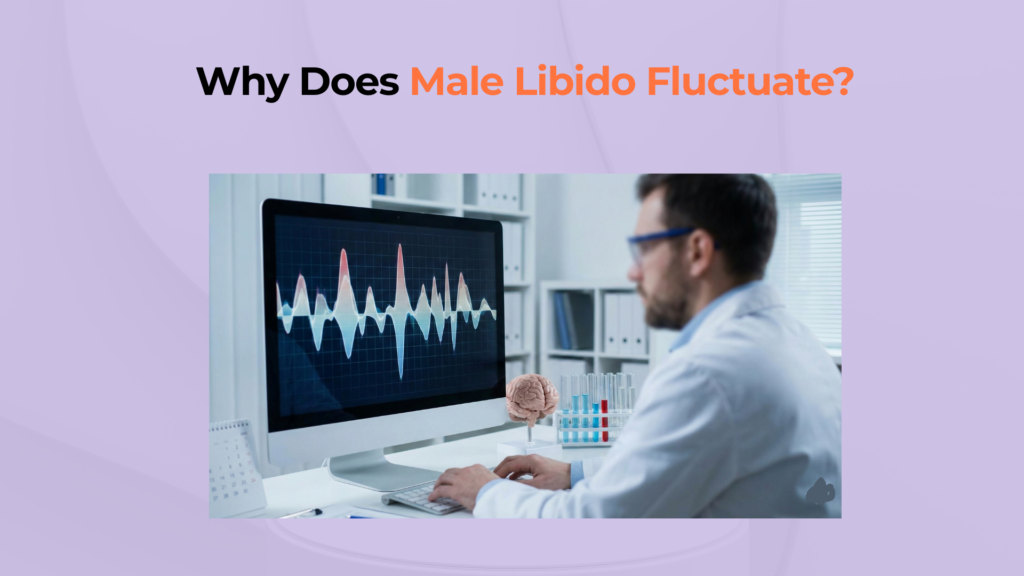
Why Does Male Libido Fluctuate?
Understanding Causes, Patterns & Red Flags
Male libido fluctuation is a normal physiological phenomenon where sexual desire varies in intensity based on circadian rhythms, stress levels, and neurochemical sensitivity [LF1]. In practice, this often reflects libido variability (acute shifts vs chronic baseline) rather than a fixed “on/off” trait.
It is rarely a flat line; instead, it is a dynamic response to internal biological clocks and external environments.
These shifts are governed by the brain’s “Gas” (Sexual Excitation System) and “Brake” (Sexual Inhibition System) reacting to daily life. Understanding this balance is key to differentiating between healthy variability and clinical concern.
Important Medical Disclaimer
This guide is for educational purposes only. While daily fluctuation is healthy, a persistent loss of desire lasting months may indicate Hypogonadism, Thyroid issues, or Clinical Depression. Consult a physician for evaluation.
Libido Fluctuation: At a Glance
What Is Fluctuating Libido and Why Is It Normal?
Fluctuating libido is defined as a non-linear state of sexual desire where the urge for intimacy varies significantly over days or weeks rather than remaining at a constant baseline [LF1]. To understand why this happens, we must look at the brain’s control mechanisms.
Defining the Ebb-and-Flow via SIS/SES
The “Ebb and Flow” of desire is the result of the brain’s dynamic balance between the Sexual Inhibition System (Brakes) and Sexual Excitation System (Gas) reacting to shifting environments [LF2].
This mechanism reflects the brain’s prioritization of energy; biological survival signals, such as acute stress, often override the drive for reproduction.
According to the Dual Control Model proposed by Bancroft & Janssen, daily stressors and cues shift the SIS/SES balance, producing normal variability in desire [LF2].
Libido Is Reactive (Entropy of Routine)
Libido is a reactive system, meaning motivation decreases when inhibition rises and cues become less salient due to routine [LF5].
In the absence of novelty or optimal health markers, the drive naturally dips as a conservation mechanism.
Often, a dip in drive is simply a healthy body’s appropriate response to an unhealthy load, such as excessive fatigue or psychological stress.
What Biological Factors Cause Rapid Shifts in Male Sex Drive?
Biological factors causing rapid shifts in sex drive include the circadian rhythm of testosterone, the inhibitory effect of stress, and the restorative power of sleep [LF4, LF6].
The Circadian Testosterone Cycle
The Circadian Testosterone Cycle creates a predictable daily rhythm where testosterone levels—and often libido—are highest in the morning and lowest in the evening [LF4]. If you want the endocrine “why” behind this daily curve, see testosterone’s role in male libido.
This morning peak significantly lowers the threshold for spontaneous desire, making arousal easier upon waking.
Studies confirm that morning testosterone peaks explain why libido velocity is highest shortly after waking and tapers off as the day’s fatigue sets in.
Stress Load and Inhibition (SIS)
Acute stress often increases inhibition and mental distraction, which suppresses desire, although individual hormonal responses can vary [LF6].
A high-stress workday forces the brain to prioritize “vigilance” and problem-solving over “intimacy” and vulnerability.
Biologically, a high-stress event activates inhibitory mechanisms (cortisol spikes that shut down libido signaling), causing a temporary shutdown of the libido pathways until safety is re-established.
Sleep Quality and REM Sleep Recovery
Sleep quality directly drives the recovery of the endocrine system, as the majority of testosterone is synthesized during deep sleep cycles [LF7].
Research indicates that just one week of restricted sleep (5 hours per night) can reduce testosterone levels by 10-15%—a classic sleep deprivation → libido suppression pattern.
Consequently, libido commonly improves significantly after just 1–3 nights of dedicated recovery sleep, highlighting the critical link between rest and drive.
What Are the Most Common Patterns of Fluctuating Libido?
The most common patterns of fluctuating libido are the “Work-Week vs. Weekend” cycle and the “Novelty-Habituation” loop.
The “Work-Week vs. Weekend” Pattern
The “Work-Week vs. Weekend” pattern typically involves suppressed libido from Monday to Friday due to cognitive load, followed by a “rebound” as the Sympathetic Nervous System relaxes [LF2].
Cognitive exhaustion depletes the mental energy required for “active” desire, leaving only enough for passive recovery.
Identifying this cycle confirms that lifestyle stress, rather than hormonal failure, is likely the primary driver of weekly desire cycles.
The Novelty-Habituation Cycle (The Coolidge Effect)
The Novelty-Habituation Cycle is driven by the Coolidge Effect, a biological phenomenon where the introduction of new visual or situational stimuli triggers a renewed dopaminergic response [LF8]. This “novelty spike then flattening” is fundamentally a dopamine-driven incentive salience / habituation effect.
As a partner or scenario becomes familiar (“Habituation”), the brain’s dopamine response naturally diminishes.
Familiarity with a stimulus diminishes the dopamine response, leading to a natural fluctuation where libido feels significantly higher in novel settings or vacations.
When Is Fluctuating Libido a Clinical Red Flag?
Fluctuating libido becomes a clinical red flag when the “valley” phase persists beyond a specific duration or is accompanied by physical symptoms of Hypogonadism [LF3, LF9].
Persistence and Distress (MHSDD Framing)
Concern rises when low desire is persistent, generalized across contexts, and causes significant distress, meeting the criteria for Male Hypoactive Sexual Desire Disorder (MHSDD) [LF10]. If you’re screening “normal valleys” vs pathology, use the low-libido warning signs checklist as the boundary condition.
The key distinction is that normal fluctuations recover after rest or stress reduction; pathology persists regardless of lifestyle improvement.
A persistent absence of desire lasting more than six months indicates a long-term hormonal or neurological imbalance requiring a comprehensive metabolic panel.
NPT Changes and Physical Symptoms
Physical symptoms accompanying libido loss, such as the cessation of Nocturnal Penile Tumescence (NPT or “Morning Wood”), suggest a structural or hormonal root cause rather than a psychological one [LF9].
Additionally, sudden mood changes, hot flashes, or profound fatigue suggest Hypogonadism [LF3].
Monitoring NPT is a key clue differentiating psychological inhibition (SIS activation) from physiological failure.
[Checklist] Auditing Your Libido Fluctuations for Health
Use this variability audit to track your desire patterns and identify whether your fluctuations are lifestyle-driven or medical.
The Libido Variability Audit
-
Stress Correlation Do “Low” days map to high stress? (Dual Control) [LF2]
-
Morning Baseline Is AM desire higher than PM? (Healthy Circadian rhythm) [LF4]
-
Sleep Restriction Was desire lower after one week of poor sleep? (10-15% drop) [LF7]
-
Novelty Check Does desire “re-activate” on vacation? (Healthy Dopamine system) [LF8]
-
Duration Check (Red Flag) Has the “Low” phase lasted >6 months? (MHSDD Flag) [LF10]
-
Safety Rule Fluctuation is healthy. Disappearance + Loss of Morning Wood requires Endocrine Evaluation [LF3]
Clinical References
- Levine SB. (2002) “Reexploring the concept of sexual desire.” (PubMed)
- Bancroft J, Janssen E. (2000) “The Dual Control Model of Male Sexual Response.” (PubMed)
- Bhasin S, et al. (2018) “Testosterone Therapy… Endocrine Society Guideline” (PubMed)
- Brambilla DJ, et al. (2009) “The effect of diurnal variation on clinical measurement…” (PubMed)
- Toates F. (2009) “An integrative theoretical framework… sexual motivation.” (PubMed)
- Hamilton LD, et al. (2008) “Cortisol, sexual arousal, and affect…” (PMC)
- Leproult R, Van Cauter E. (2011) “Effect of 1 Week of Sleep Restriction…” (PMC)
- Fiorino DF, et al. (1997) “Dynamic changes… Coolidge effect.” (PubMed)
- Burnett AL, et al. (2018) “Erectile Dysfunction: AUA Guideline.” (J Urol)
- EAU Guidelines. “Low sexual desire and male HSDD.” (EAU)


One Response