Situational Libido in Men: Context, Triggers, and Patterns—Analyzing How Environment and Emotion Govern Desire
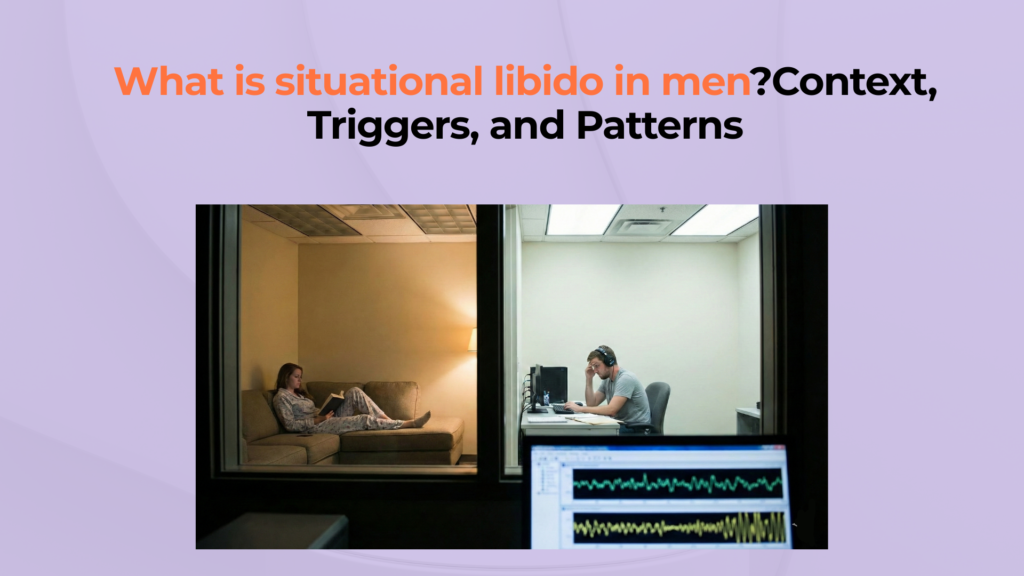
Situational libido in men refers to a state where sexual desire is not a constant baseline but is highly dependent on specific external circumstances, locations, or emotional contexts [SL1].
In many men, this overlaps with an arousal-first / responsive desire pattern where wanting emerges after context and stimulation.
Unlike chronic hormonal issues, this form of desire operates on a “conditional” basis, fluctuating based on perceived safety and stimulation.
It is often driven by Incentive Salience—the neurological process of “wanting” triggered by specific cues rather than spontaneous internal drive.
This pattern is often a sign of a sensitive Sexual Inhibition System (SIS) rather than a hormonal defect, meaning the “brakes” are easily activated by stress, routine, or domestic responsibility [SL2].
A sensitive SIS is often amplified by stress physiology; see how cortisol suppresses libido by shifting autonomic balance toward inhibition.
For many men, the Hormonal Baseline is normal, but the environmental permission to access that drive is missing in daily life.
Important Medical Disclaimer
This guide is for educational purposes only. While situational fluctuation is normal, a total inability to feel desire in any context may indicate Hypogonadism or Depression. Consult a healthcare provider for evaluation.
Situational Libido: At a Glance
The Concept
Desire requires specific conditions (“Gas” vs “Brakes”) to override inhibition [SL2].
Key Trigger
Novelty (vacations, newness) often increases incentive salience via dopamine pathways [SL8].
Key Blocker
Domestic stress or “mental load” often increases inhibition (SIS) [SL9].
The Test
If desire reliably appears in some contexts, global hormonal failure is less likely.
What Is the Definition and Scope of Situational Libido?
The definition and scope of situational libido encompass a drive that is reactive to environmental cues rather than being purely biologically driven.
This “Context-Dependent Desire” is a variation of normal sexuality, not necessarily a dysfunction.
Defining Situational Libido (The Context-Dependent Drive)
Situational libido operates on a conditional basis, where desire is high in specific “Safe/Stimulating” zones and nearly non-existent in others due to the brain’s evaluation of context [SL1].
It activates the brain’s sexual reward pathways only when inhibitory signals (stress, danger, responsibility) are low enough to be bypassed.
As noted by Levine [SL1], the psychological components of desire are often as critical as the biological substrate.
Environmental cues increase incentive salience and readiness, producing a context-tied surge of desire [SL11].
Contrast with Chronic Low Libido (HSDD Framing)
It is critical to distinguish situational libido from Chronic Low Libido (MHSDD), which presents as a persistent lack of desire regardless of setting or stimulus [SL10].
If a man has high desire in a hotel room but zero desire at home, this suggests situational gating rather than hormonal failure.
Use the acute vs chronic libido shift framework to separate “software gating” from baseline decline.
As defined in EAU Guidelines [SL10], HSDD implies a global absence of fantasy and drive.
Intact responsiveness in specific contexts is a useful clue that the biological “hardware” is functional, but the environmental “software” is inhibiting the launch.
What Are the Primary Triggers and Patterns of Situational Libido?
The primary triggers of situational libido involve neurochemical spikes from novelty or the physiological release of stress, engaging different aspects of the reward system.
The Novelty Trigger (The Coolidge Effect)
The Coolidge Effect describes a pattern where new environments or partners trigger dopaminergic signaling, temporarily bypassing existing satiation or boredom [SL9].
Animal models show the brain prioritizes the “pursuit” of the unknown via Incentive Salience [SL5].
Review dopamine’s role in libido to match your Coolidge/novelty sections.
As demonstrated by Fiorino [SL9], dopamine efflux in the Nucleus Accumbens spikes with novel stimuli.
Novel cues elevate incentive salience via dopamine pathways, temporarily increasing desire until habituation returns.
The Stress-Buffer Pattern (Escapism)
Some men report experiencing high libido only during high-stress periods as a “Stress-Buffer” or coping mechanism to regulate emotional tension [SL7].
This pattern uses sexual release as a tool for stress management—anxiolysis—rather than pure intimacy.
Research by Hamilton [SL7] highlights the complex relationship between stress physiology and arousal, where acute stress can sometimes facilitate release.
This is a self-reported coping pattern, not a universal physiological rule.
The “Safe Space” Context (Emotional Security)
For men with high inhibition sensitivity, desire only emerges when they feel 100% free of responsibility, judgment, or domestic “noise” (e.g., vacations) [SL2].
This reflects the removal of “Brakes” in the Dual Control Model.
When libido is consistently lower at home, chronic stress and libido links suggest that chronic background strain is the primary “brake” inhibiting the response.
As described by Bancroft & Janssen [SL2], high SIS scores correlate with a need for low-threat environments.
Emotional security reduces SIS inhibition, allowing desire to emerge in specific ‘safe’ contexts.
How Do Partner Dynamics Create Situational Libido Patterns?
Partner dynamics create situational patterns through psychological mechanisms like the “Pursuit vs. Pressure” dynamic and the activation of specific scripts or kinks.
The “Pursuit vs. Pressure” Dynamic
Libido often spikes when the partner is distant (“Pursuit”) but vanishes when the partner is overly available (“Pressure”), a dynamic that can create significant Desire Discrepancy [SL6].
Psychologically, desire is often fueled by the “gap” or “chase” rather than constant connection.
The ESM Position Statement [SL6] notes that relationship dynamics significantly modulate drive.
Pressure to perform acts as an inhibitor (Brake), killing the spontaneous urge.
If pursuit/pressure dynamics or conflict predict desire more than attraction does, connect this to relationship stress and libido mechanisms like rejection narratives and inhibition.
Specific Kink or Fetish Contexts
In some cases, desire is “locked” behind specific psychological scripts or fetishes, where arousal is dependent on the presence of a specific trigger [SL5].
These triggers carry high Incentive Salience (“Wanting”) that standard intimacy may lack.
Toates [SL5] explains that without the specific trigger, motivation circuits may not engage strongly enough, resulting in a lack of desire for ‘standard’ intimacy.
What Are the Risks and Management Strategies for Situational Libido?
The risks of situational libido involve relationship mismatch and feelings of rejection, requiring management strategies like “Contextual Engineering” to bridge the gap.
The Risk of Relationship Mismatch
A partner may feel rejected if they observe high libido in specific situations (e.g., watching a movie) but a lack of desire for them directly [SL6].
This interpretation (“He doesn’t want me”) ignores the context-dependent nature of the drive.
The ESM Position Statement [SL6] emphasizes that communication must shift from “Why don’t you want me?” to “What about this situation makes it easier for me to feel desire?”
Tactic: “Contextual Engineering”
“Contextual Engineering” involves identifying the specific “Gas” triggers and “Brake” inhibitors to intentionally recreate the environments where desire flourishes [SL2].
This strategy focuses on replicating the conditions of “Safe Spaces” (e.g., scheduled dates, privacy) in daily life.
Bancroft & Janssen [SL2] suggest that replicating positive situational cues lowers inhibition and increases excitation, stabilizing desire opportunities.
[Checklist] Auditing Your Situational Libido Patterns
Use this context and trigger audit to map your specific “Gas” and “Brakes” for sexual desire.
Context and Trigger Audit
- 1 Location Check: Is desire higher away from home (hotels)? (Sign of Low domestic inhibition) [SL1].
- 2 Emotional Check: Does libido spike with stress (buffer) or relaxation (safety)? [SL7].
- 3 Novelty Check: Is desire dependent on new “scripts” or content? (Animal Model data) [SL9].
- 4 Domestic Check: Does “unfinished work” kill desire? (High SIS) [SL2].
- 5 Physical Check: Do you still have Morning Wood? (If YES → Hardware is fine) [SL12].
- ✓ Safety Rule: If desire reliably appears in some contexts, global hormonal failure is less likely; focus on triggers.