
Average-Proportioned Penis: What Do Statistics Say? (A Versatility Guide)
The Average-Proportioned Penis is a biomechanical phenotype defined by statistical norms where Axial Length and Radial Girth fall within similar percentiles, creating a profile of Biomechanical Neutrality that supports positional versatility. often serving as a Cylindrical baseline for comparison.
Important Medical Disclaimer: This guide is for educational purposes only. Statistical norms describe population data, not individual health. If you experience pain or functional issues, consult a urologist.
Average-Proportioned Penis: At a Glance
- ● What is it? Length and girth percentiles are broadly aligned on population nomograms.
- ● Primary Strength: Biomechanical Neutrality (adaptable to most positions).
- ● Primary Mechanic: Full-Range Piston Stroke (leveraging both length and girth).
- ● Key Benefit: Low “Vector Mismatch” allows for extensive positional roaming.
Why Does the Average-Proportioned Penis Represent the Statistical Norm?
The Average-Proportioned Penis represents the statistical norm because its dimensions align with the central tendencies of population datasets, granting maximal Biomechanical Neutrality.
By avoiding extreme outliers in either length or circumference, this morphology occupies a functional “sweet spot” that minimizes biomechanical conflict during intercourse. Accurate categorization depends on standardized measurement methods to avoid misclassification.
How Is the Average-Proportioned Penis Defined by Statistics?
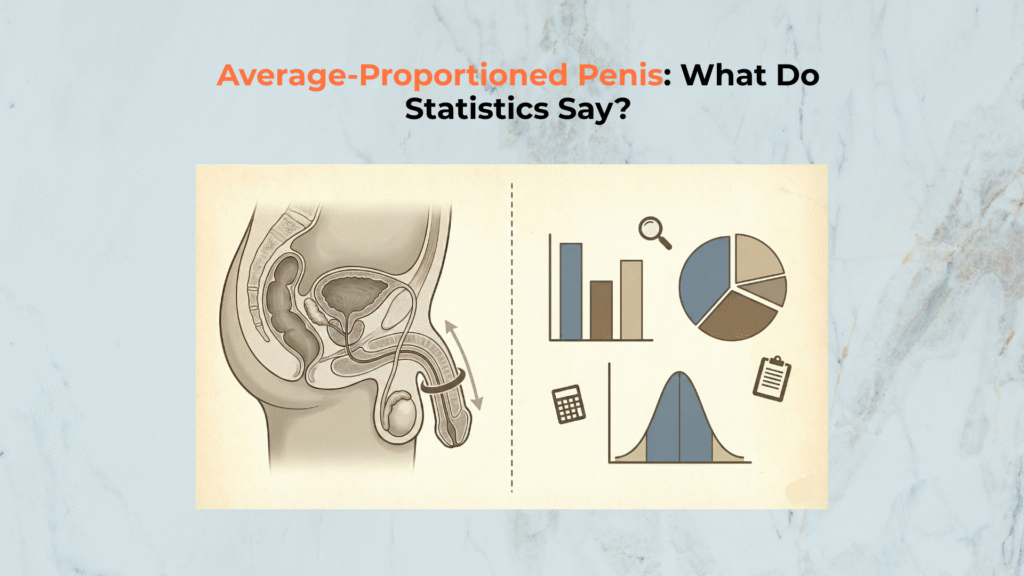
An average-proportioned profile is best defined by a percentile-aligned pattern where erect length and erect circumference both sit near the middle of population distributions, rather than a single universal ratio [AP1].
In pooled population data, Veale et al. (2015) reported a mean erect length of about 13.1 cm and a mean erect circumference of about 11.7 cm, illustrating how “central tendency” is expressed in real measurements [AP1].
In this guide, Average-Proportioned refers to the functional case where length and girth percentiles are broadly similar on nomograms, producing a balanced contact pattern during penetration (an FBU operational definition).
| Proportional Type | Anthropometric Profile | Biomechanical Implication |
|---|---|---|
| Average-Proportioned | Erect length and girth percentiles are broadly similar. | Versatile/Balanced Friction and Depth. |
| Short & Thick | Girth percentile exceeds length percentile. | Maximize Radial Compression. |
| Long & Thin | Length percentile exceeds girth percentile. | Maximize Axial Targeting. |
How Does the Average-Proportioned Penis Influence Positional Adaptability?
The Average-Proportioned Penis supports positional adaptability because a non-extreme length/girth profile reduces the need for constant “depth-only” or “girth-only” strategies during intercourse (an FBU functional interpretation).
Comfort during penetration is not determined by penis size alone; pain with sex (dyspareunia) is multifactorial, and variables such as depth, angle, tissue dryness, and friction can be involved [AP4].
Baseline vaginal dimensions also vary across individuals, which helps explain why the same angle or depth can feel different between partners [AP2].
If discomfort occurs, clinical guidance emphasizes evaluating the cause and using practical adjustments such as lubrication and position modification [AP4].
Functional Benefits of Adaptability
- Vector Neutrality: Works efficiently in diverse positional alignments.
- Impact Mitigation: Reduces likelihood of involuntary Cervical Impact compared to extreme lengths.
- Balanced Stimulation: Provides consistent friction across the mid-shaft zone.
What Anatomical Factors Define Biomechanical Neutrality?
The Biomechanical Neutrality concept in this guide refers to a balanced interaction between erectile tissue expansion and the surrounding fibrous support structures.
Penile mechanics depend on tissue properties and constraint behavior (how tissues resist and shape expansion under pressure), which is a core idea in biomechanical descriptions of erectile function [AP3].
In practical terms, the profile is framed as “neutral” when neither depth-seeking strategies nor compression-heavy strategies are consistently required to maintain effective contact (FBU functional interpretation).
Which Anatomical Structures Govern the Profile?
The shaft’s primary erectile tissues (the Corpora Cavernosa) expand under pressure, while the Tunica Albuginea provides mechanical constraint that shapes the erection.
Biomechanical and tissue-property discussions in the erectile dysfunction literature describe how penile tissue mechanics and structural behavior matter for functional outcomes [AP3].
In this guide’s neutral profile model, the key idea is proportional expansion of this hydraulic pressure system without a persistent bias toward “depth-only” or “compression-only” mechanics (FBU functional interpretation).
How Does the Friction Profile Compare to Extreme Types?
The Average-Proportioned Penis friction profile delivers consistent Distributed Pressure across the mid-shaft, mitigating the need for specialized shallow or deep thrusting techniques.
While wider girths rely on “Surface Drag” and longer lengths rely on “Axial Reach,” this profile balances both.
The friction profile delivers consistent contact across the mid-shaft, supporting versatile thrusting mechanics.
| Anatomical Structure | Function | Implication for Average-Proportioned |
|---|---|---|
| Corpora Cavernosa | Primary erectile tissue. | Proportional Axial Growth. |
| Tunica Albuginea | Fibrous sheath constraining expansion. | Proportional Radial Expansion. |
Which Positional Strategies Maximize Versatility?
Before choosing positions, review the Sexual mechanics guide for penetration mechanics and comfort fundamentals that apply to all anatomies.
Positional strategies maximize the versatility of the Average-Proportioned Penis when they focus on utilizing its balanced dimensions to achieve sustained Axial Congruence across various angles. Before choosing positions, understand that maintaining erection quality relies on the penile vascular pathway and comfort fundamentals.
Why Does the Average-Proportioned Penis Excel in Positional Roaming?
The Average-Proportioned Penis excels in Positional Roaming because its neutral dimensions maintain Axial Congruence across varied positions, minimizing Vector Mismatch. “Roaming” involves switching angles (e.g., from Missionary to Spooning) without losing efficacy.
Clinical data on dyspareunia suggests that neutral dimensions reduce the need for constant repositioning due to pain or lack of sensation [AP4]. If significant curvature disrupts this neutrality, see Peyronie’s Disease for distinct biomechanical considerations.
The neutral dimensions maintain Axial Congruence in varied positions, allowing for effective stimulation without constant repositioning.
Which Positional Modifications Activate Specific Stimulation Zones?
Positional modifications activate specific stimulation zones by utilizing controlled pelvic tilt to modulate the angle of insertion and direct Targeted Pressure.
Anterior tilt directs the axis upward toward the anterior vaginal wall, while posterior tilt directs it downward. This modulation changes the primary contact points within the canal.
Similar to the mechanics of an Upward-Angled Penis, anterior tilt directs the penile axis upward, activating anterior vaginal structures.
| Positional Strategy | Targeted Zone | Method of Angle Change |
|---|---|---|
| Anterior Tilt | Anterior Wall | User pushes hips forward (simulates upward angle). |
| Posterior Tilt | Posterior Wall | Partner pulls knees to chest (simulates downward angle). |
| Coital Alignment | External/Clitoral | User angles pubic bone against clitoral base. |
How Do Advanced Techniques Optimize Full-Range Functionality?
Advanced techniques optimize Full-Range Functionality by emphasizing maximal Axial Displacement and implementing Tactile Variation protocols to maintain sensitivity.
How to Execute the Full-Range Piston Stroke
Executing the Full-Range Piston Stroke is the essential technique, as the anatomy’s stability supports a single, linear motion leveraging both shallow and deep zones.
This motion utilizes full axial displacement, using the entire length of the shaft in a linear rhythm. This simulates the benefits of girth (on exit via stretch) and length (on entry via depth) in a single cycle.
The Full-Range Piston Stroke utilizes the entire shaft length, leveraging maximal surface contact.
Execution of the Full-Range Piston Stroke
- Utilize maximum axial displacement (perform a full thrust from entry to depth).
- Maintain linear motion to ensure the “Piston stroke” rhythm is consistent.
- Vary rhythm quickly to maximize stimulation in both shallow and deep zones alternately.
How to Maintain Sensitivity via Tactile Variation
Maintaining sensitivity requires implementing regular Tactile Variation through positional rotation to prevent neurological adaptation.
Changing angles refreshes the sensation of friction and pressure. Positional rotation prevents the “numbing” effect of repetitive motion.
Implementing positional changes frequently varies the point of friction, maintaining high tactile engagement.
Maintenance Checklist for Function
- Position Rotation: Change positions regularly to vary contact.
- Lubrication: Use adequate lubrication to reduce friction-related irritation during intercourse [AP4].
- Depth Modulation: Actively switch between deep targeting and shallow grinding.
Conclusion: What Final Action Protocol Ensures Optimal Use?
The final action protocol ensuring optimal use of the Average-Proportioned Penis confirms its Biomechanical Neutrality as the dominant functional driver and prioritizes positional Versatility. Functional success is achieved by leveraging the power of Biomechanical Neutrality. Understanding your shape helps improve body image and confidence.
Final Optimization Checklist
- Motion Shift: Prioritize the Full-Range Piston Stroke.
- Risk Focus: Prioritize comfort signals and adjust depth, angle, and lubrication if pain occurs [AP4].
- Position Priority: Utilize Positional Roaming for maximal versatility.
- Technique Acceptance: Recognize that Neutral Dimensions are the most adaptable.
FBU Assistant
Guide-AwareHi! I’m reading the “Average-Proportioned Penis Guide” right now. Ask me about stats, biomechanics, or positions below!
Suggested Questions
One Response