
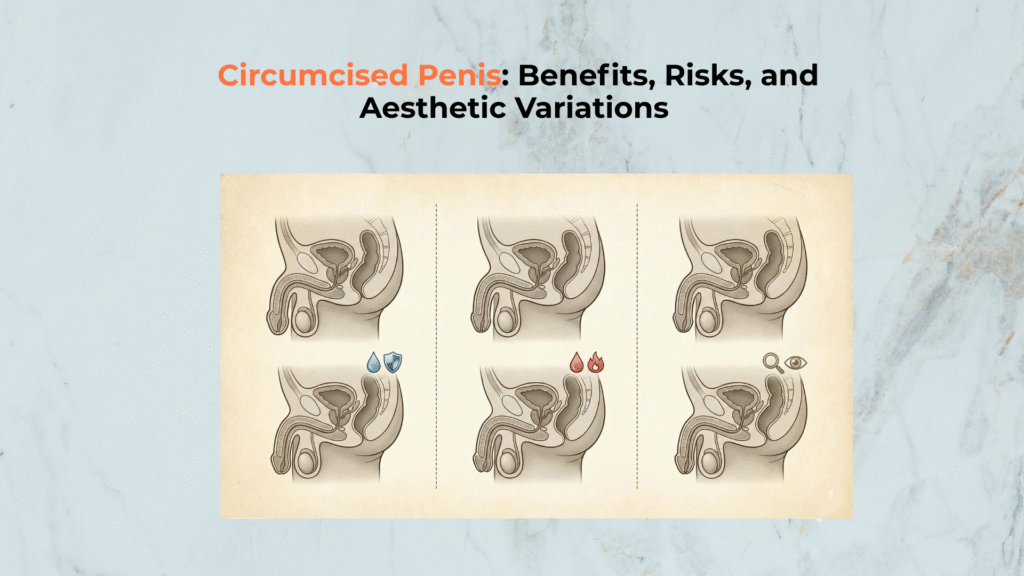
Circumcised Penis: Benefits, Risks, and Aesthetic Variations (A Functional Guide)
A circumcised penis is a penis in which the prepuce (foreskin) has been surgically removed, permanently altering integumentary status, glans exposure, and skin movement mechanics [1]. To understand exactly what structures are removed and what remains, readers should consult the foundational Penis Anatomy guide. Decisions regarding circumcision are personal or medical; this guide provides informational evidence-based health outcomes [1, 15]. As a specific morphology node, it is part of the broader Penis Types Hub.
At a Glance
- Definition: Surgical removal of the prepuce [1].
- Health Evidence: Lower relative infant UTI risk (OR ≈ 0.13) [2] and reduced heterosexual HIV acquisition in high-prevalence settings [4].
- Mechanical Shift: Transitions from a “Gliding” model to a “Surface Drag” model [17].
- Emergency: Seek care for sudden sharp pain or a popping sound (Penile Fracture) [9].
Why Evaluate Benefits and Risks?
A benefit–risk analysis matters because circumcision is a permanent procedure whose outcomes depend on individual context, age at the time of procedure, and surgical technique [1, 15]. Evaluation focuses on clinical protection, mechanical changes to the skin-glans interface, and psychological satisfaction with the aesthetic result.
Hygiene and Urological Risk Analysis
Circumcision is associated with a lower relative risk of urinary tract infections (UTIs) in infancy according to systematic review data, while the absolute risk in healthy infants remains low [2]. One significant benefit mentioned is Phimosis prevention, which separates preputial pathology from normal tightness.
| Condition | Circumcised Penis | Uncircumcised Penis |
|---|---|---|
| UTI Risk (Infancy) | Lower relative risk (OR ≈ 0.13) [2] | Higher relative risk |
| Phimosis | Pathologically impossible | Potential risk |
| Smegma / Inflammation | Can occur; hygiene reduces buildup [14]. Linked to lower Balanitis risk. | More likely to accumulate under prepuce [14]. |
| Glans Status | More continuously exposed | Protected by prepuce |
Does Circumcision Impact Tactile Sensitivity?
Research on circumcision and sexual sensation is mixed; systematic reviews often find no consistent overall impairment, while individual reports regarding sensation thresholds vary [5]. If a reader expects that “more ridge equals more entry stimulation,” the best comparator is a Pronounced Corona Penis, which concentrates contact near the entrance.
Histology confirms that Meissner’s Corpuscles (fine-touch receptors) are abundant in the prepuce tissue [6]. However, for many circumcised men, the Frenulum remains highly innervated and may serve as the primary sensory hub following the removal of inner foreskin [8].
Primary Aesthetic Variations
Aesthetic variation in the circumcised penis is primarily described by the surgical scar placement relative to the coronal ridge and the degree of remaining skin slack [16].
“High” vs. “Low” Scar
Refers to how much inner foreskin mucosa remains between the glans and the scar.
“Tight” vs. “Loose” Skin
Refers to the tension of the shaft skin during an erection.
| Style | Scar Position | Skin Tension Tendency |
|---|---|---|
| High & Tight | Further down the shaft | Less slack; may feel taut |
| Low & Tight | Closer to coronal ridge | Less slack; focal glans focus |
| High & Loose | Further down the shaft | More slack; moves when flaccid |
Glans Keratinization: The Debate
Claims that circumcision causes clinically meaningful Glans Keratinization are debated; histological observations often report equal keratinization in circumcised vs uncircumcised glans tissue [7].
When evaluating if glans prominence changes perceived sensation after circumcision, it is helpful to contrast this with a Small Glans Penis profile where shaft contact dominates. The “keratinization” observed may be better described as epithelial adaptation—a response to constant friction against clothing that potentially influences the perceived sensation threshold over time [17].
Functional Mechanics: Surface Drag vs. Gliding
Risk management focuses on managing friction comfort, scar-line sensitivity, and lubrication choices to prevent tissue irritation [12, 13]. This shift from “gliding” to “surface drag” is most apparent when compared to a morphology like the Smooth Corona Penis, where friction distribution is the dominant variable.
Safety Rule
Do not push through pain; stop and adjust with lubrication if the scar line feels taut or exhibits friction discomfort during sexual activity [12, 13]. Persistent tearing or burning should be evaluated through the Painful Sex (Dyspareunia) triage node to separate friction from clinical conditions.
When to See a Doctor (Red Flags)
- Persistent pain despite lubrication.
- Spreading redness, swelling, or fever (Signs of Infection).
- Development of new plaques, lumps, or abnormal curvature—which may signal Peyronie’s Disease [10].
Frequently Asked Questions about the Circumcised Penis
1. What is a circumcised penis?
A circumcised penis has had the foreskin surgically removed, leaving the glans permanently exposed and changing skin movement.
2. What are the main health benefits of circumcision?
Key benefits include lower infant UTI risk, prevention of true phimosis, and reduced heterosexual HIV risk in high-prevalence settings.
3. What are the main risks or downsides of circumcision?
Risks include surgical complications (bleeding, infection, scarring) and permanent loss of specialized foreskin tissue and its lubrication.
4. Does circumcision reduce sexual pleasure or sensitivity?
Population studies show similar overall sexual function, but some men notice a shift in where and how sensation is felt.
5. How does a circumcised penis move differently during sex or masturbation?
Instead of a gliding foreskin, the shaft skin grips the hand or partner directly, making lubrication more important.
6. What do “high” and “low” circumcision styles mean?
They describe scar distance from the glans: “high” leaves more inner mucosa; “low” sits closer to the coronal ridge.
7. What do “tight” and “loose” circumcision styles mean?
“Tight” means the skin is taut when erect; “loose” leaves more slack and folding movement.
8. Does circumcision cause the glans to become numb or “keratinized”?
Clinically, keratinization differences are unclear; any change is more likely due to long-term friction and adaptation than simple “numbing.”
9. Can a circumcised penis still get smegma or balanitis?
Yes, but typically less often than with a foreskin; regular gentle washing still matters.
10. Can a circumcised penis develop phimosis?
True foreskin phimosis cannot occur, but scar tightness or painful constriction can and should be assessed by a doctor.
11. How can a circumcised man reduce friction or burning during sex?
Use adequate lubricant, avoid prolonged dry friction, adjust positions, and seek medical review if pain or tearing persists.
12. Does circumcision protect against HIV and other STIs?
It lowers heterosexual HIV risk for men but does not replace condoms, testing, or other STI prevention.
13. Is it normal for a circumcision scar to look different from other men’s?
Yes, scar color, thickness, and position vary by technique and healing; new pain, ulcers, or rapidly changing plaques are not normal.
14. When should someone with a circumcised penis see a doctor urgently?
Immediate care is needed for a popping sound with sudden pain and loss of erection, or for severe swelling, fever, or new hard-curved plaques.
15. Can circumcision be done safely in adulthood, and are outcomes different?
Adult circumcision is generally safe but has a longer recovery and clearer awareness of pre- versus post-sensation differences.
16. Does circumcision guarantee a better or worse sex life?
No; sexual satisfaction depends more on comfort, communication, and managing pain or friction than on circumcision status alone.
Conclusion: Final Action Protocol
The final protocol for the Circumcised Penis synthesizes evidence-based health outcomes, realistic aesthetic descriptors, and comfort-first friction management.
A satisfying sex life is achievable regardless of circumcision status; outcomes are driven by comfort, open communication with partners, and proactive management of tissue sensitivity [5, 12, 13].
Reference Citation Map
- AAP Circumcision Policy Statement (2012). Pediatrics.
- Singh-Grewal et al. Meta-analysis: Circumcision & infant UTI (OR ≈ 0.13).
- Shabanzadeh et al. (2021) Systematic review/meta-analysis: Complications.
- WHO VMMC: Heterosexual HIV risk (RCT context).
- Tian et al. (2013) Systematic review: Sexual function outcomes.
- García-Mesa et al. (2021): Meissner’s corpuscles in prepuce.
- Frontiers: Review noting debate on post-circumcision glans keratinization.
- Yang et al. (1999): Dorsal nerve innervates glans and frenulum.
- EAU Urological Trauma guideline: Penile fracture presentation.
- AUA Peyronie’s Disease guideline: Evaluation of new plaques.
- Deflorin et al. (2020) Systematic review: Physical scar management.
- Mayo Clinic: Dyspareunia (painful intercourse) management.
- ACOG: “When Sex Is Painful” (evaluating persistent pain).
- Cleveland Clinic: Smegma definition and hygiene.
- CDC Provider Info: Male circumcision counseling frameworks.
- Descriptive Labels: High/Low and Tight/Loose styles review.
- Cox (2015): Histologic correlates / exposure claims discussed.
One Response