Peyronie’s-Type Curved Penis: What Is It and Why Does It Occur?
The Peyronie’s-Type Curved Penis is an acquired inflammatory condition resulting in fibrotic plaque that causes painful, progressive penile curvature and is not a natural anatomical variation. Risk assessment of the Peyronie’s-Type Curved Penis is essential because timely diagnosis in the acute phase provides the best chance for functional restoration without surgery.
Diagnosis is time-sensitive; early treatment in the acute phase is critical for non-surgical success, according to AUA guidelines. It is common to feel worried or embarrassed about this diagnosis, but modern treatments are highly effective.
Because Peyronie’s Disease is an acquired condition, it must be clearly distinguished from stable anatomical variants such as a naturally upward-curved penis or a lifelong downward-curved penis , which do not involve inflammatory plaque formation.
Important Medical Disclaimer
Peyronie’s Disease should be evaluated by a healthcare professional (often a urologist). New penile pain, rapidly changing curvature, or difficulty with sex are reasons to seek clinical assessment (Mayo Clinic).
Peyronie’s Disease: At a Glance
- ● Is it usually normal or serious? It can range from mild to function-limiting; it involves scar tissue (plaque) that can cause curvature and may be painful (Mayo Clinic).
- ● When should I see a doctor? If curvature is new, painful, worsening, or affecting sex/urination, get evaluated.
- ● Can this usually be managed? Management depends on whether the condition is in an active (changing) phase or stable phase and how much function is affected.
Why Is Risk Assessment of the Peyronie’s-Type Curved Penis Essential?
Risk assessment of the Peyronie’s-Type Curved Penis is essential because timely diagnosis in the acute phase provides the best chance for functional restoration without surgery.
Unlike benign curvature patterns, Peyronie’s Disease often presents alongside functional complications such as rigidity loss or pain during erection, which may overlap with vascular phenotypes like the venous-leak type penis . Proper assessment helps prevent misclassification and delayed care.
How to Differentiate the Peyronie’s-Type Curved Penis from Natural Curvature
Differentiating the Peyronie’s-Type Curved Penis from natural curvature relies on identifying the sudden onset of pain and structural change. Peyronie’s is a progressive disorder of the Tunica Albuginea characterized by inflammation, contrasting with the stable, pain-free congenital curvature. Anchor this claim with specific data: Cite Mayo Clinic guidance defining the Peyronie’s-Type Curved Penis by the presence of a palpable plaque and pain during erection, which are absent in natural curvature.
A key diagnostic step is ruling out congenital asymmetry, such as left-curved or right-curved penile anatomy , which is typically painless, non-progressive, and present since early sexual development.
| Feature | Peyronie’s-Type Curved Penis | Natural (Congenital) Curvature |
|---|---|---|
| Onset | Sudden, acquired later in life | Present since puberty/first erection |
| Pain | Often acute during erection | Absent or minimal |
| Plaque/Lump | Palpable Fibrotic Plaque | Absent |
| Progression | Worsens during the Acute Phase | Stable/Non-progressive |
How to Ensure Immediate Urological Consultation
Ensuring timely clinical evaluation for the Peyronie’s-Type Curved Penis matters because the condition often has an active (acute) phase where pain and curvature may change, followed by a chronic (stable) phase where deformity tends to stabilize. The acute phase commonly lasts about 5 to 18 months, and the chronic phase generally starts when pain improves and curvature becomes stable.
What Pathological Stages Define the Peyronie’s-Type Curved Penis?
The pathological stages that define the Peyronie’s-Type Curved Penis progress from active inflammation and pain to passive stabilization and calcification.
Which Anatomical Process Causes the Curvature?
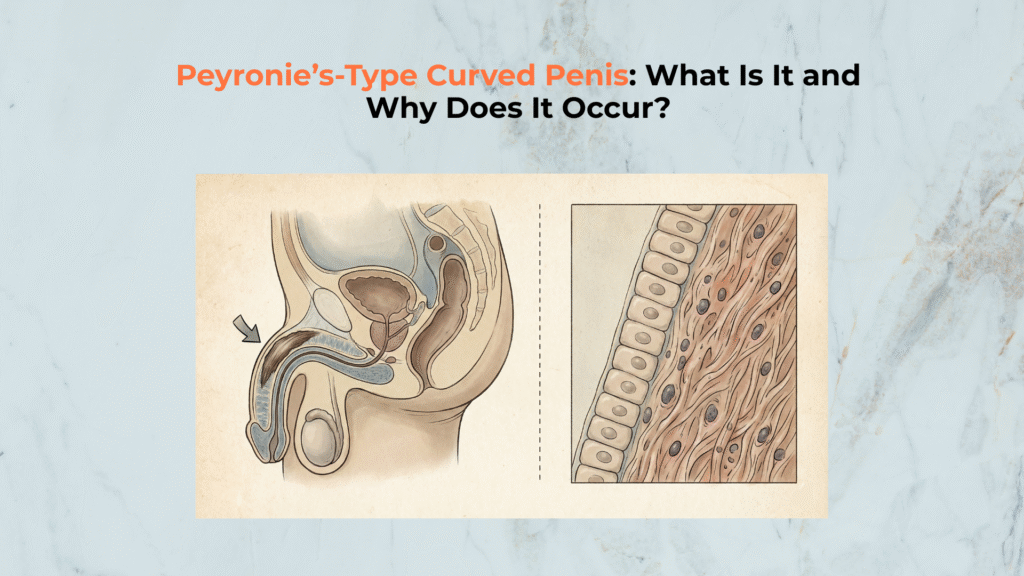
The anatomical process causing the curvature in the Peyronie’s-Type Curved Penis is the formation of inelastic scar tissue within the Tunica Albuginea. This process is initiated by micro-trauma, leading to an aberrant wound healing response and the deposition of disorganized collagen (NCBI). The resulting fibrotic plaque restricts expansion on one side of the Corpora Cavernosa during erection, causing the shaft to bend towards the inelastic tether.
The curvature direction in Peyronie’s Disease depends on plaque location; dorsal plaques may resemble an upward-curved penis caused by structural tension , while ventral plaques can mimic conditions discussed under painful downward curvature , though the underlying mechanisms differ entirely.
How to Track the Acute and Chronic Phases
Tracking the Acute and Chronic Phases of the Peyronie’s-Type Curved Penis dictates the appropriate treatment pathway and timeframe for intervention. The Acute Phase is characterized by pain and progressive curvature, commonly lasting about 5 to 18 months. Treatment during the Acute Phase focuses on stabilization, while the Chronic Phase focuses on functional restoration.
| Disease Phase | Duration | Key Symptoms | Treatment Focus |
|---|---|---|---|
| Acute Phase | Up to 18 months | Pain, Inflammation, Rapid Curvature, Penile Shortening | Non-surgical therapy (medication/injection) |
| Chronic Phase | After 12-18 months | Pain subsides, Curvature stabilizes, Calcification begins | Surgical intervention |
How Are Symptoms Accurately Diagnosed?
Symptoms of the Peyronie’s-Type Curved Penis are accurately diagnosed through patient history (pain/onset) and clinical imaging tests.
How to Perform Self-Screening
Performing self-screening involves tactile examination and visual tracking. Patients should regularly palpate the shaft for hard, dense, fibrotic lumps and visually track the progression of the curve over a period of months.
- Palpate Shaft: Check for hard, dense, fibrotic lumps (plaque).
- Assess Pain: Note if pain is present during erection or sexual activity.
- Track Curvature: Note the degree and direction of the bend (e.g., dorsal, ventral).
Men experiencing Peyronie’s Disease may also notice secondary changes in sensation or glans temperature, a pattern occasionally seen in the cold-glans phenotype , especially when plaque disrupts normal blood flow dynamics.
Clinical Tests
Urologists perform an Induced Erection Test often followed by Ultrasound or MRI imaging to confirm plaque location, size, and blood flow.
Medical and Surgical Techniques
Medical and surgical techniques are used to treat the Peyronie’s-Type Curved Penis based entirely on whether the disease is in the acute (non-surgical) or chronic (surgical) phase.
Non-Surgical Treatments (Acute Phase)
Collagenase Clostridium histolyticum (CCH / Xiaflex) is indicated for men with a palpable plaque and a curvature deformity ≥ 30 degrees. FDA trials report mean percent curvature improvement of about 34% (vs placebo).
Surgical Interventions (Chronic Phase)
Surgical interventions are used for the Chronic Phase to physically correct the deformation after pain and progression have stabilized.
When curvature stabilizes but functional dissatisfaction persists, comparison with structurally balanced morphologies such as the average-proportional penis helps patients understand the goals of corrective treatment rather than pursuing unrealistic anatomical symmetry.
| Procedure Type | Functional Goal | Applicability |
|---|---|---|
| Plication (Nesbit/Yachia) | Correct angle by shortening the long side. | Good rigidity; mild to moderate curvature (<60°). |
| Incision/Grafting | Restore length by cutting plaque and adding tissue. | Severe curvature (>60°); excellent pre-op rigidity required. |
| Prosthesis Placement | Treat severe ED and correct curvature simultaneously. | Severe ED and curvature; lack of rigidity. |
Patient Action Checklist
The Peyronie’s-Type Curved Penis checklist ensures immediate patient action is guided by the stage of the disease.
- Consult Urologist: Seek specialist advice within 6 months of onset.
- Measure Progression: Track curve degree and pain level.
- Avoid Self-Treatment: DO NOT attempt home remedies or aggressive stretching.
- Understand Phases: Treatment depends entirely on whether the curve is Acute or Chronic.
Frequently Asked Questions
Can Peyronie’s go away on its own?
Spontaneous resolution is rare (<15%). The condition typically stabilizes or progresses over 12-18 months without treatment.
Does Peyronie’s cause cancer?
No. The plaque is benign (non-cancerous) fibrous scar tissue and is unrelated to penile cancer.
Is surgery the only option?
No. In the Acute Phase, injection therapy (Xiaflex) and traction are standard. Surgery is reserved for severe, stable deformities.
Is it caused by rough sex?
Often, yes. Micro-trauma to the erect penis during vigorous activity is a primary cause, though many men do not recall a specific event.
Conclusion
In conclusion, the Peyronie’s-Type Curved Penis is a complex, acquired disorder that demands time-sensitive clinical triage to maximize the chance of non-surgical success. Early consultation with a urologist is the most critical step to preserve functional capacity.
Peyronie’s Disease represents a pathological deviation within the broader spectrum of penile morphology outlined in the Penis Types Hub , where congenital structure, functional variation, and acquired disease are clinically separated.
Talking to Your Partner: Key Sentences
“I have a medical condition called Peyronie’s Disease, and the new curve is caused by scar tissue.”
“The pain means the curve is still changing, so we need to avoid trauma and stick to the doctor’s advice.”
At FactBasedUrology, we believe early diagnosis and patient education are the cornerstones of successful PD management. Action in the Acute Phase preserves function in the Chronic Phase.