What Is the Role of the Pudendal Nerve in the Male Reproductive System?
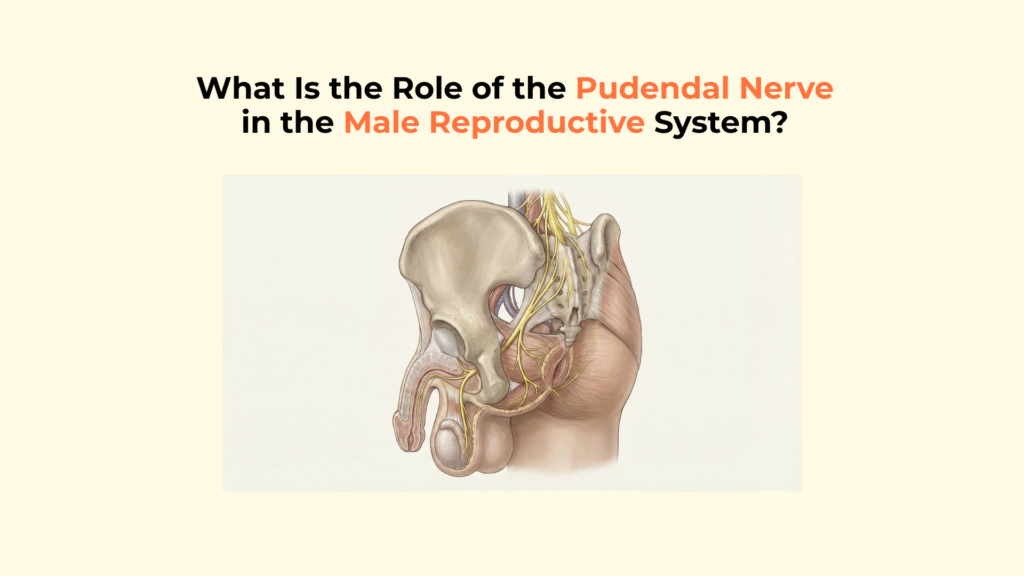
The role of the pudendal nerve in the male reproductive system is to function as the primary somatic command center, providing the sensory input from the penis that triggers arousal and the motor signals that drive ejaculation and erection rigidity. Although autonomic nerves regulate arterial dilation, the sensory trigger that initiates arousal begins at the surface of the glans penis, where dense mechanoreceptors transmit tactile input toward the spinal cord. While autonomic nerves control blood flow, the pudendal nerve controls the feeling and the force of sexual function. This guide details the specific sensory and motor roles of the “pudendal nerve,” mapping its branches to their targets and explaining its critical function in the male sexual response cycle.
Important Medical Disclaimer:
This information is for educational purposes only and is not a substitute for professional medical advice, diagnosis, or treatment. Consult with a qualified healthcare provider regarding any medical condition or concerns about your health.
Key Functional Facts: Pudendal Nerve in Males
- The Master Switch: It links conscious sensation (touch) to the body’s automatic sexual reflexes.
- Sensory Role: Its Dorsal Nerve branch provides the high-resolution sensation of the glans penis essential for arousal.
- Motor Role: Its Perineal branch powers the muscles (bulbospongiosus) responsible for the force of ejaculation.
- Rigidity: It drives the ischiocavernosus muscles to compress the penile roots, creating “rigid” erection hardness.
- Pathology: Compression of this nerve (e.g., cyclist syndrome) can cause numbness and sexual dysfunction.
How Does the Pudendal Nerve Function as the “Master Switch”?
The pudendal nerve functions as the “master switch” for male sexual activity by serving as the somatic-autonomic bridge that converts physical sensation into physiological response.
The Somatic-Autonomic Bridge
The nerve acts as the somatic (conscious) interface that initiates the sexual loop. It provides the sensory input (arousal via touch) that triggers the autonomic erection, and provides the motor output (muscle contractions) that completes the act via ejaculation. This sensory signal becomes functionally meaningful only when it synchronizes with the penile vascular erection pathway, converting neurological input into hydraulic tissue expansion. Tactile stimulation of the glans travels up the pudendal nerve, triggering the spinal reflex arc, which initiates the autonomic erectile response. A “spinal reflex arc” is a neural pathway that controls a reflex action (like erection) directly through the spinal cord without requiring immediate brain processing. While it doesn’t cause the blood flow (that’s the cavernous nerve), the erection often cannot start without its sensory input.
What Is the Sensory Role of the Pudendal Nerve in Male Anatomy?
The sensory role of the pudendal nerve is to provide innervation to the external genitalia, specifically transmitting critical tactile information from the glans penis and posterior scrotum.
Innervation of the Glans Penis (The Trigger)
Sensory data is transmitted through the dorsal nerve of the penis, integrating fine-touch feedback not only from the glans but also from the foreskin in uncircumcised anatomy. This terminal branch of the pudendal nerve transmits high-resolution tactile data (vibration, pressure, temperature) from the glans. This is the primary afferent (input) pathway for the orgasmic reflex; without it, the threshold for orgasm is difficult or impossible to reach. The glans contains a high density of Krause-Finger corpuscles supplied by this nerve. Source: BJUI Journals.
Innervation of the Posterior Scrotum
The Posterior Scrotal Nerves, arising from the perineal branch, provide sensation to the back of the scrotum and the ventral penis. Numbness in this specific area (known as Saddle Anesthesia) is the hallmark diagnostic sign of pudendal nerve entrapment.
How Does the Pudendal Nerve Drive the Mechanics of Ejaculation?
The pudendal nerve drives the mechanics of ejaculation by controlling the “expulsion phase,” firing rhythmically to contract the pelvic floor muscles and force semen out of the body.
The “Expulsion Phase” Controller
The expulsion phase of ejaculation depends on pudendal activation of the base muscles of the penis, which rhythmically compress the urethra to generate semen propulsion. Specifically, the Deep Perineal Nerve branch targets the Bulbospongiosus and Ischiocavernosus muscles to execute the final stage of orgasm. Once the emission phase (sympathetic) fills the urethra, the pudendal nerve fires rhythmically. Rapid firing of the pudendal nerve causes spasmodic contraction of the bulbospongiosus muscle, forcibly expelling semen from the urethra.
The Role in Erection Maintenance (Rigidity)
Beyond ejaculation, the nerve plays a critical role in maintaining erection rigidity by stimulating the Ischiocavernosus muscle. Maximum erection rigidity is amplified at the level of the penile crura, where pudendal-driven muscle tension intensifies the flaccid-to-erect bloodflow transition. Contraction of this muscle compresses the crura (roots) of the penis against the bone. This compression boosts intracavernosal pressure to suprasystolic levels (>150 mmHg), creating the ‘rigid’ erection phase necessary for penetration. Intracavernosal pressure retention is structurally reinforced by the tunica albuginea, which functions as the final mechanical lock. If venous outflow is not mechanically restricted through the penile venous network, intracavernosal pressure collapses even when neural signaling remains intact. Source: NCBI.
Male-Specific Branching Matrix of the Pudendal Nerve
This table details the specific branching layout of the pudendal nerve in males, mapping each branch to its target and function.
| Branch | Male Target | Male Function |
|---|---|---|
| Inferior Rectal Nerve | Anal Sphincter | Fecal Control; Continence |
| Perineal Nerve (Deep & Superficial) | Bulbospongiosus / Ischiocavernosus / Posterior Scrotum | Ejaculation force; Rigidity; Scrotal Sensation |
| Dorsal Nerve of the Penis | Glans Penis | Primary Sexual Sensation (Arousal Trigger) |
How Does Pudendal Nerve Pathology Present Specifically in Males?
Pathology of the pudendal nerve in males presents with specific symptoms related to its unique branches, most commonly manifesting as Cyclist’s Syndrome or issues with ejaculation control.
Cyclist’s Syndrome (Alcock’s Canal Entrapment)
Cyclist’s Syndrome is caused by prolonged compression of the perineum against a narrow saddle, trapping the nerve in Alcock’s Canal. Chronic compression forces accumulate within the fascial layers of the penis, while mechanical shear loads are redistributed across the penile septum, increasing the likelihood of deep nerve entrapment. Male symptoms include penile numbness (Dorsal nerve), Scrotal numbness (Scrotal nerve), and weak ejaculation or erectile instability (Motor branch). Preservation of the ‘cremasteric reflex’ (Genitofemoral nerve) but loss of the ‘bulbocavernosus reflex’ (Pudendal nerve) helps confirm the diagnosis. Source: NCBI Bookshelf.
Premature Ejaculation (Sensory Hypersensitivity)
In some cases of Premature Ejaculation (PE), over-activity or hypersensitivity of the dorsal nerve branches can trigger the ejaculatory reflex too quickly. Treatments like desensitizing sprays or Dorsal Nerve cryoablation target this specific nerve role to delay the reflex. Long-term disruption of neurovascular signaling is also frequently observed in fibrotic curvature disorders such as Peyronie’s disease, where altered nerve tension and asymmetric tunical remodeling coexist. In contrast, congenital curvature patterns originate from embryologic tissue asymmetry rather than fibrosis, a condition classified as chordee.
[Checklist] Verifying the Male Roles of the Pudendal Nerve
Use this checklist to review the critical functions of the pudendal nerve in male sexual health.
- ☑ Sensation: Is the Dorsal Nerve identified as the conduit for Glans sensitivity?
- ☑ Scrotum: Are the Posterior Scrotal nerves identified for scrotal feeling?
- ☑ Ejaculation: Is the Deep Perineal nerve identified as the motor drive for semen expulsion?
- ☑ Rigidity: Is the Ischiocavernosus muscle contraction linked to the pudendal nerve?
- ☑ Reflex: Is the Bulbocavernosus Reflex (BCR) noted as the test for pudendal integrity?
Glossary of Neurological Terms
To ensure full clarity, this glossary defines the key neurological terms used throughout this guide on the pudendal nerve.
| Term | Definition |
|---|---|
| Pudendal Nerve | The main nerve of the perineum responsible for sensation and motor function in the genitals. |
| Dorsal Nerve of the Penis | The terminal branch of the pudendal nerve that provides sensation to the glans penis. |
| Spinal Reflex Arc | A neural pathway that controls a reflex action directly through the spinal cord, bypassing the brain. |
| Bulbocavernosus Reflex (BCR) | A reflex contraction of the anal sphincter in response to squeezing the glans penis, used to test pudendal nerve function. |
| Alcock’s Canal | An anatomical tunnel in the pelvis where the pudendal nerve can become compressed (entrapped). |
| Saddle Anesthesia | Loss of sensation in the areas that would touch a saddle (inner thighs, perineum, genitals), a sign of nerve damage. |