
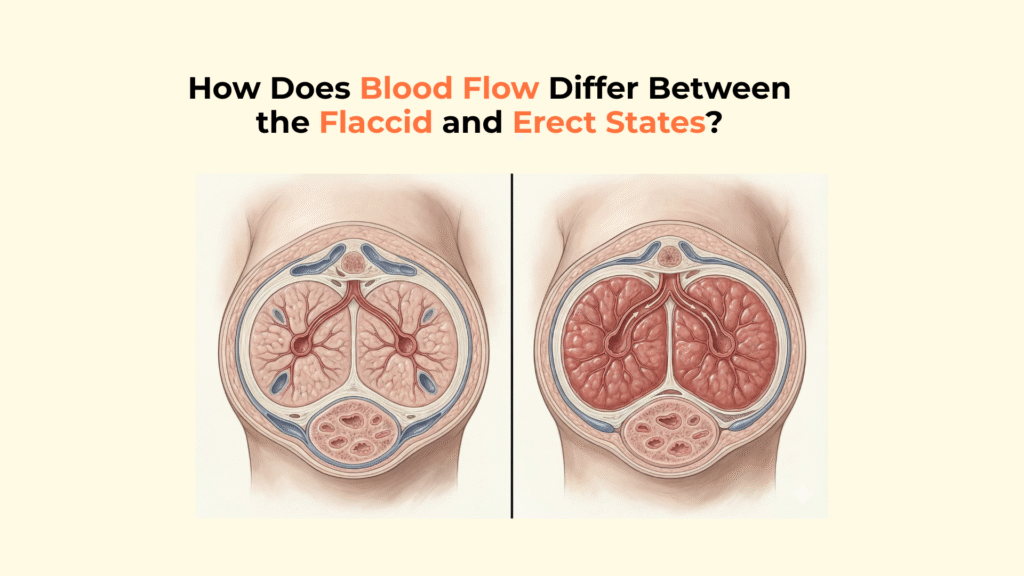
How Does Blood Flow Differ Between the Flaccid and Erect States?
Blood flow differs fundamentally between the flaccid and erect states based on vascular resistance: the flaccid state is a high-resistance, low-flow maintenance mode controlled by the sympathetic nervous system, while the erect state is a low-resistance, high-flow hydraulic event triggered by parasympathetic activation.
This “hemodynamic switch” acts like a sudden opening of floodgates, transforming the penis from a soft, pliable organ into a rigid structural column in a matter of seconds. This guide details the specific physiological mechanisms that control penile blood flow, comparing the arterial, venous, and neurological states of flaccidity versus erection.
Important Medical Disclaimer: This information is for educational purposes only and is not a substitute for professional medical advice, diagnosis, or treatment. Consult with a qualified healthcare provider regarding any medical condition or concerns about your health.
Key Hemodynamic Facts: Flaccid vs. Erect
- ●The Switch: The transition relies on a sudden drop in vascular resistance (“opening the floodgates”).
- ●Flaccid State: Controlled by Sympathetic nerves (norepinephrine). Arteries are clamped shut. Flow is minimal (“nutritional only”).
- ●Erect State: Triggered by Parasympathetic nerves (Nitric Oxide). Arteries dilate wide. Flow increases by 20-50x.
- ●The Trap: During full rigidity, inflow actually slows down because blood is trapped inside (the veno-occlusive mechanism).
- ●Oxygen: The erect penis has high oxygen levels (arterial-like), while the flaccid penis has lower levels (venous-like).
What Characterizes the Fundamental Hemodynamic Switch?
The fundamental hemodynamic switch between flaccid and erect states is characterized by a “resistance inversion,” where the vascular bed shifts from a high-resistance state to a near-zero resistance state.
The Resistance Inversion (The Core Mechanism)
This inversion is the physical opening of the vascular floodgates. In clinical physiology, “peripheral resistance” refers to the muscular clamping force of the arteries that opposes blood flow.
- Flaccid: High Resistance. Smooth muscles are contracted, clamping down on the arteries.
- Erect: Low Resistance. Smooth muscles relax, opening the arteries wide.
The relaxation of helicine arteries (Entity) drops vascular resistance to near zero (Action), allowing arterial pressure to equilibrate with systemic blood pressure (Result).
The Volume vs. Velocity Shift
The switch also alters the dynamics of blood movement, shifting from a low-volume/low-velocity state to a high-volume/high-velocity surge. This progression moves from the “Trickle” of the flaccid state, to the high-velocity “Surge” of tumescence, and finally to the high-pressure but lower-flow state of full rigidity.
How Is Blood Flow Regulated in the Flaccid State?
In the flaccid state, blood flow is tightly regulated by the sympathetic nervous system, which acts as a physiological “brake” to keep the penis soft.
Sympathetic Dominance (The “Brake”)
The Sympathetic Nervous System maintains flaccidity by releasing Norepinephrine, a neurotransmitter that keeps the smooth muscle of the helicine arteries and trabeculae tonically contracted. This maintains the penis in a metabolic ‘Maintenance Mode’ with minimal oxygen consumption, preventing unnecessary engorgement.
Nutritional Flow (The “Trickle”)
During this state, blood flow is minimal, restricted to a “nutritional trickle” sufficient only to keep the tissues alive but not enough to expand them. Flaccid blood flow rates are approximately 2-5 ml/min/100g of tissue (Source).
How Does Blood Flow Transform During the Erect State?
During the erect state, blood flow is transformed by parasympathetic activation, which acts as the “gas pedal” to trigger massive vasodilation.
Parasympathetic Activation (The “Gas”)
Sexual stimulation triggers the parasympathetic nerves to release Nitric Oxide (NO), initiating the biochemical cascade (cGMP pathway) that relaxes smooth muscle. Arterial inflow increases by 20 to 50 times the flaccid rate during the initial filling phase (Source).
The Shear Stress Mechanism
As flow velocity spikes, it creates “shear stress” against the endothelial lining of the blood vessels, creating a positive feedback loop. This mechanical shear stress (Entity) stimulates more NO release from the endothelium (Action), causing further dilation and reinforcing the erection (Result).
Comparative Matrix: Flaccid vs. Erect Hemodynamics
This table provides a direct comparison of the key hemodynamic parameters between the flaccid and erect states.
| Parameter | Flaccid State | Erect State | Typical Flow Rate |
|---|---|---|---|
| Arterial Resistance | High (Constricted) | Low (Dilated) | ~5 ml/min vs ~100+ ml/min |
| Venous Outflow | Free / Open | Occluded / Blocked | N/A |
| Dominant Nerve | Sympathetic | Parasympathetic | N/A |
| Blood Gas (pO2) | Venous-like (Lower O2) | Arterial-like (High O2) | N/A |
How Does the “Steady State” of Full Rigidity Alter Blood Flow?
Once the penis achieves full rigidity, the hemodynamics shift again into a “Steady State” where high inflow is no longer needed, and blood is effectively trapped.
The “Inflow-Outflow Equilibrium”
During full rigidity, the pressure inside the corpora cavernosa equalizes with the pressure in the cavernosal artery, causing blood flow to slow down significantly. Blood is trapped. Inflow drops to just enough to replace the tiny amount of leakage (maintenance flow), while pressure remains high.
[Checklist] Verifying the Hemodynamic Differences
Use this checklist to review the key hemodynamic differences that define sexual function.
- Resistance Check: Is Flaccid identified as High Resistance and Erect as Low Resistance?
- The “Brake”: Is Sympathetic tone identified as the cause of the flaccid state?
- The Surge: Is the massive increase (20-50x) in inflow noted during tumescence?
- Oxygenation: Is the shift from venous pO2 (flaccid) to arterial pO2 (erect) recognized?
- Steady State: Is it understood that flow decreases again once full rigidity is achieved (trapping phase)?
Related Anatomical Structures & Pathways
The resistance inversion described in this guide takes place along the same arterial tree outlined in our step-by-step map of the vascular pathway for blood flow into the penis , from the internal pudendal artery down to the cavernosal branches.
All hemodynamic changes ultimately play out inside the corpora cavernosa , where the spongy erectile tissue converts increased inflow and reduced outflow into visible enlargement and rigidity.
The veno-occlusive trap depends on the stiffness and geometry of the tunica albuginea , which turns intracavernosal pressure into a mechanical clamp on the draining veins.
At the microscopic level, the hemodynamic switch is mediated by dilation of the helicine arteries , which drop vascular resistance and allow arterial pressure to reach the sinusoidal spaces.
The structural frame that transmits this pressure is formed by the collagen–smooth muscle network of the intracavernosal struts (trabeculae) , which support both expansion and recoil between flaccid and erect states.
Once blood has entered and expanded the erectile tissue, it must still drain through the primary veins of the penis , where compression against the tunica albuginea determines how effectively blood is trapped during rigidity.
Failure of this trapping mechanism produces the hemodynamic pattern of venous leak , in which normal arterial inflow is present but venous outflow is not adequately restricted.
On a clinical level, many cases of erectile dysfunction can be understood as disturbances in this flaccid-versus-erect hemodynamic balance, whether due to arterial insufficiency, venous leak, or neurogenic factors.
Conditions that deform the tunica or alter curvature, such as Peyronie’s disease , may also disturb local pressure distribution, creating regions of impaired filling despite an otherwise intact hemodynamic switch.
Glossary of Physiological Terms
To ensure full clarity, this glossary defines the key physiological terms used throughout this guide.
| Term | Definition |
|---|---|
| Hemodynamics | The study of the forces involved in blood circulation (flow, pressure, resistance). |
| Sympathetic Nervous System | The part of the nervous system responsible for the “fight or flight” response; in the penis, it causes flaccidity. |
| Parasympathetic Nervous System | The part of the nervous system responsible for “rest and digest”; in the penis, it triggers erection. |
| Vasoconstriction | The narrowing of blood vessels, which increases resistance and reduces blood flow. |
| Vasodilation | The widening of blood vessels, which decreases resistance and increases blood flow. |
| Shear Stress | The friction force of flowing blood against the vessel wall, which stimulates the release of Nitric Oxide. |
Conclusion
In conclusion, the difference between a flaccid and erect penis is not just a change in size, but a profound hemodynamic reversal from a high-resistance, sympathetic state to a low-resistance, parasympathetic event driven by blood flow. The nervous system carefully orchestrates this “switch,” allowing arterial blood to surge in while simultaneously trapping it to maintain rigidity.
At Factbasedurology, we believe that understanding the physiology of your body empowers you to maintain its health. This complex dance of nerves and blood vessels is the silent engine of male sexual health.
One Response