How Does the Fundiform Ligament Provide Support to the Penis?
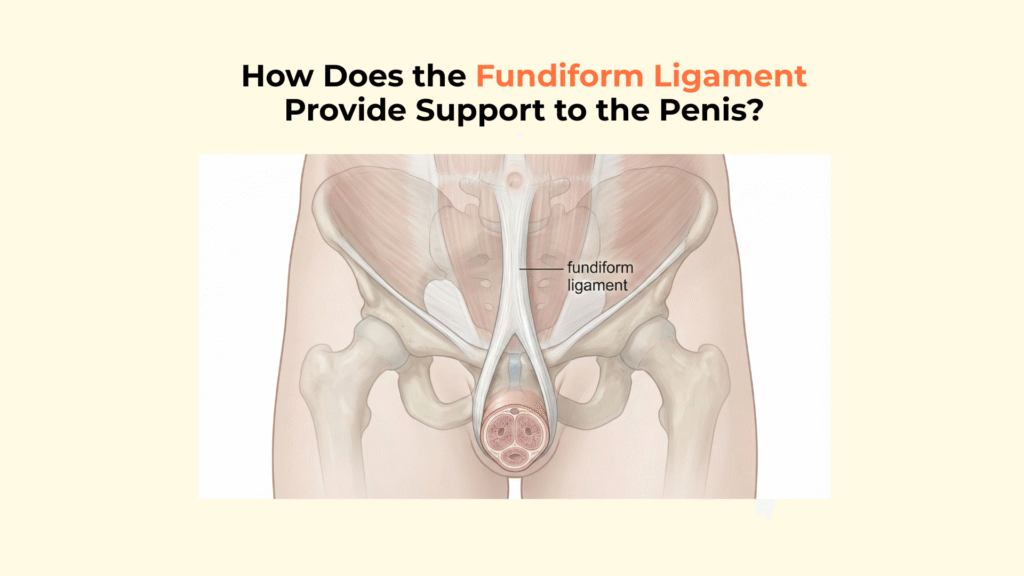
The fundiform ligament provides support to the penis by acting as a superficial, elastic sling that originates from the abdominal wall and encircles the penile base, suspending the weight of the organ and maintaining its vertical alignment.
While the deeper suspensory ligament is often discussed as the primary anchor for erection stability, the fundiform ligament plays a distinct, crucial role in the management of the flaccid penis. It functions as a dynamic tether, ensuring the organ remains centered relative to the pubic symphysis while allowing for the natural flexibility required during movement.
This guide details the unique “sling” architecture of the fundiform ligament, its elastic composition, and how it differs mechanically from the deeper suspensory ligament.
Important Medical Disclaimer: This information is for educational purposes only and is not a substitute for professional medical advice, diagnosis, or treatment. Consult with a qualified healthcare provider regarding any medical condition or concerns about your health.
Key Functional Facts: Fundiform Ligament
- The Shape of the aspect of the penis: It forms a loop or “sling” that splits to encircle the base of the penis.
- The Origin: It arises from the Linea Alba and Scarpa’s fascia of the lower abdomen.
- The Composition: The composition of the fundiform ligament of the penis is essential for the suspension of the penis. Unlike the fibrous suspensory ligament, the penile suspensory ligament is rich in elastic fibers.
- The Function: It acts as a flexible tether, supporting the flaccid penis against gravity, which is essential for maintaining the integrity of the penile suspensory ligament during penile elongation.
- Surgical Role: In the dissection of the penile suspensory ligamentous system based on human penile anatomy and its impact on penile length, it is often the first layer cut during penile lengthening surgery (ligamentolysis).
What Is the Anatomical Structure of the Fundiform Ligament?
The anatomical structure of the fundiform ligament is defined by its unique “sling” architecture, originating from the abdominal wall and splitting into two distinct bands that loop around the penis. This structure is specialized for flexible suspension rather than rigid fixation, particularly the bundles of the fundiform ligament.
The “Sling” Architecture
The ligament arises from the Linea Alba and the lower abdominal wall (Scarpa’s fascia) and runs down towards the pubis before splitting into two distinct bands (fasciculi), playing a critical role in penile erection.
These bands encircle the base of the penis and reunite underneath, blending into the Scrotal Septum. This pathway creates a literal anatomical cradle. It does not simply attach to the top of the penis; it wraps entirely around the lateral aspects, securing the organ in a supportive loop that connects the abdominal fascia to the scrotal tissues.
The fundiform sling surrounds the penile base just above the origin of the crura and bulb, helping limit excessive lateral deviation during walking or physical activity.
Because it loops around the lateral aspects of the shaft, the sling interacts indirectly with the deeper fibers of the penile root, contributing to the centering effect of the flaccid penis.
Where the sling merges near the scrotal septum, it lies in close anatomical proximity to the ascending pathway of the dorsal nerve, without directly altering its sensory function.
Composition: Elasticity vs. Rigidity
A key distinction is that unlike the deep suspensory ligament (which is fibrous and rigid), the fundiform ligament contains a high proportion of elastic fibers, contributing to the penile suspensory ligamentous system.
This specific tissue composition is derived from the membranous layer of subcutaneous tissue (Scarpa’s fascia) and contributes to the function of the ligament of penis. It acts as a flexible tether, allowing the penis to hang naturally while keeping it centered relative to the body.
As the ligament descends from the abdominal wall, it lies superficial to the penile fascial layers, blending with the membranous tissue that helps stabilize the base during movement.
While the deep suspensory ligament is composed of collagenous fibers designed to withstand the high tension of an erection, the fundiform ligament relies on this elasticity to manage the variable states of the flaccid organ.
How Does the Fundiform Ligament Mechanically Support the Penis?
The fundiform ligament mechanically supports the penis through a “spring-loaded” suspension system that absorbs weight and provides mobile stability, crucial for the erectile function.
Its elastic bands distribute weight toward the abdominal midline, while the structural tension of the penile ligaments ensures that the organ maintains its anatomical alignment.
The “Spring-Loaded” Suspension
Because it originates from the abdominal wall and loops around the penis, the ligament effectively supports the weight of the organ against gravity. Mechanically, the elastic nature of the fundiform ligament absorbs the weight of the flaccid penis, maintaining its vertical alignment with the abdomen, supported by the ligament of penis. Without this structure, the angle of the penis relative to the abdominal wall would lack definition, potentially leading to a retracted appearance.
When excessive tension pulls the penis upward, the elasticity of the sling allows the shaft to reset to a midline position without stressing the deeper circumferential tissues of the penile base.
The “Mobile Stability” Role
The fundiform ligament provides superficial stability, allowing the penis to move freely while returning to a central position. It allows the penis to swing during movement due to its elasticity, whereas the deeper suspensory ligament locks the angle during erection. This allows for comfort and protection during daily activities, such as walking or running.
Even though this structure is superficial, its stabilizing effect indirectly influences how the pelvic base muscles manage rotation and recoil forces at the proximal shaft.
During forward motion or pelvic rotation, the elastic sling helps keep the shaft aligned above the urethral tract, minimizing unnecessary torque on the ventral tissues.
By supporting the flaccid organ, the ligament ensures that the penile shaft remains centered over the pelvic attachment points that define the deeper mechanics of erection.
How Does the Fundiform Ligament Differ from the Suspensory Ligament?
The fundiform and suspensory ligaments differ fundamentally in their anatomical depth, tissue composition, and primary functional role, particularly in relation to the fibers of the suspensory ligament. While they are anatomically adjacent, their contributions to penile mechanics are distinct.
The superficial course of the ligament places it just above the deeper suspensory ligament, creating a layered support system that divides elastic suspension from rigid anchoring.
Its superficial suspension works together with the deep fibers that connect the corpora to the tunica albuginea, forming a coordinated system that balances mobility with structural support.
Although the fundiform ligament does not attach to the erectile cylinders, its position affects how the tunica albuginea maintains axial alignment when the flaccid penis transitions toward partial tumescence.
The ligament can influence the perceived angle of the flaccid penis, even though the erection angle is governed primarily by the rigid support of the corpora cavernosa and their pubic attachments.
| Feature | Fundiform Ligament | Suspensory Ligament |
|---|---|---|
| Origin | Linea Alba (Abdominal Wall) | Pubic Symphysis (Bone) |
| Insertion | Scrotal Septum (loops around) | Tunica Albuginea (direct attachment) |
| Composition | Elastic / Dartos tissue | Fibrous / Collagen tissue |
| Primary Function | Flaccid Support | Erect Angle Stability |
The “Sling vs. Anchor” Comparison
Think of the Fundiform Ligament as a “Sling” (superficial, elastic, supports weight) and the Suspensory Ligament as an “Anchor” (deep, rigid, locks angle). This analogy helps clarify why damage to one affects the flaccid state, while damage to the tunica albuginea of the corpora affects the erectile angle.
How Is the Fundiform Ligament Modified in Surgical Procedures?
The fundiform ligament is frequently modified during penile lengthening surgery (ligamentolysis), where it is severed to allow the penile shaft to drop forward and hang lower, impacting the overall function of the albuginea of the corpora cavernosa. Understanding this procedure requires recognizing the trade-off between visual length and anatomical support.
Penile Lengthening Surgery (Ligamentolysis)
In ligamentolysis, the fundiform ligament is typically the first layer cut to release superficial tension. The mechanical logic is straightforward: severing the fundiform ligament releases the superficial tension holding the penis to the pubis, allowing the flaccid penis to hang lower and appear longer.
However, the American Urological Association (AUA) notes that such procedures carry risks, including potential reattachment or instability if not managed correctly, especially regarding the penile suspensory ligamentous system based on visible human data sets (Source: AUA Journals on erectile dysfunction and penile anatomy).
Reconstruction and Instability
If the fundiform ligament is cut without proper re-stabilization, the penis may lack support, leading to a “loose” feeling or rotational instability at the base. The loss of the “sling” means the penis no longer has its natural mechanism to return to a midline position after movement, which can result in the penis hanging lower but with less control over its orientation.
During ligamentolysis, releasing the sling changes the resting position of the organ, while deeper support from the penile septum remains intact and continues to maintain erectile symmetry.
As the penis drops lower after fundiform release, the vascular expansion of the shaft still depends on the integrity of the arterial and venous pathways that traverse the midline.
Surgical alteration of the sling does not interfere with hemodynamics, because inflow from the helicine arteries and the function of the distal erectile tissues remain governed by deeper structural layers.
Any postoperative change in penile positioning occurs above the level where the organ receives sensory input from the somatic and autonomic innervation pathways.
[Checklist] Identifying the Fundiform Ligament’s Support Role
Use this checklist to review the defining anatomical features of the fundiform ligament.
- ✓ Origin Check: Does it originate from the Linea Alba (abdominal wall and superficial fascia)?
- ✓ Shape Check: Is it described as splitting into two bands (a bundle) around the dorsal arteries?
- ✓ Composition Check: Is it identified as elastic and superficial (unlike the fibrous suspensory ligament)?
- ✓ Termination: Does it reunite below the deep dorsal vein to join the scrotal septum?
- ✓ Function: Is its primary role identified as supporting the suspension of the flaccid penis?
Glossary of Anatomical Terms
- Fundiform Ligament
- The superficial, elastic ligament that forms a sling around the base of the penis, supporting it when flaccid.
- Suspensory Ligament
- The deep, rigid arcuate pubic ligament that anchors the penis to the pubic bone and maintains erection angle.
- Linea Alba
- The fibrous connective tissue running down the midline of the abdomen, from which the fundiform ligament originates.
- Ligamentolysis
- A surgical procedure to cut the penile ligaments to increase flaccid hang length.
- Scarpa’s Fascia
- The deep membranous layer of the abdominal wall, continuous with the fundiform ligament.
Frequently Asked Questions
1. What is the function of the fundiform ligament in supporting the flaccid penis?
It acts as an elastic sling to support the weight of the flaccid penis and keep it aligned with the abdomen.
2. How does the fundiform ligament differ anatomically from the suspensory ligament?
The fundiform is superficial and elastic (sling-like), whereas the suspensory is deep, fibrous, and rigid (anchor-like).
3. Does the fundiform ligament affect the angle of erection or only the flaccid position?
It primarily affects the flaccid position. The suspensory ligament controls the angle of erection.
4. What tissues form the fundiform ligament, and why is it classified as an elastic structure?
Formed from elastic fibers derived from Scarpa’s fascia, allowing it to stretch and recoil during movement.
5. How does the fundiform ligament’s “sling” architecture help keep the penis centered on the midline?
Its two bands encircle the penile base and reunite underneath, creating a cradle that prevents lateral deviation.
6. What happens to penile support if the fundiform ligament is cut during lengthening surgery?
The penis drops forward and hangs lower, potentially increasing visible length but reducing base stability.
7. Is the fundiform ligament directly attached to the corpora cavernosa or the tunica albuginea?
No, it loops around the penis. The suspensory ligament attaches directly to the tunica albuginea.
8. How does the fundiform ligament interact with the abdominal fascia and Scarpa’s fascia?
It arises directly from the Linea Alba and is continuous with the membranous layer of Scarpa’s fascia.
9. Why is the fundiform ligament the first structure released during ligamentolysis?
It is the most superficial layer contributing to the penopubic angle, making it accessible and effective to cut for length.
10. Can cutting the fundiform ligament cause instability or rotation at the penile base?
Yes, severing it removes the natural tether, which can lead to rotational instability or a lack of midline orientation.
11. Does the fundiform ligament influence blood flow, or is hemodynamics controlled by deeper structures?
No, hemodynamics are controlled by the cavernosal arteries and smooth muscle, not the supportive ligaments.
12. How does the fundiform ligament contribute to the visual appearance of penile length when flaccid?
It holds the penile base up against the pubic bone; releasing it allows the penis to hang more vertically, increasing apparent length.
13. What are the biomechanical differences between the fundiform and suspensory ligaments during motion?
The fundiform absorbs movement and allows swinging (mobile stability), while the suspensory limits movement to maintain angle.
14. Can damage to the fundiform ligament affect penile sensitivity or nerve pathways?
Unlikely directly, as it is superficial to the deep dorsal nerves, though surgical dissection carries general risks.
15. Does every man have the same fundiform ligament structure, or do thickness and elasticity vary?
Yes, anatomical thickness and elasticity can vary significantly between individuals.
Conclusion
In conclusion, the fundiform ligament is a specialized elastic structure that functions as a supportive sling, working in tandem with the deeper suspensory ligament to ensure the penis is securely anchored and properly aligned. Its unique composition allows it to manage weight and movement without rigidity.
At Factbasedurology, we believe that understanding the hidden architecture of your body, including the deep dorsal vein, is the key to appreciating its function. It is the unsung hero of penile support, maintaining position and stability every day.