
How Is the Penis Anchored to the Pelvis?
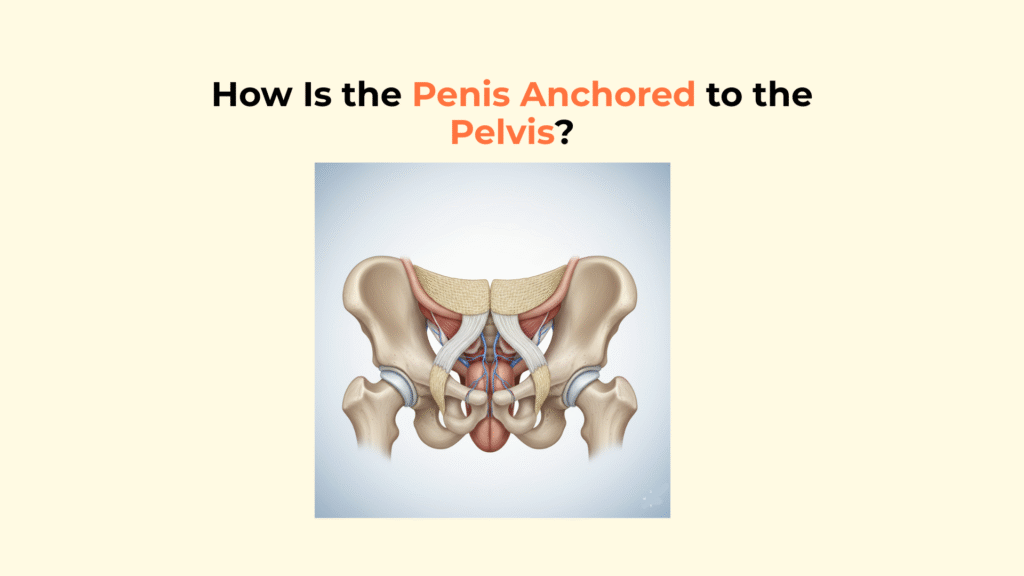
The penis is anchored to the pelvis through an integrated system comprising its internal root (the crura and bulb providing direct bony and fascial attachment), two key ligaments (suspensory and fundiform providing suspension), and associated perineal muscles providing dynamic reinforcement.
This complex, multi-part anchoring system is essential for providing the rigid stability required for the penis to withstand forces during an erection and the flexible support needed when flaccid.
Think of this anchoring system like a suspension bridge: it requires both strong foundation points (the root) and supportive cables (the ligaments) to function.
This guide provides a detailed, medically accurate explanation of ‘how the penis is anchored to the pelvis,’ detailing the bony, ligamentous, and muscular components of this vital support system.
Important Medical Disclaimer
This information is for educational purposes only and is not a substitute for professional medical advice, diagnosis, or treatment. Consult with a qualified healthcare provider regarding any medical condition or concerns about your health.
Key Components of the Penile Anchoring System
- The Bony Anchor (Root): The root of the penis (composed of the crura and bulb) provides the primary foundation, attaching the erectile tissues directly to the pubic arch.
- The Deep Ligament Anchor: The suspensory ligament is a strong, deep band that anchors the penis shaft to the pubic symphysis (pubic bone), providing stability for erections.
- The Superficial Ligament Anchor: The fundiform ligament is a more flexible, sling-like ligament that descends from the abdomen to support the penis’s weight.
- Muscular Reinforcement: The ischiocavernosus and bulbospongiosus muscles actively contract to maximize erectile rigidity and support the anchor points.
How Does the Root of the Penis Create a Bony Anchor to the Pelvis?
The root of the penis creates the primary bony anchor to the pelvis through the direct attachment of its erectile tissue components—the crura—to the pubic arch.
What Is the Root of the Penis?
The root of the penis is the internal, non-visible proximal portion of the organ that serves as its structural foundation and primary anchor point within the perineum. It is composed of the two crura, the single bulb, and the muscles that cover them (ischiocavernosus and bulbospongiosus). This internal root makes up approximately one-third of the penis’s total length.
How Do the Crura Attach Directly to the Pelvic Bone?
The two crura, which are the internal continuations of the corpora cavernosa, attach directly and firmly along the ischiopubic rami, forming the primary rigid bony anchor for the penis. This connection to the pelvic bone is incredibly strong, providing the stable base necessary for the penis to angle upwards and maintain rigidity during an erection. (Source: StatPearls, Perineum Anatomy)
How Does the Bulb Attach to the Pelvic Floor?
The bulb of the penis, the internal continuation of the corpus spongiosum, provides a central anchor point by attaching to the inferior surface of the perineal membrane. The perineal membrane is a tough, fibrous sheet of deep fascia that spans the pubic arch and forms part of the pelvic floor structure. This provides a central, slightly more flexible anchor compared to the rigid bony attachment of the crura.
The crura and bulb form the internal root of the penis, and their structural anatomy is detailed in our guide to the crura and bulb of the penis.
How Do the Suspensory and Fundiform Ligaments Anchor the Penis?
The suspensory and fundiform ligaments provide additional anchoring for the penis by connecting the base of the external shaft to the pubic symphysis and lower abdominal wall, respectively.
What Is the Role of the Suspensory Ligament as a Deep Anchor?
The role of the deep suspensory ligament is to act as a primary suspension cable, connecting the deep fascia (Buck’s fascia) surrounding the base of the penile shaft directly to the anterior surface of the pubic symphysis. This firm connection is what supports a stable, upward angle during erection. (Source: PMC, Penile Anatomy Review 2013)
What Is the Role of the Fundiform Ligament as a Superficial Anchor?
The role of the superficial fundiform ligament is to provide a more flexible, sling-like anchor, originating from the linea alba and Scarpa’s fascia of the lower abdomen and encircling the base of the penis. The linea alba is the fibrous midline seam of the abdominal muscles, and Scarpa’s fascia is a deep layer of subcutaneous tissue. This ligament acts as a supportive sling, helping to suspend the weight of the flaccid penis.
How Do Muscles Reinforce the Anchor of the Penis to the Pelvis?
Muscles associated with the root of the penis—primarily the ischiocavernosus and bulbospongiosus—provide dynamic reinforcement to the static bony and ligamentous anchors, particularly during erection.
The primary muscles located at the base of the penis within the perineum are the Bulbospongiosus, the paired Ischiocavernosus, and the Superficial Transverse Perineal muscles, all playing essential roles in sexual function and pelvic floor stability. These muscles, though often overlooked, are not passive structures. They are active participants located in the perineum that are critical for achieving rigid erections and ejaculation.
This guide provides a detailed, medically accurate explanation of the “muscles at the base of the penis,” their specific anatomy, their precise location, and their crucial function in sexual health.
Where Are the Bulbospongiosus and Ischiocavernosus Muscles Located Anatomically?
Anatomically, the Bulbospongiosus and Ischiocavernosus muscles are located within the superficial perineal pouch, directly overlying the erectile tissues that form the root of the penis. These muscles encase the erectile components located at the penile base. For foundational context, see our full breakdown of the root of the penis.
What Is the Superficial Perineal Pouch?
The superficial perineal pouch is an anatomical compartment in the perineum, bounded inferiorly by the perineal fascia (Colles’ fascia) and superiorly by the perineal membrane. The pouch also surrounds the proximal urethra—learn more about this structure in our anatomical overview of the male urethra.
How Do These Muscles Relate to the Root of the Penis?
These muscles have a direct anatomical relationship with the root of the penis: the Bulbospongiosus muscle ensheathes the bulb, and the two Ischiocavernosus muscles ensheathe the two crura. These muscles anchor the erectile tissues to the pelvic region via key ligamentous supports. Explore their connections in our discussion of the suspensory ligament attachment.
How Do the Bulbospongiosus and Ischiocavernosus Muscles Function?
Functionally, the Bulbospongiosus and Ischiocavernosus muscles are crucial for male sexual function, playing active roles in achieving maximum erection rigidity and facilitating the forceful expulsion of semen during ejaculation. These muscles compress the corpora cavernosa to maintain high pressure—learn more in our focused article on the corpora cavernosa structure.
What Is Their Combined Role in Ejaculation?
As the bulbospongiosus contracts, it propels semen through the penile urethra toward the external opening, known as the urethral meatus.
What Can Affect the System Anchoring the Penis to the Pelvis?
The complex system anchoring the penis to the pelvis can be affected by physical trauma, such as pelvic fractures, or specific surgical procedures like ligamentolysis.
How Can Injury Affect These Anchoring Structures?
Significant trauma to the pelvis, such as pelvic fractures from accidents or severe straddle injuries, can damage the crura, ligaments, or the pudendal nerve that controls the anchoring muscles. Such injuries can compromise the stability of the penile base, potentially leading to erectile dysfunction or an altered angle of erection.
What Is Suspensory Ligament Release Surgery (Ligamentolysis)?
Suspensory ligament release (ligamentolysis) is a controversial surgical procedure that cuts the suspensory ligament with the aim of increasing the apparent flaccid length of the penis. Releasing this ligament surgically detaches the primary upward support. This allows more of the internal shaft to hang externally, but it can result in a lower, less stable erection angle and, notably, does not increase the erect length of the penis. (Source: AUA Position Statement)
Summary Matrix: The Complete System Anchoring the Penis to the Pelvis
This table provides a comprehensive overview of the integrated system of structures responsible for anchoring the penis to the pelvis.
| Structure | Type of Anchor | Attachment Point | Primary Function in Anchoring |
|---|---|---|---|
| Crura (x2) | Bony (Rigid) | Pubic Arch (Ischiopubic Rami) | Provides the primary fixed anchor. |
| Bulb | Fascial (Firm) | Perineal Membrane | Provides a central anchor point. |
| Suspensory Ligament | Ligamentous (Deep) | Pubic Symphysis | Suspends the penis; critical for erection angle/stability. |
| Fundiform Ligament | Ligamentous (Superficial) | Abdominal Fascia (Linea Alba) | Provides flexible, sling-like positioning support. |
| Muscles (Ischio/Bulbo) | Muscular (Dynamic) | Covers the Crura & Bulb | Reinforces anchors; creates super-rigid erection. |
Conclusion: An Integrated System for Penile Stability
In conclusion, the penis is securely anchored to the pelvis not by a single structure, but by a sophisticated, integrated system involving bony attachments, fascial connections, suspensory ligaments, and dynamic muscular reinforcement.
The root provides the direct bony connection, the ligaments provide suspension, and the muscles provide dynamic reinforcement, all working synergistically to ensure stability.
Understanding the complete anatomy—both seen and unseen—is the key to appreciating the body’s complex design. This integrated anchoring system is a marvel of biological engineering, essential for both stability and peak sexual function.
Glossary of Clinical Terms
To ensure full clarity, this glossary defines the key anatomical terms used throughout this guide on how the penis is anchored to the pelvis.
| Term | Definition |
|---|---|
| Root of the Penis | The internal, attached portion of the penis located in the perineum, which anchors the organ to the pelvic bones. | t/tr>
| Crura (singular: Crus) | The two paired, tapered columns of erectile tissue in the root that are the internal continuations of the Corpora Cavernosum. |
| Bulb of the Penis | The single, enlarged erectile structure in the root that is the internal continuation of the Corpus Spongiosum. |
| Perineum | The diamond-shaped area between the pubic symphysis (pubic bone) and the coccyx (tailbone), located between the legs. The perineum lies just beneath the visible portions of the penis—these are mapped out in our guide on the visible parts of the penis. |
| Suspensory Ligament | The deep, fibrous ligament that provides the primary anchor for the penis to the pubic bone. |
| Fundiform Ligament | The superficial, elastic ligament that forms a supportive sling around the base of the penis, originating from the lower abdomen. |
| Ischiocavernosus Muscle | The muscle that covers each crus and contracts to increase erectile rigidity. |
| Bulbospongiosus Muscle | The muscle that covers the bulb and contracts to aid in erection and expel semen. |
One Response