The Vascular Engine Blueprint: Your 4-Week Mission to Build Elite Cardiovascular Performance
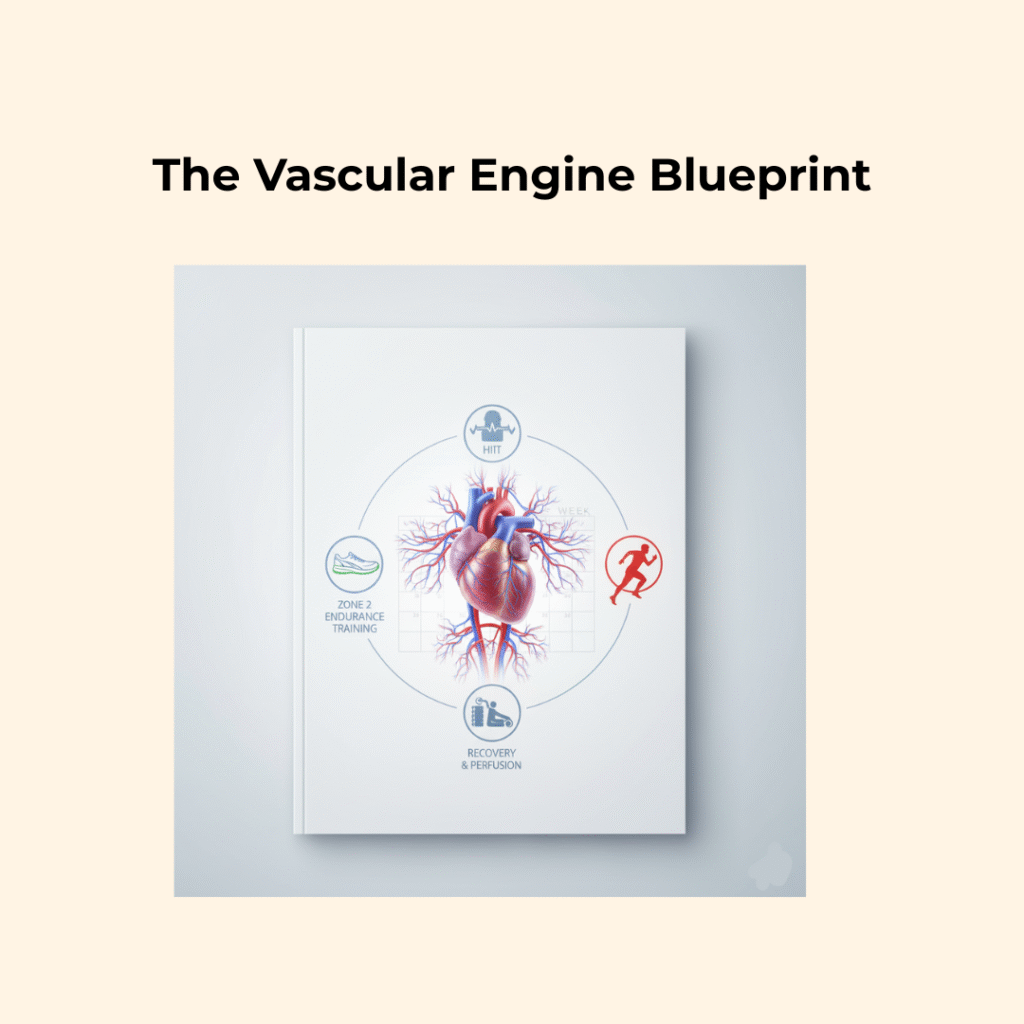
The Vascular Engine Blueprint is a 4-week, science-backed training mission designed to systematically upgrade your cardiovascular system by enhancing endothelial function, boosting nitric oxide, and building a powerful aerobic base for elite blood flow.
Your circulatory system is not a set of passive pipes; it is a dynamic, trainable network. This guide provides a complete guide to the ‘Vascular Engine Blueprint,’ the science behind each training modality, and the tools to track progress and plan future improvements.
Important Medical Disclaimer
This fitness protocol is for informational purposes only. Consult with a physician or qualified physical therapist before beginning any new exercise program, especially if you have pre-existing health conditions. The information provided herein is not intended to be a substitute for professional medical advice, diagnosis, or treatment.
Mission Briefing: Why Upgrading Your Vascular Engine is a Game-Changer
Upgrading your vascular engine is a game-changer because optimal health and performance depend on the body’s ability to efficiently deliver oxygenated blood to every cell, a process governed by the health of your endothelium and the availability of nitric oxide.
Cardiovascular disease (CVD) is the leading cause of mortality worldwide, responsible for nearly 1 in 3 deaths. However, the American Heart Association notes that up to 90% of it is considered preventable through lifestyle changes.
A critical early event in CVD is endothelial dysfunction—damage to the inner lining of blood vessels, characterized by reduced nitric oxide bioavailability. Its prevalence is as high as 67% in individuals with three or more cardiovascular risk factors.
Precise training protocols → enhance endothelial function and boost nitric oxide → building a vascular system capable of maximum efficiency and power.
The Protocol Library: The “Why” and “How” Behind Your Training
The Protocol Library details the “why” and “how” of your training, breaking down the three core protocols—Zone 2 Endurance (Z2E), High-Intensity Interval Training (HIIT), and Recovery & Perfusion (R&P)—into specific objectives and exercises.
Protocol 1: Zone 2 Endurance (Z2E) for Building Your Aerobic Base
The objective of Zone 2 Endurance (Z2E) training is to increase mitochondrial density and improve metabolic flexibility, training your body to become incredibly efficient at using oxygen and clearing lactate. While HIIT is a potent driver of mitochondrial biogenesis, Z2E is essential for building the aerobic infrastructure (capillary density, stroke volume) that enables high-quality HIIT performance, reflecting the “polarized training” model used by elite athletes. Research confirms its benefits for improving metabolic health.
Zone 2 training significantly increases mitochondrial density over time.
How to Perform It
- Activity: 45-60 minutes of low-intensity cardio (brisk walking on an incline, light jogging, cycling).
- Intensity: Stay in a heart rate zone of approximately 60-70% of your maximum. A simple test is that you should be able to comfortably hold a conversation without gasping for breath.
Protocol 2: High-Intensity Interval Training (HIIT) for Boosting Nitric Oxide
The objective of High-Intensity Interval Training (HIIT) is to use the “shear stress” of rapid blood flow on artery walls to signal the endothelium to produce more nitric oxide (NO), the key molecule for vasodilation. A 2022 meta-analysis showed HIIT produced a 1.59% greater improvement in Flow-Mediated Dilation (FMD) compared to Moderate-Intensity Continuous Training (MICT). Another study found 8 weeks of HIIT increased VO2 Max by 7.2%.
HIIT shows a greater improvement in Flow-Mediated Dilation (FMD).
How to Perform a Basic HIIT Session
- Warm-up: 5 minutes of light jogging or jumping jacks.
- Work Interval: 30 seconds of maximal effort (e.g., sprinting, burpees).
- Rest Interval: 60 seconds of active rest (e.g., walking).
- Repeat: Complete 8-10 cycles.
Protocol 3: Recovery & Perfusion (R&P) for Accelerating Gains
The objective of Recovery & Perfusion (R&P) is to enhance local blood flow (perfusion) and clear metabolic waste on rest days or after workouts to maximize adaptation and prevent overtraining.
How to Perform It
- Activity: 10-15 minutes on rest days or after workouts of foam rolling, dynamic stretching, or deliberate nasal breathing exercises.
- Nasal Breathing: Inhaling through the nose promotes the release of nitric oxide directly in the paranasal sinuses. A 1996 study found this resulted in 10% higher transcutaneous oxygen tension compared to oral breathing.
Your Mission Log: The 4-Week Training Matrix
The “4-Week Training Matrix” is your personal mission log, designed to track your consistency. The goal is to execute 2x Zone 2 sessions and 2x HIIT sessions per week on non-consecutive days, with Recovery & Perfusion work integrated throughout.
| Week | Mon | Tue | Wed | Thu | Fri | Sat | Sun |
|---|
How to Conduct Your Performance Debrief (After 4 Weeks)
The “Performance Debrief Matrix” is the analysis phase of your mission. For each protocol, check the box that best describes its impact on your key performance outcomes.
| Key Training Protocol | Impact on Energy | Impact on Erection Quality | Impact on Stamina |
|---|---|---|---|
| Consistent Z2E (>1x/wk) | S M N | S M N | S M N |
| Consistent HIIT (>1x/wk) | S M N | S M N | S M N |
| Consistent R&P (>3x/wk) | S M N | S M N | S M N |
S = Strong Positive, M = Minor Positive, N = No Effect
Your Most Impactful Protocol
How to Design Your Next Training Cycle with Progressive Overload
Designing your next training cycle involves applying the principle of progressive overload, which means systematically increasing the demands placed on your body over time to ensure continuous adaptation and improvement. This is the key to avoiding plateaus and achieving long-term results.
| My Area of Greatest Opportunity Is: | My Measurable Objective for Next Cycle Is: | The Specific Action I Will Take Is: |
|---|---|---|
A Checklist for Your First Vascular Engine Mission
Frequently Asked Questions
Glossary of Clinical & Technical Terms
| Term | Definition |
|---|---|
| Endothelial Function | The overall health of the endothelium, the single-cell-thick inner lining of blood vessels, which is critical for regulating blood flow. |
| Nitric Oxide (NO) | A potent vasodilator, a signaling molecule that tells blood vessels to relax and widen, increasing circulation. |
| Zone 2 Endurance | Low-intensity aerobic exercise performed at 60-70% of maximum heart rate, designed to improve mitochondrial efficiency and build an aerobic base. |
| HIIT | A training protocol involving short bursts of intense anaerobic exercise with less-intense recovery periods. |
| VO2 Max | The maximum rate of oxygen the body can utilize during intense exercise; the gold-standard measure of aerobic fitness. |
| Progressive Overload | The principle of gradually increasing the stress placed on the body during exercise in order to elicit continuous adaptation and improvement. |
The Vascular Engine Blueprint is a comprehensive program designed to enhance cardiovascular performance over a four-week period. This structured mission focuses on developing endurance, efficiency, and overall heart health, guided by scientifically-backed principles. Participants will engage in targeted exercises and nutritional strategies aimed at optimizing vascular function and elevating athletic capabilities. Adopting The Vascular Engine Blueprint can lead to significant improvements in physical fitness and cardiovascular resilience.