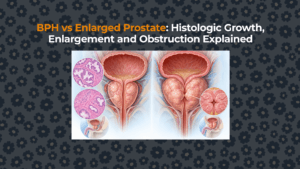
Finasteride is a 5-alpha-reductase inhibitor used for BPH when prostate enlargement or progression risk is present. It lowers dihydrotestosterone (DHT), gradually reduces prostate volume and changes how PSA results must be interpreted.
01. Finasteride: Mechanism and Role in BPH
What target or pathway does finasteride act on?
Finasteride inhibits type 2 5-alpha-reductase, the enzyme that converts testosterone to DHT in prostate tissue. DHT is a potent androgenic signal for prostate epithelial and stromal growth. Lowering DHT promotes gradual regression of androgen-dependent tissue; it does not immediately relax smooth muscle at the bladder outlet.
Which prostate or urinary outcomes can finasteride change?
Finasteride can reduce prostate volume, improve IPSS and modestly increase peak urinary flow in men with enlarged prostates. The 5-alpha-reductase inhibitor overview places these outcomes in context: class effects usually require at least six months, and symptom benefit is less reliable when the prostate is small.
Long-term randomized trials show prevention as well as symptom effects. In PLESS, finasteride reduced the relative risk of acute urinary retention by 57% and surgery by 55% over four years; absolute risk reductions were 4% and 7%. In MTOPS, relative reductions were 68% for retention and 64% for surgery, with absolute reductions of 2% and 3%. Absolute effects vary with baseline risk.
02. How Does Finasteride Work for BPH?
How quickly can finasteride affect symptoms or measurements?
DHT falls rapidly, but gland shrinkage and symptom improvement take months. PSA commonly approaches a new lower baseline after six to twelve months. Prostate volume typically decreases by about 18–28% across the drug class, while longer-term studies report IPSS improvement of about 15–30% and Qmax increases near 1.5–2.0 mL/s in appropriately selected men.
| Outcome | Expected timing | What the change means |
|---|---|---|
| DHT | Falls early | Confirms pharmacologic action, not symptom success |
| PSA | Usually about 50% lower after 6–12 months | Requires a new baseline and ongoing trend interpretation |
| Prostate volume | Measurable reduction over 6–12 months | Supports tissue response; does not directly prove obstruction relief |
| LUTS | Often requires 3–6 months or longer | Should be judged against baseline severity and bother |
| Retention/surgery risk | Benefit demonstrated over years | Risk reduction, not complete prevention |
Which patients are most likely to be considered for finasteride?
Finasteride is generally considered when moderate-to-severe bothersome LUTS coexist with objective enlargement or higher progression risk. Examples include prostate volume above roughly 30–40 mL, palpable enlargement or a PSA level that supports larger gland volume after appropriate cancer assessment. Men needing quick relief may also receive an alpha blocker initially.
Selection should occur within the broader BPH medication pathway, which weighs symptom pattern, gland size, PSA, emptying, complications, blood pressure, sexual priorities and patient preference.
03. Finasteride: Benefits, Adverse Effects and Treatment Selection
What adverse effects are most relevant to men using finasteride?
Reduced libido, erectile dysfunction, ejaculatory dysfunction and lower ejaculate volume are the main treatment-related adverse effects. Breast tenderness or enlargement occurs in about 1–2% across 5-ARIs. A breast lump or nipple discharge needs assessment. Depression and suicidal ideation have been reported; new mood symptoms require prompt medical advice.
Some patients report sexual, mood or physical symptoms persisting after discontinuation. Regulators acknowledge post-marketing reports, but their frequency, mechanisms and individual causality remain uncertain. Counselling should neither dismiss symptoms nor claim that persistence is inevitable.
How can finasteride affect sexual or reproductive function?
Finasteride can reduce desire, erection quality and semen volume. Semen parameters may decline in susceptible men, particularly when fertility is already impaired, and often recover after stopping. Someone who is or may be pregnant should not handle crushed or broken tablets because absorption could affect development of a male fetus; intact coated tablets prevent ordinary contact with the active ingredient.
04. When Is Finasteride Considered or Avoided?
How does finasteride compare with other treatments in the same pathway?
Finasteride inhibits type 2 5-alpha-reductase, whereas dutasteride inhibits types 1 and 2. Both substantially lower intraprostatic DHT and can modify progression in men with enlargement; direct and indirect evidence does not establish a large, consistent difference in clinical BPH effectiveness.
Alpha blockers work faster but do not shrink the gland or prevent long-term retention. Combination therapy may suit men with bothersome LUTS plus enlargement and higher progression risk, but adverse effects increase. When complications or inadequate benefit make medication insufficient, BPH procedures may offer a more direct and durable reduction in obstruction.
When should response, safety or treatment choice be reassessed?
Review adherence, symptom severity and bother, sexual function, mood, breast symptoms and PSA after enough time for a biologic response. A new PSA baseline is usually established after six to twelve months. Confirmed PSA rise, failure to suppress as expected, worsening emptying, retention, infection, bladder stones or kidney effects warrants reassessment.
| Finding | What it may indicate | Next clinical question |
|---|---|---|
| Little benefit after 6–12 months | Small gland, non-prostatic LUTS, poor adherence or advanced obstruction | Was the treatment target correctly identified? |
| Confirmed PSA rise | Benign variation, inflammation, nonadherence or cancer | What evaluation is required now? |
| Troublesome sexual or mood effects | Treatment burden may exceed benefit | Would adjustment or another strategy preserve goals? |
| Retention or BPH complication | Medical therapy may be insufficient | Is urgent or procedural management needed? |
Finasteride should remain explicitly within the BPH assessment and management pathway. It should not be used to explain every urinary symptom or replace evaluation for cancer, infection, urethral narrowing, bladder dysfunction or neurologic disease.
Summary
- Finasteride 5 mg daily inhibits type 2 5-alpha-reductase and gradually lowers prostate DHT.
- It is most useful when LUTS coexist with objective prostate enlargement or higher progression risk.
- It can shrink prostate volume and reduce long-term retention and surgery risk, but symptom benefit takes months.
- PSA commonly falls by about half; the new nadir and any confirmed rise require careful interpretation.
- Sexual adverse effects, breast changes and mood symptoms deserve balanced counselling and follow-up.
Educational disclaimer: This article provides general medical education and does not determine whether finasteride is appropriate or provide an individual treatment plan.