Veiny Penis: Is It Normal or a Sign of High Blood Flow? (A Structural Guide)
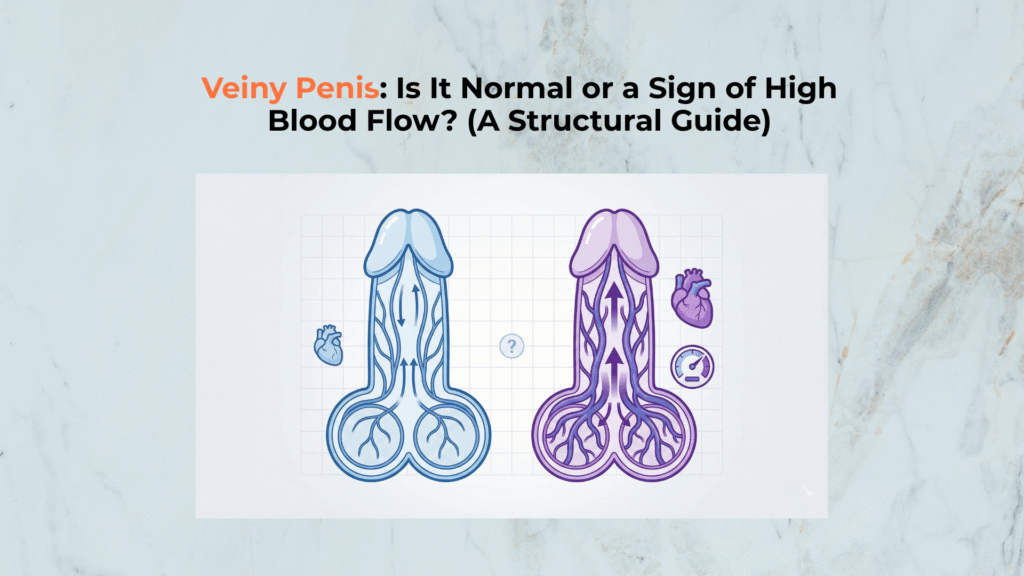
The Veiny Penis is a common anatomical variation characterized by prominent Superficial Dorsal Veins. It fits within the broader Penis Types hub classification as a surface-visibility phenotype, a visual trait determined by the thickness of the Integumentary Layer rather than erectile capacity.
This guide deconstructs the focus on Structural Normality, the role of the thin Integumentary Layer, and the necessity of debunking the High Blood Flow Myth [R1], [R2].
This guide is for informational purposes only. It is not a substitute for professional medical advice, diagnosis, or treatment. Always consult a qualified healthcare provider for any questions regarding your health or erectile function.
Why Is the Veiny Penis Appearance Normal, Debunking the High Blood Flow Myth?
The Veiny Penis appearance is normal because the visibility of Subcutaneous Veins is a benign structural variant dictated by skin thickness, not high blood flow or performance capacity [R1].
The Integumentary Layer, comprising the skin and subcutaneous tissue, acts as a filter for vascular visibility.
How Prevalent Is the Veiny Penis Appearance in the Adult Male Population?
The Veiny Penis appearance is frequently normal and structurally benign, with visibility primarily linked to the thinness of the Subcutaneous Layer rather than pathology [R1], [R2].
Lower Subcutaneous Fat reduces the tissue barrier between veins and the skin surface.
Clinical data notes that low body fat increases vein visibility universally [R8].
A thin subcutaneous layer reduces the depth of superficial veins increasing their visual prominence. This stands in contrast to the smooth-surface penis, where thicker tissue obscures these vessels, reinforcing that skin thickness determines visibility.
| Surface Trait | Visibility Cause | Structural Implication |
|---|---|---|
| Veiny Penis | Low subcutaneous fat/Thin skin. | Veins are superficial and close to surface. |
| Smooth-Surface | High subcutaneous fat/Thick skin. | Veins are deep and obscured by tissue. |
| Thick Raphe | Ventral scar line. | Localized fibrous thickening. |
How Does the Veiny Penis Relate to Blood Flow and Performance Myths?
The Veiny Penis relates to blood flow and performance myths because its visual appearance is an anatomical effect that is not a clinical measure of arterial inflow or erectile performance. A review of the vascular pathway clarifies why surface veins can be prominent even when erectile inflow is standard [R1], [R2].
Rigidity depends on the deep Veno-Occlusive Mechanism—specifically the tunica albuginea role in pressure trapping—not the size of superficial veins.
Dean & Lue [R5] confirm that the visibility of superficial veins reflects integumentary anatomy and is unrelated to deep erectile rigidity.
What Structural and Integumentary Factors Govern Veiny Penis Visibility?
Structural and Integumentary Factors govern Veiny Penis visibility, fundamentally dictated by the thickness of the Subcutaneous Fat Layer and the location of the Superficial Dorsal Veins [R3].
Subcutaneous Veins are the superficial drainage vessels responsible for this appearance. A review of penile veins distinguishes these cosmetic superficial dorsal veins from the deeper outflow structures.
Which Anatomical Structures Govern Vein Prominence in the Veiny Penis?
Anatomical structures governing vein prominence are the Superficial Dorsal Veins, which lie immediately beneath the skin and above the deep fascia [R3], [R4].
These veins are distinct from the Deep Dorsal Vein, which is buried beneath the deep fascia.
The Superficial Dorsal Veins run within the subcutaneous tissue creating the visible ‘veiny’ contour.
| Vascular Structure | Location | Role in Appearance |
|---|---|---|
| Deep Dorsal Vein | Beneath deep fascia. | Not visible; regulates erection outflow. |
| Superficial Dorsal Veins | Above deep fascia [R3]. | Highly Visible; main cosmetic element. |
| Subcutaneous Fat | Between skin and fascia. | Thickness determines visibility. |
How Do Environmental and Physical Factors Influence Vein Prominence?
Environmental and physical factors influence prominence through Thermoregulation, which causes temporary Vasodilation or increased surface blood volume.
Heat and exertion cause veins to dilate to release body heat [R8], [R9].
Exposure to heat triggers peripheral vasodilation temporarily increasing vein diameter and visibility.
Which Scenarios Best Leverage the Veiny Penis for Tactile Stimulation?
For more on sensation mechanics, review the Sexual Mechanics Guide. Scenarios best leverage the Veiny Penis for Tactile Stimulation when they utilize positions that maximize the partner’s sensation of the unique Surface Topography.
Why Does the Veiny Penis Provide Enhanced Tactile Feedback?
The Veiny Penis provides enhanced Tactile Feedback because its unique Surface Topography offers palpable variation that may alter friction perception for the partner.
The raised contours create a textured surface rather than a smooth one [R4].
Surface topography creates variation in contact pressure offering unique tactile sensations.
| Positional Strategy | Mechanical Rationale |
|---|---|
| Spooning (Lateral) | Allows constant pressure against lateral veins. |
| Reverse Cowgirl | Texture is leveraged during grinding motion. |
| Deep Piston | Vein prominence is less felt at maximum depth. |
Which Vascular Risks Require Monitoring in the Veiny Penis?
Vascular risks require monitoring to ensure sudden swelling or pain are not signs of Penile Mondor’s Disease (superficial thrombophlebitis).
Symptoms include the sudden appearance of a firm, painful, cord-like vein on the shaft [R11], [R12].
Persistent pain or a hard cord suggests superficial thrombosis requiring medical assessment.
How Are Cosmetic Concerns and Medical Risks Managed in the Veiny Penis?
Cosmetic concerns and medical risks are managed by adopting a positive visual frame and executing specialized techniques to maximize functional output.
Thrombophlebitis (vein inflammation) should be ruled out if pain is present.
How to Frame the Veiny Penis Appearance for Improved Confidence
Framing the appearance for improved confidence requires validating its structural normalcy and reframing visibility as a sign of healthy anatomy.
Genital self-image is linked to sexual function [R13], [R14].
Reframing the appearance validates anatomical diversity reducing body image anxiety.
How to Execute Specialized Techniques to Maximize Tactile Sensation
Executing specialized techniques maximizes sensation by utilizing slow, shallow movements that intensify the perception of Surface Topography.
Rotational or shallow thrusts maximize contact with the superficial structures.
Utilizing slow movements increases registration of texture enhancing the tactile experience.
Functional Technique Checklist
- ✓ Low Friction: Use minimal lubrication (if comfortable) to enhance texture.
- ✓ Directional Thrusts: Rotational movements maximize lateral contact.
- ✓ Partner Palpation: Encourage manual appreciation of texture.
Conclusion: What Final Action Protocol Ensures Optimal Use of the Veiny Penis?
The final action protocol ensuring optimal use confirms Structural Normality and prioritizes techniques that leverage unique Surface Topography.
By reframing “Veiny” as “Textured,” one can embrace the anatomical distinctiveness of this variant.