Thick Raphe Penis: What Is the Raphe and Why Does It Vary? (A Structural Guide)
Listen to Guide
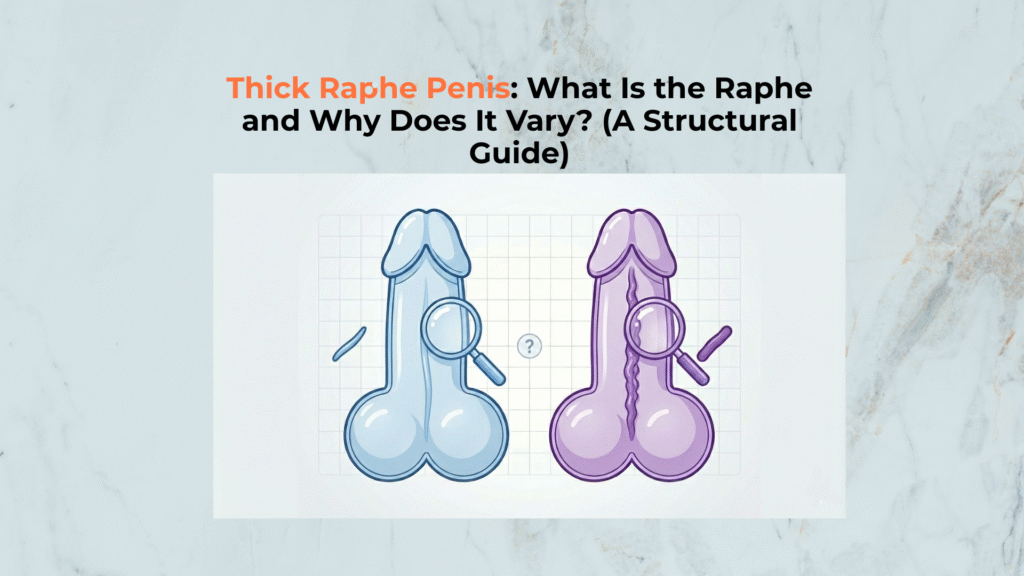
The Thick Raphe Penis is an anatomical variation defined by a prominent Ventral Seam, which serves as a visible marker of the Embryological Fusion process during male development [S1], [S3]. For a broader classification of variations, visit the Penis Types Hub.
This guide deconstructs the focus on Embryological Fusion, the role of Fibrous Tissue, and the necessity of validating Structural Normality [S4]. Understanding the raphe provides insight into normal male development and alleviates aesthetic anxiety.
Important Medical Disclaimer
This guide is for informational purposes only. It is not a substitute for professional medical advice, diagnosis, or treatment. Always consult a qualified healthcare provider for any questions regarding your health or erectile function.
Why Is the Thick Raphe Penis Biomechanically Significant for Tactile Sensation?
The Thick Raphe Penis is biomechanically significant for Tactile Sensation because its prominent Ventral Seam provides a unique, highly localized point of pressure and sensory feedback.
The raphe, or median Ventral Seam, acts as a distinct textural ridge along the penile shaft, offering a tactile profile distinct from the Smooth-Surface Penis.
How Is the Thick Raphe Penis Defined by Anatomical Prominence?
The Thick Raphe Penis is defined by its anatomical prominence, which results from the visible demarcation of the fusion line where urethral folds joined during development [S3], [S4].
A more prominent raphe typically reflects normal variation in ventral skin structure, not a disease process.
The raphe is a manifestation of urethral fold fusion, serving as a biological record of successful canalization.
| Raphe Trait | Developmental Context | Practical Meaning |
|---|---|---|
| Prominent Raphe | Visible fusion line. | Normal anatomical variant. |
| Flat/Subtle | Less visually raised. | Also normal variation. |
| Darker Raphe | Pigmentation variation. | Pigment difference is not pathology. |
How Does the Thick Raphe Penis Relate to Sexual Performance and Aesthetics?
The Thick Raphe Penis relates to sexual performance and aesthetics because its prominent seam is a normal structural variant unrelated to deep vascular function or rigidity [S11].
Erectile function is governed by corporal smooth muscle and veno-occlusion within the deep Penile Shaft Layers, not superficial skin seams.
However, if the raphe feels “draggy” during intimacy, adequate Lubrication reduces friction and potential discomfort [S12].
What Embryological Factors and Tissue Density Govern the Thick Raphe Penis?
Embryological Factors govern the Thick Raphe Penis because the prominence directly reflects the fusion of the Urethral Folds during development [S2], [S5].
Embryological Fusion is the process by which separate tissue structures join to form a single continuous unit.
Which Embryological Process Forms the Raphe in the Thick Raphe Penis?
The Raphe in the Thick Raphe Penis is formed during the final Embryological Fusion of the urogenital folds, creating a Ventral Seam that marks the closure of the urethra [S4], [S5].
Male development involves canalization of the urethral plate and fusion of the folds in a “zipper-like” fashion from the base to the glans.
How Do Environmental and Physical Factors Influence Raphe Prominence in the Thick Raphe Penis?
Environmental and physical factors influence Raphe prominence by temporarily altering the elasticity and fullness of the surrounding Integumentary Thickness.
Changes in skin turgor or irritation history can make the raphe appear more or less prominent.
Etiology Focus: Influencing Factors
- Weight Loss: Reduces subcutaneous fat, increasing prominence.
- Hygiene: Poor hygiene can lead to localized inflammation.
- Aging: Changes in skin elasticity affect visibility.
Which Positional Strategies Maximize the Surface Texture of the Thick Raphe Penis?
For more on positional mechanics, review the Sexual Mechanics Guide.
Positional strategies maximize the surface texture of the Thick Raphe Penis by focusing on motion that applies pressure to the Ventral Seam, increasing Localized Palpation.
Why Does the Thick Raphe Penis Provide Enhanced Ventral Tactile Feedback?
The Thick Raphe Penis provides enhanced ventral Tactile Feedback because its prominent ridge offers a unique point of Localized Palpation against the vaginal floor.
The raised seam creates a textured surface distinct from smooth skin.
| Positional Strategy | Main Variable | Evidence-Safe Rationale |
|---|---|---|
| Reverse Cowgirl | Control of Pressure | Comfort depends on friction control. |
| Spooning | Reduced Shear | Can reduce irritation by limiting friction. |
| Missionary | Variable | Comfort varies by lubrication. |
Which Aesthetic and Functional Risks Require Monitoring in the Thick Raphe Penis?
Aesthetic and functional risks require monitoring to ensure swelling or localized pain are not signs of underlying infection or developmental cysts [S8], [S9].
Monitor for new lumps, discharge, or persistent pain along the midline.
How Are Cosmetic Concerns and Functional Benefits Managed in the Thick Raphe Penis?
Cosmetic concerns and functional benefits are managed by adopting a positive Validation frame and utilizing techniques that leverage the seam’s Palpable Topography.
Fibrous Tissue is the connective tissue that forms the structural basis of the raphe.
How to Frame the Thick Raphe Penis Appearance for Improved Confidence
Framing the appearance for improved confidence requires validating its normal embryological origin and emphasizing the unique Tactile Marker it provides.
Genital self-image is consistently associated with sexual function [S13], [S14].
How to Execute Techniques to Maximize Tactile Sensation
Executing techniques to maximize Tactile Sensation requires targeting positional strategies that apply vertical or lateral pressure to the seam.
Prioritize positions where the ventral surface engages contact.
Functional Technique Checklist
- ☑ Ventral Focus: Press underside against partner.
- ☑ Lateral Thrusts: Engage seam against lateral walls.
- ☑ Lubrication: Use high-quality lube to minimize drag [S12].
Conclusion: Final Compliance Protocol for the Thick Raphe Penis
The final compliance protocol confirms Structural Normality and prioritizes techniques that leverage Fibrous Tissue density for enhanced Localized Palpation.
What Are the Key Structural Takeaways for the Thick Raphe Penis?
The key structural takeaways establish the Thick Raphe Penis as a Structural Normality dictated by Embryological Fusion and its unique Palpable Topography.
Key Structural Takeaways
How to Complete the Action Checklist for the Thick Raphe Penis Owner
Completion of the action checklist involves protocols for aesthetic acceptance, functional motion, risk monitoring, and hygiene.