Smooth-Surface Penis: Skin Texture and Appearance (A Structural Guide)
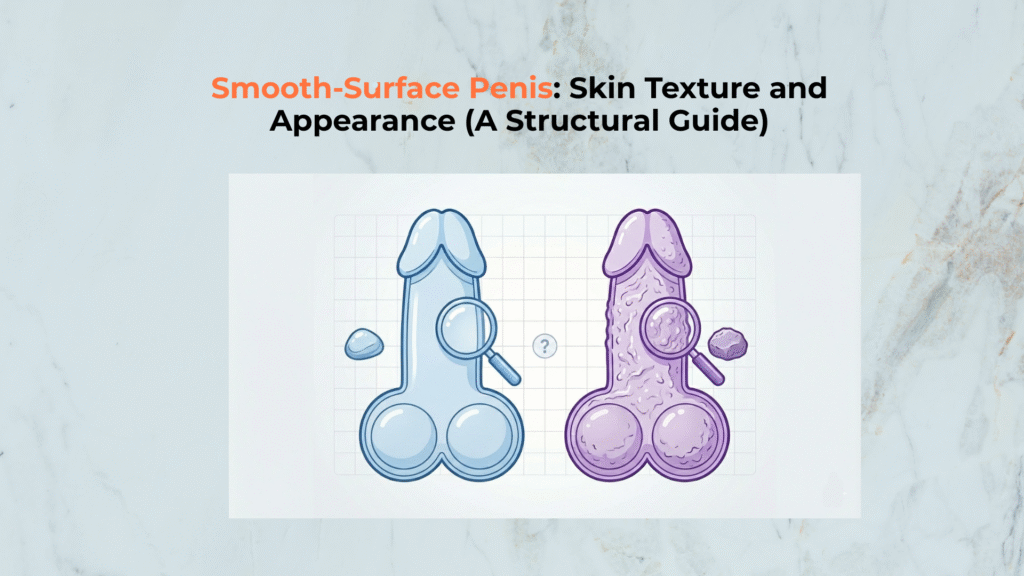
The Smooth-Surface Penis is a common anatomical variation characterized by low superficial vein prominence, a trait determined by the thickness of the Integumentary and Subcutaneous layers rather than vascular deficiency.
To frame “smooth-surface” as a normal morphology category rather than a diagnosis, we anchor this variant within the Penis Types hub, where surface phenotype is treated as structural variation.
This guide deconstructs the focus on Structural Normality, explaining how tissue depth naturally obscures vasculature.
Furthermore, it addresses the necessity of debunking the High Blood Flow Myth [S1], ensuring that low vein visibility is understood as a benign integumentary characteristic rather than a functional deficit.
By understanding the Tunica Albuginea and fascial layers, we can confirm that surface aesthetics are unrelated to the deep mechanics of erection [S2].
Important Medical Disclaimer
This guide is for informational purposes only. It is not a substitute for professional medical advice, diagnosis, or treatment. Always consult a qualified healthcare provider for any questions regarding your health or erectile function.
Why Is Tissue Opacity the Main Factor in Smooth-Surface Penis Normality?
Tissue opacity is the main factor in Smooth-Surface Penis normality because thick Integumentary Thickness naturally obscures the underlying vascular structures, confirming its benign status [S1].
In this context, Integumentary Thickness refers to the combined density of the skin and the subcutaneous adipose tissue beneath it.
This structural depth acts as a visual buffer, rendering the veins invisible despite their normal physiological function.
How Prevalent Is the Smooth-Surface Penis Appearance in the Adult Male Population?
The Smooth-Surface Penis is a common and normal structural variant, with its low visibility primarily linked to the thickness of the Subcutaneous Layer.
Higher subcutaneous fat or thicker skin layers actively obscure the superficial veins from view. This stands in direct contrast to the Veiny Penis, where thin integument makes veins visible without implying better rigidity.
Clinical reviews [S9] confirm that superficial vein visibility varies naturally with overall body composition and anatomy. Therefore, a thicker subcutaneous layer increases tissue opacity, masking the visibility of superficial veins.
| Surface Trait | Visibility Cause | Structural Implication |
|---|---|---|
| Smooth-Surface | High subcutaneous fat/Thick skin. | Veins are deep and obscured by tissue. |
| Veiny Penis | Low subcutaneous fat/Thin skin. | Veins are superficial and close to surface. |
| Thick Raphe | Ventral scar line. | Localized fibrous thickening. |
How Does the Smooth-Surface Penis Relate to Blood Flow and Rigidity?
The Smooth-Surface Penis relates to blood flow and rigidity because its visual aesthetics have no clinical correlation to arterial inflow or erectile firmness [S2].
Rigidity is governed by the deep Corpora Cavernosa and Tunica Albuginea, which are anatomically distinct from the superficial skin veins. Erectile performance depends on deep inflow mechanics described in the vascular pathway, not whether superficial veins are visible.
According to Dean & Lue [S2], physiology dictates that the absence of visible veins is an integumentary characteristic and has no impact on deep erectile rigidity.
What Structural Factors Are Necessary for Smooth-Surface Penis Biomechanics?
Structural factors necessary for Smooth-Surface Penis biomechanics are dictated by high Integumentary Thickness, which causes the veins to be deeply embedded within the Subcutaneous Layer.
This layer consists of dense adipose tissue that provides a cushion, minimizing the superficial relief of vascular structures.
Which Anatomical Structures Cause Low Vein Visibility in the Smooth-Surface Penis?
Anatomical structures causing low vein visibility are the Subcutaneous Fat Layer and the surrounding Integumentary tissue, which jointly obscure the superficial vasculature [S1][S9].
By mapping the specific fascial layers, we can see how skin, superficial tissue, and fascia depth determine whether superficial contours appear on the surface.
The Superficial Dorsal Veins run above the fascia but are hidden by adipose tissue in this morphology.
Anatomical reviews confirm that the depth of the veins within the Subcutaneous Layer obscures the Superficial Dorsal Veins, creating a smooth surface appearance.
| Vascular Structure | Location | Role in Appearance |
|---|---|---|
| Deep Dorsal Vein | Under Buck’s Fascia [S1]. | Not visible; regulates erection outflow. |
| Superficial Dorsal Veins | Dartos Fascia [S9]. | Obscured by tissue; minimal cosmetic impact. |
| Subcutaneous Fat | Between skin and fascia. | Thickness determines invisibility. |
How Do Environmental and Physical Factors Influence Vein Prominence?
Environmental and physical factors influence Smooth-Surface Penis prominence minimally, as systemic Vasoconstriction does not significantly alter the visibility of deeply embedded veins.
While cold temperatures generally cause vasoconstriction, the insulating subcutaneous layer masks these changes.
Effectively, the protective subcutaneous layer masks minor vascular changes, maintaining a consistent smooth appearance.
Etiology Focus: Influencing Factors
- Temperature: Veins constrict in cold (minimal visible change due to tissue depth).
- Hydration: Optimal hydration maintains skin turgor, enhancing smoothness.
- Erection: Deep vessels compress, but superficial aesthetics remain stable.
Which Positional Strategies Optimize the Smooth-Surface Penis for Gliding Friction?
Positional strategies optimize the Smooth-Surface Penis for Gliding Friction by prioritizing linear, deep movements that leverage the anatomy’s uniform, low-drag surface.
Why Does the Smooth-Surface Penis Provide Superior Gliding Friction?
The Smooth-Surface Penis provides superior Gliding Friction because its minimal Palpable Topography reduces surface drag, maximizing consistent, linear glide during intromission.
The lack of raised veins creates a uniform contact surface without “friction hotspots.” This uniform surface offers minimal Palpable Topography, maximizing consistent glide during intromission.
| Positional Strategy | Friction Dynamic | Mechanical Rationale |
|---|---|---|
| Piston Stroke (Deep) | Consistent Glide | Uniformity reduces friction hotspots. |
| Spooning (Lateral) | Low Drag | Smoothness minimizes drag against walls. |
| Grinding/Rotational | Low Effectiveness | Lacks vein topography for texture. |
Which Aesthetic Concerns Require Monitoring in the Smooth-Surface Penis?
Aesthetic concerns require monitoring to ensure sudden changes in texture or localized hardening are not signs of underlying issues like Peyronie’s disease or Penile Mondor’s Disease.
This distinction separates a stable surface variant from a focal fibrotic process that can alter shape and texture. One should watch for hard lumps (plaques) or a sudden cord-like vein.
Clinical guidelines from the AUA [S3, S4] indicate that localized hardening indicates possible Fibrotic Plaque, requiring medical assessment.
Medical Screening Checklist
How Are Confidence and Functional Glide Techniques Executed for the Smooth-Surface Penis?
Confidence and functional glide techniques are executed for the Smooth-Surface Penis by reframing the smooth appearance positively and utilizing Piston Strokes that maximize deep penetration efficiency.
How to Execute Techniques to Maximize Functional Glide
Executing techniques to maximize functional glide requires utilizing fast, deep Piston Strokes that leverage the low surface drag for high stimulation efficiency.
Linear strokes minimize friction drag compared to rotational movements. Research [S8] emphasizes lubricant safety to prevent irritation during repetitive motion.
Ultimately, utilizing deep motions leverages the low surface drag, maximizing deep stimulation efficiency.
Functional Glide Technique Checklist
- Low Friction Motion: Prioritize linear Piston Strokes.
- Lubrication: Use body-safe options; avoid hypertonic agents [S8].
- Motion Variety: Avoid relying on rotational friction.
Conclusion: Compliance Protocol for the Smooth-Surface Penis
The final compliance protocol for the Smooth-Surface Penis confirms its Structural Normality and prioritizes techniques that leverage its inherent Gliding Friction and low surface drag.
By reframing “Smooth” as “Efficient,” owners can maximize confidence and function.
What Are the Key Structural Takeaways for the Smooth-Surface Penis?
- Structural Normality: Appearance is a benign anatomical variant.
- Low-Drag Intromission: Superior Gliding Friction during linear motion.
- Thick Subcutaneous Layer: The primary cause of low vein visibility.
How to Complete the Action Checklist for the Smooth-Surface Penis Owner
Final Action Checklist
- Motion Shift: Prioritize deep Piston Strokes.
- Aesthetic Frame: Link smoothness to Subcutaneous Thickness.
- Risk Monitoring: Check for plaques/lumps [S6].
- Hygiene: Maintain good Integumentary Health.
References & Clinical Citations
- [S1] “Normal Penile… Anatomy…” (2011) PMC. https://pmc.ncbi.nlm.nih.gov/articles/PMC3312188/
- [S2] Dean & Lue (2005) “Physiology of Penile Erection…” PMC. https://pmc.ncbi.nlm.nih.gov/articles/PMC1351051/
- [S3] AUA Guidelines. “Peyronie’s Disease Guideline”. https://www.auanet.org/guidelines-and-quality/guidelines/peyronies-disease-guideline
- [S4] AUA Guideline (2015) PMC. https://pmc.ncbi.nlm.nih.gov/articles/PMC5027990/
- [S5] “Thrombosis of the dorsal vein…” (2010) PMC. https://pmc.ncbi.nlm.nih.gov/articles/PMC2978449/
- [S6] NHS. “Penis lumps and spots”. https://www.nhs.uk/symptoms/penis-lumps-and-spots/
- [S7] American Cancer Society. “Signs and Symptoms of Penile Cancer”. https://www.cancer.org/cancer/types/penile-cancer/detection-diagnosis-staging/signs-symptoms.html
- [S8] “Observational cohort study… lubricant” (2021) PLOS ONE. https://journals.plos.org/plosone/article?id=10.1371/journal.pone.0250153
- [S9] Kenhub. “Dorsal veins of penis”. https://www.kenhub.com/en/library/anatomy/dorsal-veins-of-penis