Smooth Corona Penis: Visual Traits and Texture Differences
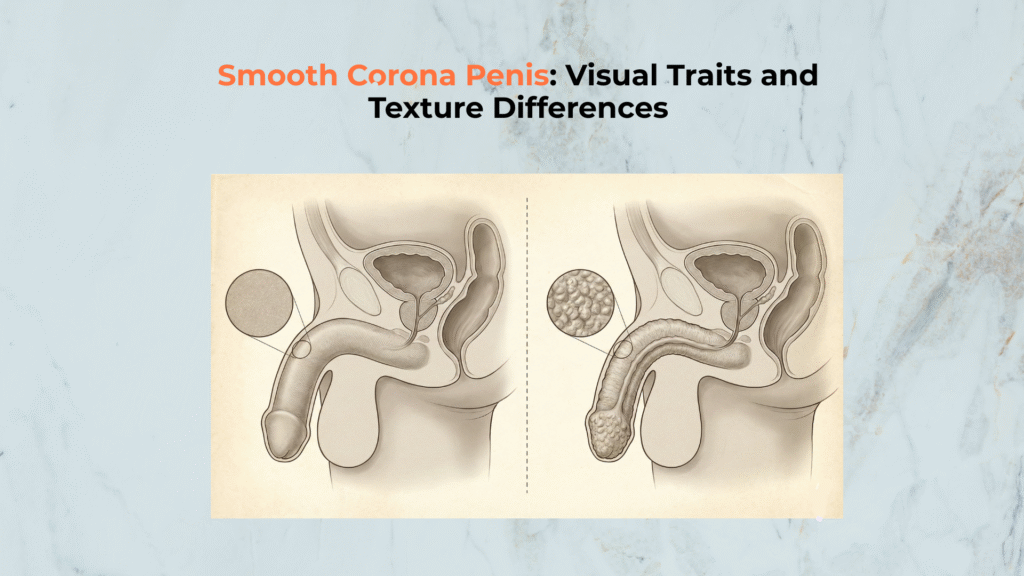
The Smooth Corona Penis describes a penis with a relatively subtle coronal ridge (corona glandis), which can reduce abrupt “rim” contact at the vaginal entrance and shift perceived contact emphasis toward the shaft during penetration [1].
Anatomically, the proximal portion of the glans is termed the corona; ‘Smooth Corona Penis’ is used here as a descriptive, non-diagnostic label for a less protrusive coronal ridge [1]. This profile may feel specialized for comfortable internal fullness for some partners because it can reduce abrupt entrance friction compared with a more pronounced ridge.
Important Medical Disclaimer
This guide discusses anatomical variation and comfort strategies. If penetration causes persistent pain, bleeding, or tearing, stop immediately and seek evaluation, as this may indicate dyspareunia, infection, vestibular sensitivity, or tissue injury [3, 4, 5, 7].
Subtle Ridge Profile: At a Glance
- Is it usually normal or serious? Usually normal (visual variation).
- When should I see a doctor? For new plaques/curvature, persistent pain, bleeding, or sudden injury [3, 4, 10].
- Can this usually be managed or adapted? Often yes—via depth control, lubrication, angle adjustments, and communication [4].
How Does a Smooth Coronal Ridge Affect Friction Mechanics?
A smooth coronal ridge affects friction mechanics by reducing localized “rim” concentration at the entrance and tending to distribute contact more evenly across the penetrative length during full-length motion.
How Is the Smooth Corona Penis Classified Visually?
In this guide, the Smooth Corona Penis is classified by a coronal ridge that appears less protrusive relative to the mid-shaft diameter. This distinguishes it from the balanced geometry of an Average Proportional Penis, creating a streamlined transition similar to the Small Glans Penis which further minimizes entrance stimulation. Mechanically, reducing localized edge pressure at the entrance may improve comfort for partners with vestibular sensitivity [1, 5, 6, 7].
| Glans Profile | Visual Transition | Biomechanical Contact Tendency |
|---|---|---|
| Smooth / Subtle | Minimal “lip” over sulcus | Distributed friction across the entire shaft. |
| Typical | Moderate ridge definition | Balanced contact at entry and mid-canal. |
| Pronounced | Distinct ridge flare | Focal, high-impact friction at the entrance. |
How Does the Smooth Corona Penis Influence Partner Stimulation?
The Smooth Corona Penis shifts emphasis from entrance-focused “rim” sensation toward broader shaft contact. This contrasts with the Pronounced Corona Penis or Mushroom-Shaped Penis, where a sharper ridge concentrates stimulation at the vaginal entrance. Instead, the Smooth Corona shares friction characteristics with the Cylindrical Penis Shape, emphasizing consistent internal fullness. Physiologically, while touch and pressure rely on specific mechanoreceptors (Meissner and Pacinian corpuscles), the overall experience is defined by partner sensitivity [11].
What Anatomy Creates the Smooth Coronal Ridge Profile?
The profile of the corona reflects how the proximal glans rim transitions into the penile shaft, and individuals vary in how pronounced that rim appears [1].
Which Anatomical Structures Create the Subtle Ridge?
The glans is the distal expansion of the corpus spongiosum, and the corona is the proximal portion of the glans; variation in contour produces a more subtle or more pronounced rim [1]. The Coronal Ridge is the proximal portion of the glans penis that caps the paired dorsal columns known as the corpora cavernosa [1]. In this morphology, the erectile tissue at the proximal glans rim remains nearly flush with the shaft diameter, creating the streamlined visual profile.
How Does Sensation Distribution Affect This Morphology?
Sensation in the glans and shaft is supported by dense neural innervation, including branches of the dorsal nerve of the penis, which is a terminal branch of the pudendal nerve [2, 15]. While specific receptor types (Meissner and Pacinian) relate to vibration and pressure perception, the overall sensory experience is defined by the partner’s arousal and tissue sensitivity [11]. This sensory profile encourages techniques that prioritize sustained contact and linear motion.
When Should You Seek Evaluation for Pain and Discomfort?
Seek evaluation whenever sexual pain persists, worsens, involves bleeding or tearing, or follows a sudden injury during intercourse.
Red Flags Requiring Urological or Gynecological Consultation
Specific red flags require consultation with a sexual medicine specialist or gynecologist to rule out underlying pathology, such as Chordee, where curvature—not surface contour—drives mechanical pain. Persistent pain during deep penetration (Deep Dyspareunia) warrants evaluation to assess for pelvic floor dysfunction, cervical sensitivity, or infection [3, 4, 7]. Cite ACOG guidance that vestibular/vulvar pain requiring evaluation includes burning, persistent irritation, or pain lasting >3 months [5].
EMERGENCY SAFETY: Stop immediately and seek urgent care if there is a sudden sharp pain, a “popping” sound, or rapid loss of erection followed by deformity (Red Flags for Penile Fracture) [8, 9].
- Persistent Deep Pain: Pain during deep thrusting that does not resolve with position changes [4, 7].
- Acute Structural Changes: Sudden pain, popping, or immediate swelling (Urological Emergency) [8, 9].
- New Lumps: Palpable hard spots or plaques on the shaft (Peyronie’s Risk) [10].
- Vestibular Distress: Chronic burning or tearing at the vaginal opening [5, 6].
Which Deep Penetration Scenarios Best Leverage the Smooth Corona?
Deep penetration scenarios may feel more comfortable for some partners when depth is controlled and positions are adjusted to reduce sharp pain during thrusting [4].
Why Does a Subtle Ridge Often Support Deeper Comfort?
A subtle ridge can improve comfort in deep penetration positions because it reduces the intensity of impact at the partner’s Vaginal Introitus. Reducing abrupt contact with the partner’s cervix—often termed “reduced uncomfortable cervical contact”—is a key adaptation for partners with deep penetration sensitivity. Cite Mayo Clinic and clinical reviews noting that position changes and depth control are the primary recommendations for managing pain during thrusting [4, 7].
| Mechanical Feature | Smooth / Subtle Corona | Pronounced Corona |
|---|---|---|
| Friction Focus | Distributed / Mid-Shaft | Focal / Vaginal Entrance |
| Primary Motion | Deep Piston / Full Stroke | Shallow Pulse / Withdrawal |
| Partner Sensation | Can provide consistent internal fullness | Can provide intense pressure at entry |
How Can Specific Techniques Enhance Distributed Friction?
Techniques enhance distributed contact by utilizing controlled full-length strokes, sufficient lubrication, and angle adjustments.
How to Execute “The Full Piston” Technique
“The Full Piston” technique utilizes controlled, full-length strokes to engage the entire shaft circumference while maintaining comfortable depth. This motion ensures continuous contact and leverages the volume of the shaft, which is the primary source of sensation for this morphology. Never push through pain; use communication to regulate pace and depth [3, 4].
Maximize Volume with Anterior Pelvic Tilt
Anterior pelvic tilt changes mechanics by altering pelvic orientation and hip angles, which can modify perceived depth and pressure distribution [13]. A forward pelvic tilt may change the intromission angle, allowing the widest parts of the shaft to engage more effectively with the partner’s tissues. Physical therapy literature confirms that Anterior Pelvic Tilt alters hip orientation and pelvic depth measurements, potentially modifying the angle of entry [13].
Conclusion: What Final Actions Ensure Optimal, Comfortable Use?
Optimal use of the Smooth Corona Penis is achieved by prioritizing comfort, communication, lubrication, and controlled depth while recognizing this morphology is a normal variation. The smooth profile is the specialized key to deep, consistent internal fullness.
Optimization Checklist
- Motion Shift: Prioritize controlled full-length strokes.
- Targeting: Adjust angle for comfort; avoid painful cervical contact.
- Lubrication Plan: Increase lubrication if friction or discomfort occurs at the entrance [4].
- Position Priority: Favor positions that allow maximum depth control.
Talking to Your Partner
“Because my shape is smoother, let’s try a position that focuses on deep fullness.”
“Let me know if this depth feels comfortable, or if we should adjust the angle.”
Related Anatomical Profiles & Mechanical Comparisons
These links extend understanding through biomechanical contrast and anatomical dependency.
- Because distributed shaft friction defines this morphology, contrasting it with a Pronounced Corona Penis clarifies how a sharper coronal ridge concentrates stimulation at the vaginal entrance rather than along the shaft.
- When consistent internal fullness is the primary sensation driver, a Cylindrical Penis Shape demonstrates a similar friction distribution pattern created by uniform diameter rather than coronal flare.
- In comparisons involving extreme glans expansion, the Mushroom-Shaped Penis highlights how increased glans width shifts stimulation back toward entrance-focused pressure.
- When depth comfort and angle control are emphasized, reviewing an Average Proportional Penis helps distinguish balanced shaft-to-glans geometry from a deliberately streamlined coronal profile.
- If deep penetration discomfort persists despite a smooth ridge, separating anatomy from pathology is essential, particularly in conditions such as Chordee , where curvature—not surface contour—drives mechanical pain.
- For readers evaluating sensory intensity versus endurance, the Small Glans Penis illustrates how reduced glans prominence can further minimize entrance stimulation and prolong thrust tolerance.
Clinical References
- StatPearls (NCBI Bookshelf): Anatomy, Abdomen and Pelvis, Penis [https://www.ncbi.nlm.nih.gov/books/NBK482236/]
- StatPearls (NCBI Bookshelf): Anatomy, Abdomen and Pelvis, Penis Dorsal Nerve [https://www.ncbi.nlm.nih.gov/books/NBK525966/]
- ACOG: When Sex Is Painful [https://www.acog.org/womens-health/faqs/when-sex-is-painful]
- Mayo Clinic: Painful intercourse (dyspareunia) [https://www.mayoclinic.org/diseases-conditions/painful-intercourse/diagnosis-treatment/drc-20375973]
- ACOG Committee Opinion: Persistent Vulvar Pain [https://www.acog.org/clinical/clinical-guidance/committee-opinion/articles/2016/09/persistent-vulvar-pain]
- StatPearls (NCBI Bookshelf): Female External Genitalia [https://www.ncbi.nlm.nih.gov/books/NBK547703/]
- PMC: Evaluation and Treatment of Female Sexual Pain [https://pmc.ncbi.nlm.nih.gov/articles/PMC5969816/]
- EAU Guidelines: Urological Trauma [https://uroweb.org/guidelines/urological-trauma/chapter/urogenital-trauma-guidelines]
- Cleveland Clinic: Penile Fracture [https://my.clevelandclinic.org/health/diseases/21707-penile-fracture]
- AUA: Peyronie’s Disease Guideline [https://www.auanet.org/guidelines-and-quality/guidelines/peyronies-disease-guideline]
- StatPearls (NCBI Bookshelf): Mechanoreceptor Physiology [https://www.ncbi.nlm.nih.gov/books/NBK541019/]
- Dinh et al. (PMC): Keratinization of the Adult Male Foreskin [https://pmc.ncbi.nlm.nih.gov/articles/PMC2951978/]
- PMC: Clinical Measures of Pelvic Tilt in Physical Therapy [https://pmc.ncbi.nlm.nih.gov/articles/PMC8486407/]
- Mayo Clinic: Body dysmorphic disorder [https://www.mayoclinic.org/diseases-conditions/body-dysmorphic-disorder/symptoms-causes/syc-20353938]
- StatPearls (NCBI Bookshelf): Pudendal Nerve [https://www.ncbi.nlm.nih.gov/books/NBK542258/]