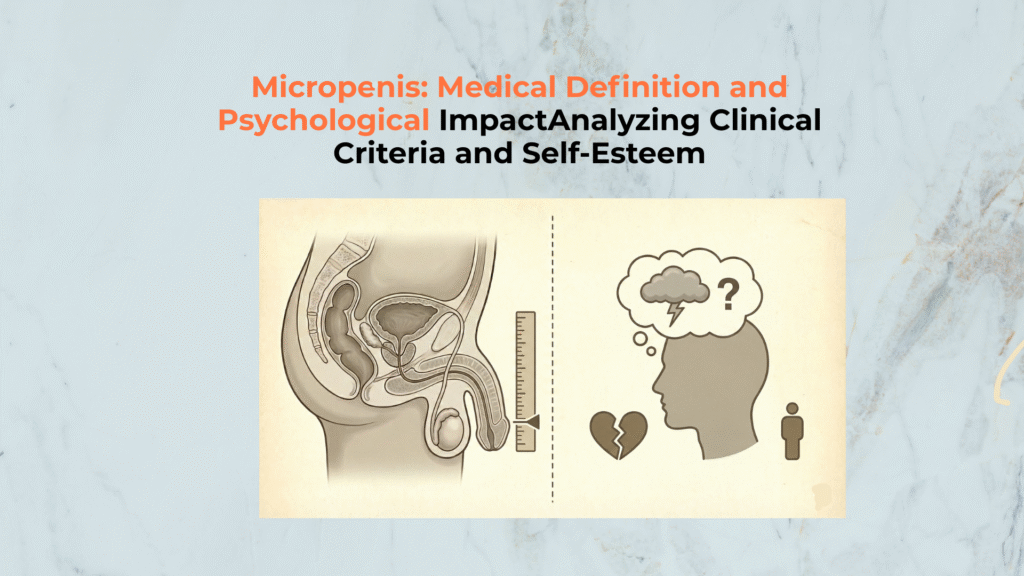
Micropenis: Medical Definition and Psychological Impact—Analyzing Clinical Criteria and Self-Esteem
A comprehensive guide to diagnosis, hormonal etiology, and managing the psychological landscape.
Micropenis is a rare, medically defined condition diagnosed by strict clinical criteria, and its greatest challenge is often the profound psychological impact it has on self-esteem and sexual function, driven by a cycle of performance anxiety. The condition is fundamentally rooted in hormonal deficiency during fetal development, specifically a lack of adequate androgen exposure.
While the physical diagnosis is specific, the emotional reality often involves navigating [C8] Penile Dysmorphic Disorder (PDD). Understanding the distinction between anatomical reality and body image perception is the first step toward effective management.
Important Medical Disclaimer
Micropenis is a diagnosis requiring objective measurement by a physician using the BPEL standard. Early hormonal intervention is critical and should be managed exclusively by an endocrinologist or urologist.
What Is the Clinical and Medical Definition of Micropenis?
Micropenis is a clinical and medical condition strictly defined by statistical measurement criteria that quantify the deviation from normal development. It is not a subjective term but a statistical diagnosis confirmed by an Endocrinologist.
The Measurement Criteria
Micropenis is a clinically defined condition where the penis length, when fully stretched and erect, measures 2.5 standard deviations or more below the average for age [C1] [C2]. The standard technique required for this diagnosis is the Bone-Pressed Erect Length (BPEL) or Stretched Penile Length (SPL). For an adult male, this typically translates to a length of less than 7 cm (approximately 2.8 inches) [C2] [C3]. It is crucial to distinguish this objective medical finding from Penile Dysmorphic Disorder (PDD), which is a body image distress occurring in men with normal anatomy [C8].
The Hormonal Cause (Fetal Deficiency)
The root cause of Micropenis is developmental failure stemming from Fetal Androgen Deficiency during critical growth windows in utero. Specifically, this involves deficient androgen production or action along the hypothalamic-pituitary-testicular axis [C1]. Inadequate fetal androgen exposure prevents the Corpora Cavernosa from developing fully, resulting in a reduced adult penile length. This biological mechanism underscores why early intervention is vital [C6].
How Does Micropenis Affect Self-Esteem and Psychological Well-being?
The Micropenis diagnosis frequently has a severe impact on self-esteem and psychological well-being, often manifesting as feelings of inadequacy and chronic performance anxiety.
The Impact on Masculinity and Self-Image
The diagnosis psychologically affects men by deeply impacting their sense of masculinity and self-image due to cultural pressures. Societies often falsely equate size with virility and competence. Studies indicate that this can lead to profound distress, shame, and the prevalence of Penile Dysmorphic Disorder (PDD) [C8] [C9] [C11]. This distress is significant and often requires therapeutic intervention [C17].
The Cycle of Performance Anxiety
Anxiety about anatomical size fuels a self-perpetuating Negative Feedback Loop that directly impairs sexual function. Anxiety activates the sympathetic nervous system, causing vasoconstriction—the narrowing of blood vessels [C12]. Sympathetic nervous system activation restricts cavernosal blood flow, reinforcing the cycle of erectile difficulty. The anxiety creates a physical failure, confirming the user’s initial fear.
What Is the Functional Reality of Micropenis in Sexual Satisfaction?
The functional reality of Micropenis is that it is often compatible with high sexual satisfaction because length is secondary to targeted stimulation and technique.
Debunking the “Penetration-Only” Myth
The “penetration-only” myth is challenged by anatomical fact: sexual satisfaction often centers on external and superficial stimulation. The Clitoris and the outer third of the vagina contain the highest density of sensory receptors [C13] [C14]. A micropenis is capable of stimulating these highly sensitive zones effectively.
Compensation via Skill and Girth
Functional satisfaction is supported by maximizing the organ’s girth factor and applying superior skill and positional strategy. Often, girth is preserved even when length is reduced [C1]. Studies indicate that technique, variety, and clitoral stimulation correlate more strongly with partner satisfaction than size alone [C15] [C16]. Skill focuses on non-phallic stimulation and strategic positioning to maximize contact with sensitive zones.
What Are the Key Treatment and Management Considerations?
The key treatment and management considerations for Micropenis involve capitalizing on time-sensitive hormonal intervention and mandatory psychological support.
Treatment Focus: Early Hormonal Intervention
Testosterone therapy and Dihydrotestosterone (DHT) application are the clinical treatment focus for growth stimulation, provided during existing hormonal windows. Intervention is most effective in infancy or pre-puberty before growth plates fuse [C1] [C6]. Protocols aim to push dimensions out of the -2.5 SD range [C1] [C7]. This process must be strictly overseen by an Endocrinologist to monitor bone age and systemic effects.
Management Focus: Psychological Support
Psychological Support is a mandatory management focus required to address the profound emotional and sexual distress caused by the condition. Therapy is necessary to address PDD and anxiety, preventing the Negative Feedback Loop described earlier [C8] [C9]. Guidelines recommend Cognitive Behavioral Therapy (CBT) and potentially SSRIs as first-line treatments for body dysmorphic concerns [C17] [C18]. Psychological support ensures the patient can maximize functional outcomes regardless of physical dimensions.
[Checklist] Essential Steps for Micropenis Management
Use this health audit checklist to confirm essential steps for Micropenis management have been followed.
- Diagnosis: Confirmed by physician using BPEL standard (< 7 cm / -2.5 SD) [C1] [C2].
- Treatment Window: Consulted endocrinologist regarding early Testosterone/DHT therapy (if pediatric) [C1] [C6].
- Mental Health: Addressing psychological impact via counseling or CBT [C17] [C18].
- Safety Rule: Avoid self-diagnosis; confirm with medical professional.
Conclusion
In conclusion, Micropenis is a medical condition defined by early hormonal failure, but its management success relies equally on maximizing the window for physical growth and rigorously addressing the associated psychological distress. Successful management always integrates endocrine reality with psychological support. Seek immediate professional guidance to maximize both growth potential and lifelong confidence.
References
[C1] Hatipoğlu N, Kurtoğlu S. “Micropenis: Etiology, Diagnosis and Treatment Approaches.” J Clin Res Pediatr Endocrinol. 2013.
[C2] Veale D, et al. “Am I normal? A systematic review… of nomograms.” BJU Int. 2015.
[C3] Ubie Doctor’s Note. “What is a micro penis?”
[C6] Hatipoğlu & Kurtoğlu (2013) – Critical Timing.
[C7] EAU Guidelines on Sexual and Reproductive Health.
[C8] Veale D, et al. “Penile Dysmorphic Disorder: Development of a Screening Scale.” Arch Sex Behav. 2015.
[C9] Okechukwu CE, et al. “Penile dysmorphic disorder: A secret obsession in men.” Urological Science. 2020.
[C11] Veale D, et al. “Sexual Functioning… of Men with Body Dysmorphic Disorder.” Sex Med. 2015.
[C12] Dean RC, Lue TF. “Physiology of Penile Erection and Pathophysiology of Erectile Dysfunction.” Urol Clin North Am. 2005.
[C13] Boundless A&P. “26.5E: Vagina.”
[C14] Cleveland Clinic. “Clitoris: Anatomy, Function & Disorders.”
[C15] Francken AB, et al. “What importance do women attribute to the size of the penis?” Eur Urol. 2002.
[C16] Hoy M, et al. “The Influence of Types of Stimulation…” Sexuality Research and Social Policy. 2022.
[C17] Phillips KA. “Pharmacotherapy for Body Dysmorphic Disorder.” Psychiatr Ann. 2010.
[C18] Mayo Clinic. “Body dysmorphic disorder – Diagnosis and treatment.”