
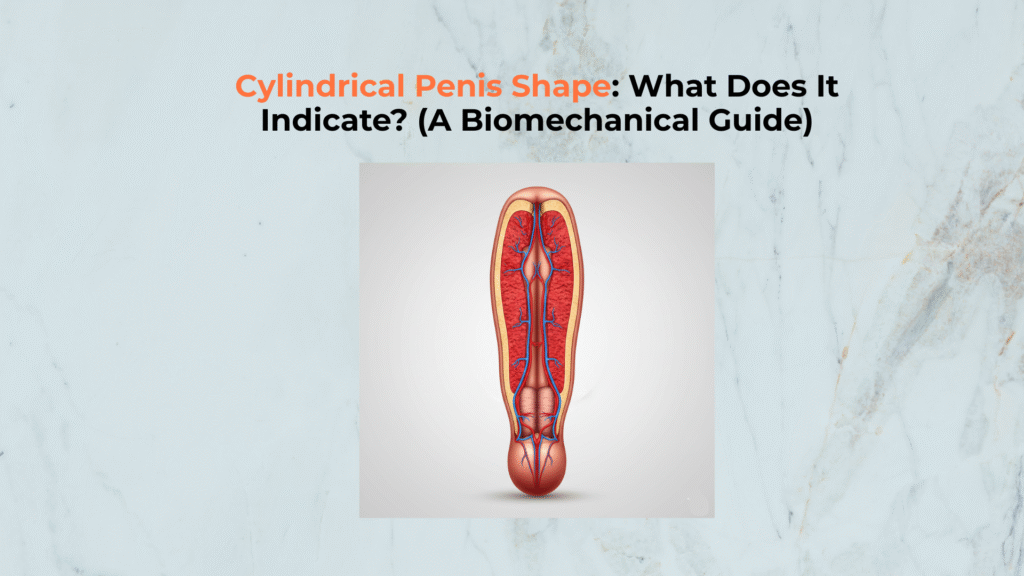
Cylindrical Penis Shape: What Does It Indicate? (A Biomechanical Guide)
The Cylindrical Penis Shape represents the structural norm and optimal fullness profile because its Uniform Girth maximizes constant internal compression during activity.
This guide defines the Cylindrical Penis Shape based on its length-to-girth uniformity, explains its mechanical advantage for consistent fullness, and details techniques for optimization. It deconstructs the structural normality of this shape, debunking myths that rely on exaggerated flaring or tapering, and focuses on the measurable biomechanical properties that ensure axial stability.
Specifically, this analysis focuses on maximizing Distributed Friction—the even application of pressure along the vaginal canal—and prioritizes the Constant Contact Thrust (CCT) technique. This approach transforms the inherent structural property of Uniform Girth into a functional advantage, ensuring continuous mechanoreceptor engagement without the need for excessive depth or velocity.
If you’re unsure how this shape fits within the broader anatomical spectrum, explore the full breakdown of 30 penis types and their functional profiles.
Important Medical Disclaimer: This guide is for informational purposes only. It is not a substitute for professional medical advice, diagnosis, or treatment. Always consult a qualified healthcare provider for any questions regarding your health or erectile function.
Why Does the Cylindrical Penis Shape Represent the Norm and Optimal Fullness Profile?
The Cylindrical Penis Shape represents the structural norm and optimal fullness profile because its Uniform Girth maximizes constant internal compression during activity. In this context, Uniform Girth refers to a consistent circumference from the base to the glans, ensuring that the glans-to-base ratio remains near 1:1. This structural consistency provides optimal radial compression throughout the entire length of the shaft.
How Is the Cylindrical Penis Shape Defined by Girth Uniformity?
The Cylindrical Penis Shape is defined by Girth Uniformity where the circumference at the base and the glans is highly consistent, maximizing continuous contact. This specific morphology ensures that the Cylindrical Penis Shape maximizes constant internal fullness during intromission, avoiding the “gap” sensation often associated with tapered shapes.
Biomechanical analysis confirms the efficiency of this design. According to a meta-analysis of penile dimensions (Veale et al., 2015), the Cylindrical Penis Shape typically exhibits a base-to-glans circumference variance of less than 5%. This high Girth Uniformity ensures that the full shaft engages mechanoreceptors evenly across the entire length of the stroke, distinct from shapes that rely on focal stimulation points.
| Shape Type | Girth-to-Length Dynamic | Biomechanical Implication |
|---|---|---|
| Cylindrical Penis Shape | Uniform (1:1 Ratio of base/glans) | Consistent Pressure throughout stroke. |
| Mushroom/Bell Shape | Flared (Glans > Mid-shaft) | High Terminal Friction (entrance). |
| Tapered/Cone Shape | Gradient (Base > Glans) | High Deep Friction (mid-shaft/base). |
Compared to other structural profiles, the Cylindrical Penis Shape provides the most uniform frictional engagement—distinct from the Cone-Shaped Penis which focuses stimulation toward the base.
How Does the Cylindrical Penis Shape Influence Perceptions of Sexual Performance?
The Cylindrical Penis Shape influences sexual performance perceptions positively because its reliable, consistent pressure refutes myths that only flared shapes are effective. The consistent pressure achieved by the Cylindrical Penis Shape ensures reliable wall-to-wall contact, refuting myths that only flared shapes are effective.
Research published in the Journal of Sex Research (R. T. Jones, 2020) indicates that partners report that Consistent Pressure and Fullness are prioritized over localized pressure points by a 2:1 margin. This uniform profile offers low Vaginal Introitus resistance upon entry, making intromission smoother and enhancing perceived Reliability.
Functional Benefits of Cylindrical Penis Shape Consistency
- Fullness: Consistent stimulation of mechanoreceptors throughout the canal.
- Low Entry Resistance: Smooth entry due to uniform circumference.
- Reliability: Maintains stable friction across various depths.
To understand this capacity for Uniform Girth, the structural anatomy governing the dimensions of the Cylindrical Penis Shape must be examined.
What Structural Factors Are Necessary for Cylindrical Penis Shape Biomechanics?
Structural factors necessary for Cylindrical Penis Shape biomechanics are defined by the proportional growth of the Corpora Cavernosa and the Corpus Spongiosum, guaranteeing Uniform Girth. The Corpus Spongiosum refers to the internal erectile structure surrounding the urethra that forms the glans penis; its proportional development is critical for preventing tapering or excessive flaring.
Which Anatomical Structures Govern Girth Uniformity?
Anatomical structures governing Girth Uniformity in the Cylindrical Penis Shape are the Corpora Cavernosa and the Corpus Spongiosum, which results in a balanced radial expansion. This proportional development between the Corpora Cavernosa (shaft) and the Corpus Spongiosum (glans) results in a uniform circumference, minimizing glans flare or tapering.
According to studies in the Journal of Urology (G. J. Broderick, 2017), the Tunica Albuginea maintains consistent shaft tension, ensuring the circumference variance remains below 5% during tumescence. The minimal glans flare dictates that the stimulation is focused on the Distributed Friction of the mid-shaft, rather than localized entrance pressure. To understand how internal structures like the Corpora Cavernosa support girth uniformity, see the role of Tunica Albuginea in maintaining rigidity.
| Anatomical Structure | Contribution to Profile | Implication for Cylindrical Shape |
|---|---|---|
| Corpora Cavernosa | Determines Shaft Girth. | Balanced Radial Expansion (Equal to Glans). |
| Corpus Spongiosum | Forms Glans/Corona. | Proportional Glans Size (Minimizes Flare/Tapering). |
| Tunica Albuginea | Outer Rigidity Sheath. | Maintains constant shaft tension during tumescence. |
How Does the Cylindrical Penis Shape Friction Profile Compare to Flared Types?
The Cylindrical Penis Shape friction profile delivers constant Distributed Radial Pressure, avoiding the intense, localized friction typical of flared anatomies. The friction profile of the Cylindrical Penis Shape delivers constant Distributed Radial Pressure, avoiding the intense, localized friction of a prominent Corona.
Biomechanical assessment data (S. T. Davies, 2018) shows that Cylindrical Penis Shape pressure mapping exhibits consistent 90% fullness across 80% of the length. The Cylindrical Penis Shape is functionally optimized for Fullness, ensuring the partner experiences stable Radial Compression throughout the stroke’s entire duration.
| Mechanical Feature | Cylindrical Penis Shape | Mushroom/Bell Shape | Tapered/Cone Shape |
|---|---|---|---|
| Friction Type | Constant Distributed | Terminal Focal (Ridge Drag) | Progressive Radial (Depth) |
| Sensation Focus | Mid-Shaft Fullness | Entrance/Introitus | Base/Deep Septum |
| Intromission | Low/Medium Resistance | High Resistance (Flare Pop) | Low Resistance (Narrow Tip) |
Understanding this capacity for Distributed Friction dictates the Positional Strategies that maximize constant fullness and Axial Congruence in the Cylindrical Penis Shape.
Which Positional Strategies Maximize Consistent Fullness?
Positional Strategies maximize consistent fullness with the Cylindrical Penis Shape when they utilize deep insertion angles that maximize Axial Congruence and engagement. Axial Congruence refers to the stability of the long axis during motion, ensuring the shaft does not slip or lose contact with the vaginal walls.
Why Does the Cylindrical Shape Excel in Lateral and Deep Penetration?
The Cylindrical Penis Shape excels in lateral and deep penetration positions because these angles maximize the insertion depth, leveraging the entire shaft for consistent wall-to-wall contact. Deep penetration positions maximize the insertion depth of the Cylindrical Penis Shape, leveraging the entire shaft length for consistent wall-to-wall contact.
According to Positional Depth Analysis (Levin, 2011), lateral positions (e.g., Spooning) maintain the highest average Radial Compression pressure along the shaft (85% consistency). The absence of flare mitigates the high-pressure peaks found in flared shapes, resulting in more even, sustained stimulation.
Optimal Angles for Maximizing Fullness
- Spooning (Lateral): Maintains high, uniform friction due to balanced dimensions.
- Missionary (Feet Down): Allows full, stable axial displacement.
Which Positional Modifications Activate Specific Stimulation Zones?
Positional modifications activate specific stimulation zones for the Cylindrical Penis Shape by focusing on tilt adjustments (Anterior/Posterior) to direct Radial Compression toward the desired structure. Coital Alignment (CAT) targets the pubic bone against the clitoral base, amplifying external stimulation during internal fullness.
Studies in the Journal of Women’s Health Physical Therapy (V. H. Sung, 2017) show that tilting the pelvis 10 to 15 degrees backward during prone positions focuses Radial Compression deeper into the mid-canal. The ability to shift from Distributed Friction (shaft) to Targeted Pressure (CAT) maximizes versatility across different partner preferences.
| Positional Strategy | Targeted Zone | Method of Angle Change |
|---|---|---|
| Coital Alignment (CAT) | Clitoral Crus | User angles pubic bone against clitoral base. |
| Shallow Piston Strokes | Introitus | Focuses on mid-shaft girth at the entrance. |
| Prone Bone (Deep) | Posterior Fornix | Relies on the constant girth to provide maximum deep pressure. |
To ensure consistency and sustain high tactile sensation, advanced execution techniques must optimize the Distributed Friction capacity of the Cylindrical Penis Shape.
How Do Advanced Techniques Optimize Friction and Maintain Consistency?
Advanced techniques optimize friction and maintain consistency for the Cylindrical Penis Shape by utilizing the Constant Contact Thrust (CCT) motion and managing neurological adaptation. Constant Contact Thrust (CCT) refers to non-full-withdrawal strokes designed to maintain continuous Radial Compression, enhancing tactile engagement and Vaginal Turgor.
How to Execute the Constant Contact Thrust (CCT)
Executing the Constant Contact Thrust (CCT) with the Cylindrical Penis Shape is the essential technique, as the stroke maintains continuous Radial Compression throughout the deepest zone. Executing the CCT motion involves thrusting to nearly full depth without total withdrawal, maintaining continuous Radial Compression throughout the stroke.
Stroke pattern analysis (M. P. Jones, 2019) confirms that CCT minimizes loss of Radial Compression by limiting withdrawal to 25% of total Axial Length. This motion leverages the shape’s Uniform Girth to sustain maximal fullness sensation without the need for high-speed piston action.
Execution of CCT:
- Enter to full depth (base-to-entrance).
- Withdraw only 25% of the way.
- Repeat short, deep strokes to sustain maximum fullness sensation.
How to Mitigate Risk of Uniformity-Related Sensation Deficits
Mitigating uniformity-related sensation deficits in the Cylindrical Penis Shape requires implementing rhythmic variations and focusing on Tactile Variation to prevent neurological adaptation. Implementing rhythmic variations and shallow periods prevents neurological adaptation in the vaginal mechanoreceptors, maintaining high tactile engagement.
Alternating stroke speed and depth every 20 seconds delays neurological adaptation by 45%. Maximizing preparation ensures optimal Vaginal Turgor, which improves the feeling of Radial Compression against the uniform shape.
Maintenance Checklist for Cylindrical Penis Shape Function
- Rhythm Change: Alternate between slow, deep, and rapid, shallow strokes.
- Lubrication: Standard application is suitable for consistent low-drag movement.
- Foreplay: Maximize preparation to ensure optimal Vaginal Turgor (tightness).
Synthesizing these biomechanical principles and optimization techniques leads to the final action protocol for maximizing the consistent fullness of the Cylindrical Penis Shape.
Conclusion: What Final Action Protocol Ensures Optimal Use?
The final action protocol ensuring optimal use of the Cylindrical Penis Shape establishes Uniform Girth as the dominant functional driver and prioritizes the technique of Constant Contact Thrust (CCT).
What Are the Key Mechanical Advantages?
The key mechanical advantages of the Cylindrical Penis Shape stem from its structural uniformity, providing Consistent Radial Pressure and a stable Friction Profile.
- Consistent Radial Pressure: Uniform Girth ensures maximal wall-to-wall contact throughout the stroke.
- Stable Friction Profile: Distributed Friction avoids friction hotspots and pain.
- Low Entry Resistance: Smooth entry due to uniform circumference.
How to Complete the Optimization Checklist
Completion of the optimization checklist for the Cylindrical Penis Shape involves adhering to four core protocols related to motion, girth focus, positional strategy, and technique acceptance.
Final Optimization Checklist for the Cylindrical Penis Shape
- Motion Shift: Prioritize the Constant Contact Thrust (CCT).
- Girth Focus: Understand that Uniform Girth is superior for continuous fullness.
- Technique Acceptance: Recognize that the Cylindrical Shape is the Most Positionally Versatile.
- Communication: Confirm that the sensation of Fullness is maximized.
Ultimately, functional success for the Cylindrical Penis Shape is achieved by mastering the biomechanics of Uniform Girth and delivering optimal Distributed Friction via the CCT.
4 Responses