“Penis size change during puberty” is a gradual, multi-year process driven by a surge in key hormones, following a predictable pattern of development that typically begins between the ages of 9 and 14 and concludes by the late teens. Puberty is a time of rapid penis growth, and understanding how the male penis is meant to grow during puberty can provide significant reassurance.
This guide explains how “penis size change during puberty” occurs. We will cover the hormonal triggers, the typical stages of growth, and what changes to expect in both length and girth. It is essential to recognize that development varies widely. The timing of when penis growth starts and concludes is a unique journey for everyone, influenced by genetics and individual hormonal timelines for male sexual development.
Why Does Penis Size Change Significantly During Puberty?
Penis size changes significantly during puberty because the brain signals the body to produce a massive surge of hormones, primarily testosterone and growth hormone, which activate androgen receptors in penile tissue, triggering a rapid phase of growth. The rise in testosterone in the body is the central mechanism for these changes.
The Hormonal Surge: Testosterone and Growth Hormone (GH)
The primary driver of “penis size change during puberty” is a hormonal surge, where the brain signals the testes to dramatically increase testosterone production. Rising testosterone levels are responsible for the development of secondary male sexual characteristics, including the growth of the penis and testicles.
Growth Hormone (GH) works in concert with testosterone to fuel the rapid growth rate of all bodily tissues during this time. This combination of hormones ensures that the bones, muscles, and organs, including the human penis, all grow in a coordinated fashion during the adolescent growth spurt.
Increased Androgen Sensitivity
During puberty, the tissues of the penis not only receive more hormones but also become significantly more sensitive to androgens like testosterone, which maximizes the growth response from the hormonal surge. You can think of androgen receptors as “docking stations” for hormones. During puberty, their sensitivity increases, making the cells more responsive to circulating testosterone. This heightened sensitivity is a critical factor that allows for the rapid “penis size change during puberty,” translating the hormonal signal into physical growth.
What Is the Typical Timeline for Penis Size Change During Puberty?
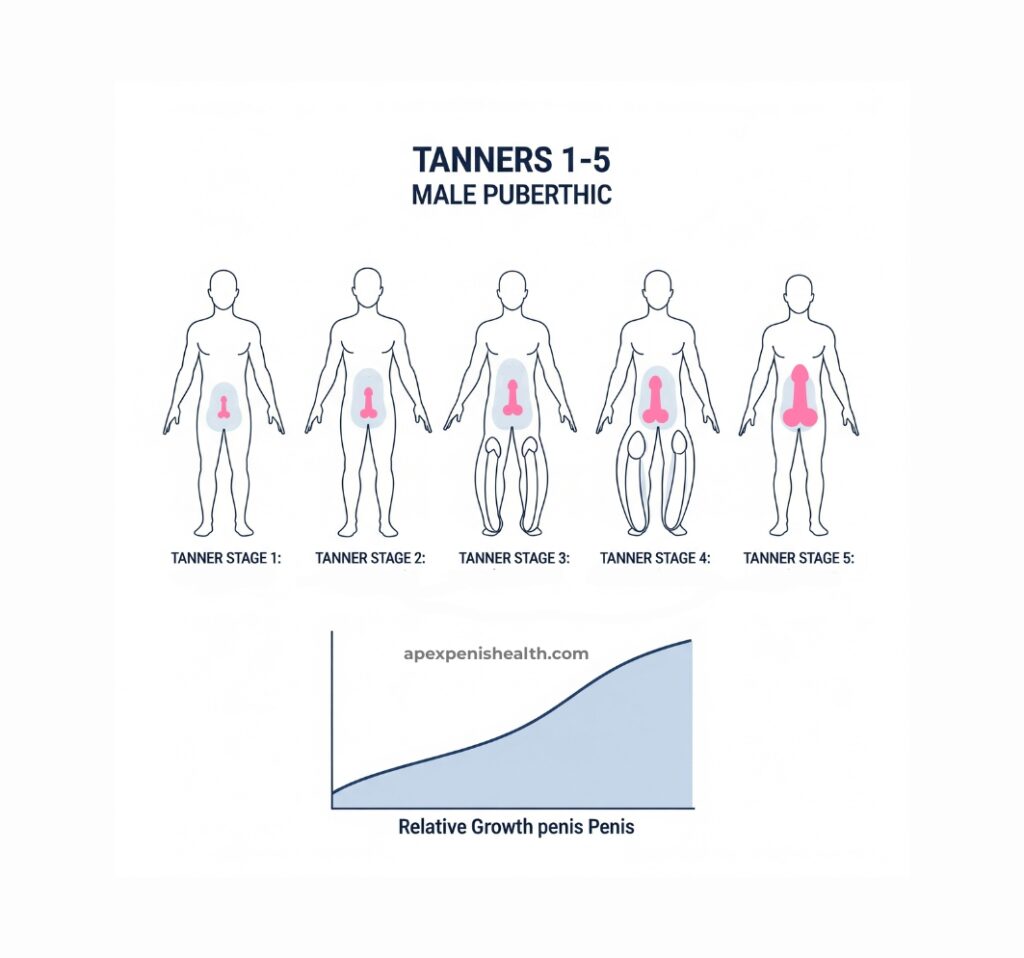
The typical timeline for “penis size change during puberty” is best understood through the Tanner Stages, a medical framework that shows penis growth occurs beginning around Stage 3 and concluding by the end of puberty. The onset of puberty varies, but the pattern is predictable. While most growth is done by the late teens, some continued growth can occur. Any significant deviation, such as delayed puberty, should be discussed with a physician who can perform a physical examination.
Tanner Stage 1 (Pre-Puberty: Ages <9-12)
During Tanner Stage 1, which is the pre-pubertal phase, there is no significant “penis size change during puberty.” At this point, the penis, testicle, and scrotum remain at their childhood size.
Tanner Stages 2-3 (Early Puberty: Ages 9-13)
In Tanner Stages 2 and 3, typically between ages 9 and 13, the first sign of puberty is testicular enlargement. This is followed by the initial “penis size change during puberty,” where the first phase of penile growth primarily involves an increase in length with minimal change in girth.
Tanner Stages 4-5 (Mid-to-Late Puberty: Ages 12-16)
Tanner Stages 4 and 5 represent the period of the most rapid “penis size change during puberty,” where both penis length and circumference increase significantly. This is when the penis is likely to grow the most. By the time puberty ends, adult genital size and shape are reached, and the penis will not grow much more. This is the stage where most individuals stop growing.
| Tanner Stage | Typical Age Range | Key Penis Size Change During Puberty |
| Stage 1 | < 9-12 | Pre-pubertal size, no change. |
| Stage 2 | 9-12 | Minimal to no change. Testes enlarge. |
| Stage 3 | 10-13 | Growth in length begins. |
| Stage 4 | 12-15 | Significant growth in length and girth. |
| Stage 5 | 13-16 | Adult size and shape are reached. Growth concludes. |
What Are the Main Physical Changes to Penis Size During Puberty?
Main Physical Changes During Puberty
Length → Girth → Glans development (schematic, non-clinical)
Time Courses of Change (Normalized)
Early rise in length, later rise in girth, late peak in glans prominence
The main physical changes to penile size during puberty occur in distinct phases, typically involving primary growth in length, followed by a significant increase in girth or circumference, and the final development of the glans.
Growth in Length
Growth in length is often the first noticeable “penis size change during puberty.” This increase applies to both the flaccid and erect penis length. Accurate size measurements for the length of the penis are taken from the base of the penis at the pubic bone to the tip of the penis. This measurement provides a clinical understanding of growth, distinct from visual perception.
Increase in Girth (Circumference)
The increase in penile girth, or circumference, is a key “penis size change during puberty” that typically follows the initial growth in length. This widening adds overall volume to the shaft and is a crucial part of achieving adult size by the time development is complete. This change in girth contributes significantly to the final shape and volume.
Development of the Glans
The development of the glans, or head of the penis, is a final key “penis size change during puberty.” The tip of the penis grows in size and becomes more anatomically distinct from the shaft, completing the transition to its adult form.
What Are the Key Facts to Remember About Penis Size Change During Puberty?
The key facts to remember are that growth occurs over several years, individual timelines vary, and penis size is determined by genetics and hormones.
Key Facts About Pubertal Growth
- ☐ It’s a Marathon, Not a Sprint: Growth happens over several years.
- ☐ Everyone’s Timeline is Different: The age puberty starts and ends varies widely.
- ☐ Growth Follows a Pattern: Testicular growth comes first, then length, then girth.
- ☐ It’s Part of a Bigger Process: This change happens alongside other signs of male sex development.
Frequently Asked Questions (FAQ) About Pubertal Growth
At what age does the penis stop growing?
The penis typically stops growing at the end of puberty, which generally occurs between the ages of 16 and 18
Does masturbation or sexual activity affect penis size during puberty?
No. These activities do not affect penis size. Growth is a biological process determined by hormones.
Why do I seem to have a small penis compared to my friends?
Pubertal timelines vary widely. Comparing yourself to others is unreliable and causes unnecessary anxiety about having a small penis or smaller penis. The range of what is considered a normal size is very broad. Many factors, including the appearance of a flaccid penis, can be misleading.
Is there anything that can be done to increase penis size during puberty?
During puberty, penis size is primarily determined by genetics and hormones, and there’s generally not much that can be done to significantly increase it.
Does penis size matter?
If you are concerned about your penis size, it is helpful to know that research on this topic shows most people are satisfied with their partner’s penis size. The anxiety around whether penis size matter is often greater than the reality. Open communication and intimacy are far more important in relationships.
What is the average penis size?
The scientifically established average penis size is approximately 5.16 inches (13.12 cm) in erect length and 4.59 inches (11.66 cm) in erect girth, according to a major 2015 systematic review.
Glossary of Clinical Terms
This glossary defines key clinical terms used in this guide.
Glossary of Key Terms
| Term | Definition |
| Puberty | The period of human development during which a person becomes sexually mature. Puberty usually begins between 9 and 14. |
| Testosterone | The primary male sex hormone responsible for changes during puberty. |
| Tanner Stages | A five-stage scale used to assess physical development during puberty. Source: Nationwide Children’s Hospital |
| Corpora Cavernosa | The two chambers of erectile tissue that run along the shaft of the penis. |
| Girth | The circumference or thickness of the penis shaft. |
| Flaccid Penis | The penis in its non-erect, soft state. |
Conclusion
In conclusion, “penis size change during puberty” is a natural, multi-year process. Understanding the normal developmental timeline is the best tool for alleviating anxiety. The journey of penis size across the lifespan is a predictable biological event. The purpose of this information is to provide reassurance, not to create a rigid schedule for comparison. Physical development is a unique journey for every individual.