What Are the Common Myths About Penis Size?
The most “common myths about penis size” revolve around inaccurate beliefs about sexual pleasure, physical correlations, and the effectiveness of enlargement products, all of which can be debunked by scientific evidence and a clear understanding of human biology.
Misinformation about penis size, including misconceptions about erect and flaccid penis measurements, is widespread and fuels significant anxiety for many individuals, especially those with a micropenis.
The first step to building confidence and fostering a healthy perspective is separating these pervasive myths and truths about penis size from reality.
This guide directly debunks the most “common myths about penis size,” including misconceptions about erect and flaccid measurements, and highlights that smaller flaccid penises can still be perfectly normal.
We will tackle each myth one by one, replacing it with scientific evidence and factual information about the average size of the human penis, including the impact of medical conditions like peyronie’s disease.
By focusing on clarity and facts, we aim to provide an authoritative and reassuring resource that addresses these “common myths about partner’s penis size” and empowers readers with accurate knowledge.
Why Are Myths About Penis Size So Prevalent?
Myths about penis size are so prevalent due to a historical lack of open and honest conversation on the topic, the powerful influence of unrealistic standards set by pornography, and a pervasive industry that profits from marketing insecurity.
These factors combine to create a perfect storm of misinformation about penis length and girth that can be difficult to navigate.
The Lack of Open and Honest Conversation
The lack of open and honest conversation about penis size, driven by the topic often being considered taboo, forces many individuals to rely on unreliable sources like friends, internet forums, and locker room talk instead of medical professionals for information.
This creates an information vacuum where anecdotal evidence and falsehoods about penis growth are treated as fact.
Without guidance from clinical or scientific sources, myths about penis size can spread unchecked, passed down through generations as conventional wisdom despite having no basis in reality, particularly regarding the average penis size.
The Powerful Influence of Pornography
The powerful influence of pornography is a key reason for prevalent myths, as the industry creates a completely unrealistic baseline by selectively casting performers who are statistical outliers, which many viewers then perceive as the “norm.”
The adult film industry deliberately selects performers with well-above-average penis size to create a specific visual fantasy.
This constant exposure to a non-representative standard leads many to internalize a skewed perception of what is average or typical, fuelling the pervasive “bigger is better” myth about penis size and girth.
The Marketing of Insecurity
A large and profitable industry exists to market insecurity, perpetuating “myths about penis size” by promoting unproven and often dangerous “enlargement” products, which relies on consumer anxiety to drive sales.
The marketing for pills, creams, supplements, and mechanical devices often creates or amplifies insecurities regarding the average size of the penis, leading to misconceptions about erectile function.
It’s crucial to understand that these products are generally unregulated by health authorities and are not scientifically proven to be effective, instead profiting from the very myths they help sustain.
What Are the Most Common Myths About Penis Size (and What Is the Truth)?
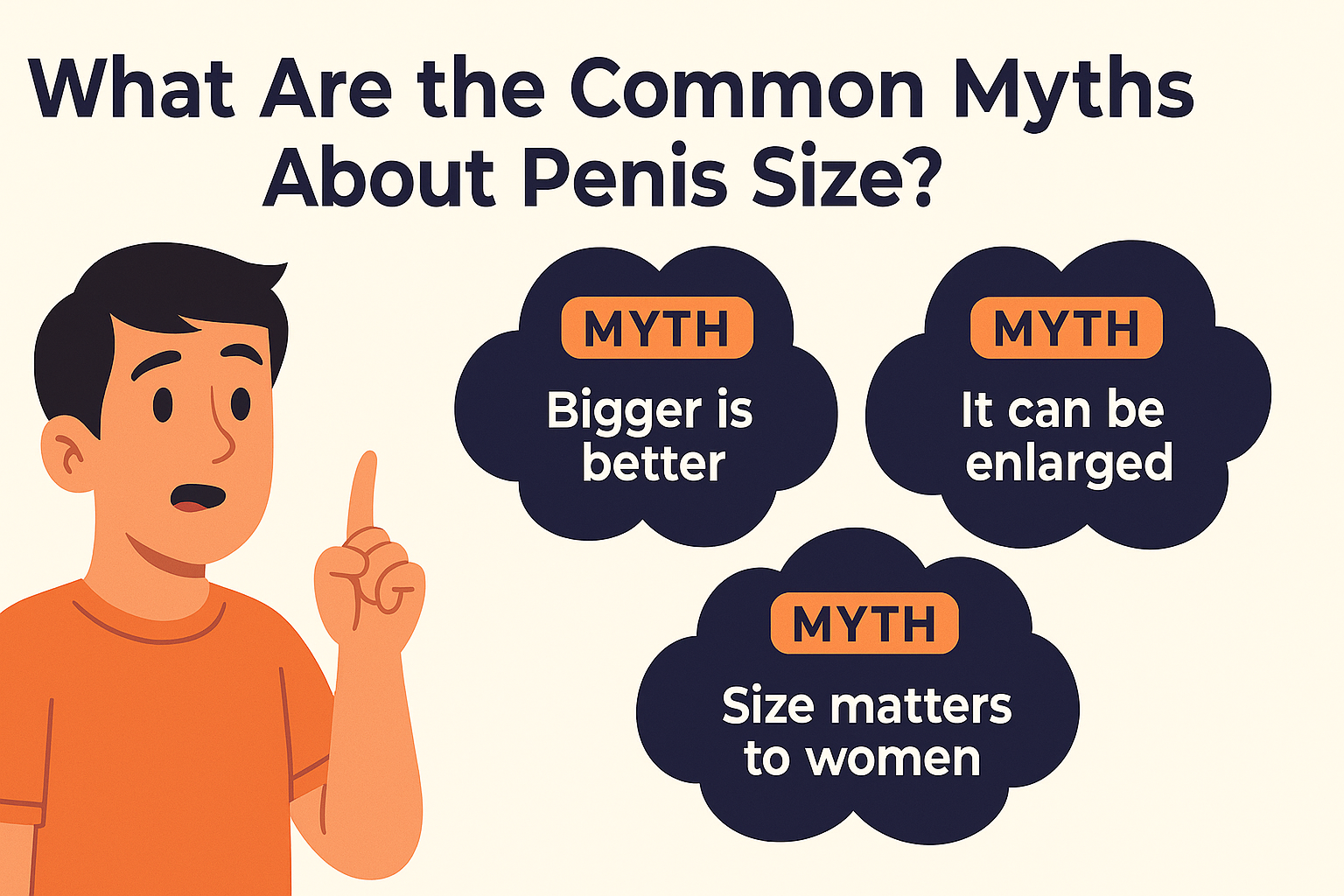
The most “common myths about penis size” include the beliefs that bigger is always better for partner pleasure, that size can be determined by other body parts, and that pills or creams can increase size, all of which are contradicted by scientific reality.
Myth 1: “Bigger Is Always Better for a Partner’s Pleasure”
The reality is that partner satisfaction is far more dependent on factors like skill, emotional connection, communication, and confidence than on penis size, especially as the most sensitive part of the vagina for most women is the outer third. Skill, intimacy, and a partner’s overall attentiveness are the primary drivers of mutually satisfying sexual experiences.
Anatomically, the G-spot and the majority of the clitoral nerves are located in the outer portion of the vaginal canal, meaning extreme length is often irrelevant for stimulating these highly sensitive areas.
This makes it clear that “bigger is better” is more myth than reality, which leads to the question does a larger penis improve sex.
Myth 2: “You Can Tell a Man’s Penis Size by His Shoe Size, Hands, or Nose”
The reality is that multiple scientific studies have conclusively found no statistical correlation between the size of a man’s penis and the size of his other body parts like feet, hands, or nose; this myth is a complete fabrication with no basis in human biology.
This is one of the oldest and most persistent myths, yet it has been repeatedly debunked by scientific research, particularly regarding the average length of the human penis.
Any perceived link between these body parts is purely coincidental and has no predictive value whatsoever.
Myth 3: “Certain Pills, Creams, or Foods Can Increase Penis Size”
The reality is that once puberty is complete, the anatomical structure of the penis is fixed, and no food, supplement, pill, or cream has been scientifically proven to permanently increase its size; these products are generally ineffective, unregulated, and potentially unsafe.
Penis size is determined by genetics and hormones during puberty and is set in adulthood. No topical or ingested product can alter this fundamental anatomical structure of the human penis.
Consumers should be wary of these products, as they are not only a waste of money but can sometimes contain harmful, unlisted ingredients that prey on insecurities related to a small penis.
Myth 4: “Penis Size Shrinks Significantly With Age”
The reality is that while erection quality can change over a lifetime due to vascular health, the actual anatomical size of the penis remains stable throughout most of adulthood, with any potential decrease in very late life being minimal and not noticeable for most men.
Factors like an increase in belly fat can make the penis appear smaller (by obscuring its base), but this does not change its actual anatomical length, which is often misunderstood in discussions about penile length.
Significant shrinking of the erect penis is not a normal part of the aging process, and any concerns about changes in erection quality should be discussed with a medical professional.
Common Penis Size Myths vs. Scientific Reality
| The myth | The Scientific Reality |
| Bigger is always better is a common misconception that is rooted in penis myths. | Skill, confidence, and connection are more important for partner pleasure. |
| You can tell size from hands/feet. | There is zero scientific correlation between penis size, including flaccid and erect measurements, and other body parts, emphasizing that size varies greatly. |
| Pills and creams can make the penis grow, but they often do not deliver on their promises. | No product can permanently increase anatomical size, including penis length, after puberty. |
| It shrinks a lot as you get older, particularly the erect penis, which can lead to concerns about size and potential issues like erectile dysfunction. | Actual penile size of the human penis is stable through adulthood; only erection quality may change. |
What Are the Key Takeaways for Debunking Common Myths About Penis Size?
The key takeaways for debunking “common myths about penis size” are to critically question the source of information, prioritize sexual function over physical form, understand that anatomical size is stable after puberty, and reject baseless physical correlations.
A Checklist for Identifying and Rejecting Myths
☐ Question the Source: Is the information from a scientific study or from pornography and marketing that perpetuates myths about penis growth, including those related to masturbation?
☐ Prioritize Function Over Form: The most satisfying sexual experiences are built on skill, not partner’s penis size.
☐ Understand That Size is Stable: Recognize that after puberty, your anatomical size, including both flaccid and erect penis measurements, is set.
☐ Reject Physical Correlations: Know that there is no link between penis size, whether flaccid or erect, and other body parts, as size varies significantly among individuals.
Conclusion
In conclusion, the most “common myths about penis size” are deeply ingrained cultural fictions, often perpetuated by marketing and unrealistic media, which stand in direct opposition to scientific fact and medical reality. By understanding the science and recognizing the sources of these falsehoods about penis myths, it becomes easier to reject them. By debunking these “myths about penis size,” men can free themselves from harmful, unrealistic standards, which in turn reduces anxiety and allows them to focus on what truly matters in sexual health and relationships.
True sexual confidence comes from knowledge and skill, not from chasing myths about size or being satisfied with their partner’s penis.