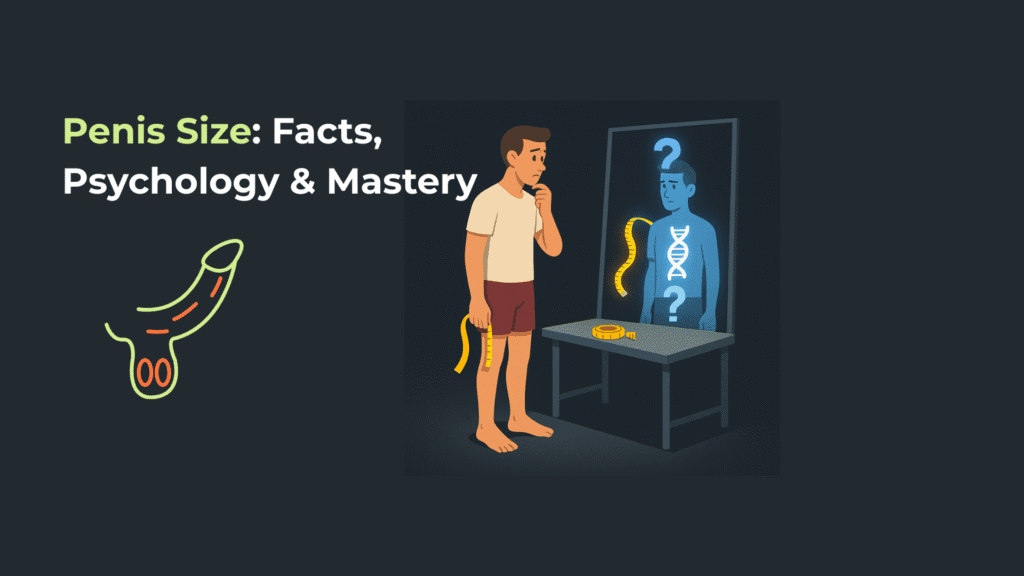
A comprehensive understanding of “penis size” requires analyzing three distinct pillars: the biological facts of its development and measurement, its profound psychological impact on confidence and self-esteem, and the actionable path to sexual mastery, where function consistently outweighs form.
Compare your measurement: Use the evidence-based penis size calculator to estimate a length or girth percentile from clinician-measured reference data.
“Penis size” is a topic of immense interest and anxiety, yet it remains clouded by misinformation, particularly from distorted portrayals in pornography and media. This guide provides a complete, evidence-based overview of “penis size,” covering the three critical pillars: the biological facts of its development, its profound psychological impact, and the path to mastering true sexual confidence.
Quick Answers to Common Questions About Penis Size (FAQ)
What is the average penis size?
Large clinician-measured reviews put average adult erect length at about 13–14 cm. The 2015 review reported 13.12 cm in length and 11.66 cm in girth; the 2023 review reported mean erect length of 13.93 cm. See the average penis size statistics page for centimetre and inch tables, sample sizes, percentiles and study limitations.
How is penis size measured correctly?
“Penis size” is measured correctly using the Bone-Pressed Erect Length (BPEL) method, where a firm ruler is pressed to the pubis bone and measured to the tip along the top side. Girth is measured with a flexible tape measure around the mid-shaft.
What causes penis size variation?
“Penis size” variation is caused by a combination of genetics (it is a polygenic trait like height) and the influence of hormones, primarily dihydrotestosterone (DHT) and testosterone, during critical growth windows in the womb and during puberty.
Can penis size be increased?
No, “penis size” cannot be permanently increased after puberty. The American Urological Association (AUA) does not endorse any pills, creams, or penis enlargement surgeries for cosmetic purposes, as they are unproven and carry significant risks.
Does penis size affect sexual satisfaction?
Scientific research shows “penis size” has a minor impact on sexual satisfaction for most partners. Factors like skill, emotional intimacy, and a partner’s confidence are consistently ranked as far more important for mutual pleasure.
What is a micropenis?
A micropenis is a rare, congenital medical disease, not a subjective feeling. It is clinically defined as an adult penis with a bone-pressed erect length of less than 7.5 cm (approx. 3 inches) and is caused by hormonal issues like hypogonadism during fetal development.
Does penis size matter to partners?
Research, such as a study in Psychology of Men & Masculinity, shows the vast majority of partners (over 85% in that study) are satisfied with their partner’s “penis size.” They consistently rate other factors like attentiveness and emotional connection as more critical for a good relationship.
Can anxiety about size cause dysfunction?
Yes, anxiety about “penis size” can cause real sexual dysfunction. The stress response releases catecholamines (adrenaline), which are vasoconstrictors that directly inhibit the blood flow required to achieve a firm erection, creating a negative feedback loop.
How do I build confidence regardless of size?
Building confidence regardless of “penis size” involves shifting your mental focus from anatomy to controllable skills. This means mastering functional abilities like erection quality and stamina, and focusing on your partner’s pleasure, which provides positive feedback and builds competence.
Pillar 1: The Biological Facts of Penis Size
How Is Penis Size Correctly Measured by Medical Standards?
Penis size” is correctly measured by medical standards using two distinct methods: Bone-Pressed Erect Length (BPEL) for length, and a mid-shaft circumference measurement for girth, both of which are designed to produce accurate and repeatable data.
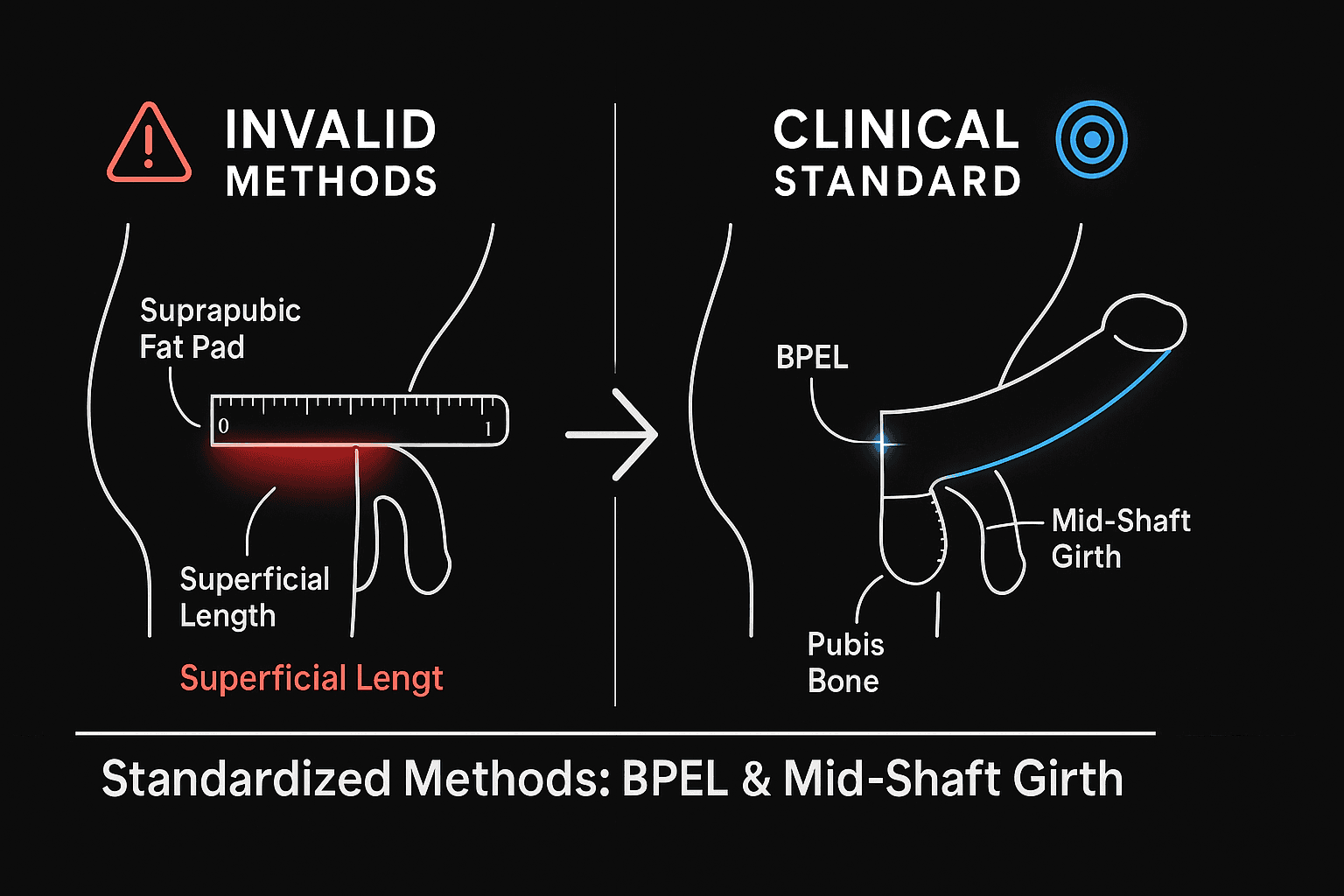
The BPEL technique requires a rigid ruler pressed firmly to the pubis bone to bypass the suprapubic fat pad, which can obscure 1–3 cm of length. Although BPEL is the gold standard in research, the European Association of Urology notes that clinical practices may also use stretched penile length (SPL).
Girth is measured using a flexible tape at the mid-shaft. The 2015 BJU International meta-analysis of over 15,500 men found the average erect penis length to be 13.12 cm (5.16 inches) and average girth to be 11.66 cm (4.59 inches).
Non-bone-pressed or ventral measurements are clinically invalid. A micropenis is defined as a bone-pressed erect length under 7.5 cm in adult males.
What Developmental Factors Influence Penis Size?
The developmental factors that influence “penis size” are primarily a combination of genetics, which provide the initial blueprint as a complex polygenic trait, and the actions of key hormones during critical growth windows in the womb and during puberty.
“Penis size” is a polygenic trait, meaning it results from the cumulative influence of many genes—similar to height. No single mutation or gene determines size.
Dihydrotestosterone (DHT), derived from testosterone, is the primary androgen responsible for male genital growth in utero, particularly from week 9 to the end of gestation. Estrogen regulates erectile tissue function and maintains the structural integrity of the corpus cavernosum.
Growth occurs during two distinct windows: prenatal development and puberty. During adolescence, especially between Tanner Stages 3 and 5, the final growth spurt takes place. Penis size stabilizes permanently by the end of puberty.
Comparison Table: Influencing Factors
| Influencing Factor | Specific Role in Determining Penis Size |
| Genetics | Provides the overall “blueprint” as a complex polygenic trait. |
| Androgens (Testosterone/DHT) | Act as the primary “growth signal” during fetal and pubertal stages. |
| Estrogen | Acts as a “regulator” ensuring proper structural formation. |
| Developmental Timing | Growth is concentrated in specific windows (fetal/puberty). |
Pillar 2: The Psychological Impact of Penis Size
How Does Penis Size Psychologically Affect Men?
“Penis size” psychologically affects men by becoming deeply intertwined with self-esteem and body image due to cultural pressures, which in turn creates a potent “negative feedback loop” of performance anxiety and can manifest as clinical conditions like Small Penis Syndrome.
The perceived link between “penis size” and masculinity is a social construct amplified by pornography, where depictions often show statistically abnormal sizes as the baseline. This distorts perception and erodes self-confidence.
Performance anxiety activates the sympathetic nervous system, releasing catecholamines (like adrenaline), which are vasoconstrictors. These chemicals actively inhibit the vasodilation needed to achieve an erection, thus causing erectile dysfunction even in physically healthy men.
Small Penis Syndrome, or Penile Dysmorphic Disorder (PDD), is a subtype of Body Dysmorphic Disorder. Despite average or even above-average size, men with PDD perceive their penis as deficient. Studies in the Journal of Sexual Medicine show over 85% of men with such concerns are within the statistically normal range.
Pillar 3: Function, Skill, and Confidence
What Are the Key Takeaways on the Topic of Penis Size?
The key takeaways on the topic of “penis size” are that its measurement must be standardized to be meaningful, its dimensions are determined early in life, its psychological impact is often its most significant effect, and that function and skill consistently outweigh anatomy in sexual contexts.
The Most Important Facts About Penis Size:
☑ Measurement Must Be Standardized: Only Bone-Pressed Erect Length (BPEL), which averages 13.12 cm, provides an accurate, medically accepted length measurement.
☑ Size is Determined Early: Genetics and hormones set your anatomical “penis size” before you reach early adulthood; it is not changeable thereafter.
☑ The Psychological Impact is Real: Anxiety about “penis size” is a significant mental health concern, with over 85% of concerned men having a normal-sized penis.
☑ Function and Skill Outweigh Anatomy: In the context of human sexual activity and satisfaction, what you do is far more important than your specific measurements.
Conclusion
In conclusion, “penis size” is a multifaceted topic best understood through three distinct pillars: the unchangeable biological facts that determine its physical nature, the powerful psychological impact it has on confidence and self-esteem, and the actionable path to mastery, which prioritizes function over form.
A factual understanding of the biology can dismantle the myths that fuel psychological distress, allowing men to shift their focus from anatomy to the trainable skills that truly enhance confidence and sexual performance.
At our clinic, we empower men by focusing on these trainable, functional skills to build unshakeable confidence. Knowledge is the ultimate tool for overcoming anxiety, and true sexual mastery is independent of size.
Table of Attributes for Penis Size
Key Attributes and Values for Penis Size
| Attribute | Value/Explanation |
| Average erect length | 13.12 cm (5.16 in) |
| Average erect girth | 11.66 cm (4.59 in) |
| Standard measurement | Bone-pressed erect length (BPEL) |
| Micropenis definition | <7.5 cm erect (adult male) |
| Growth windows | Fetal (9–20 weeks), Puberty (Tanner 3–5) |
| Key hormones | DHT, testosterone, estrogen |
| % of men dissatisfied | >50% express anxiety, but 85% are in normal range |