Which Hormones Influence Penis Size?
Medically Reviewed by: Dr. Julian Hayes, MD, Urology
The primary hormones that influence penis size are androgens—specifically testosterone and its more potent derivative dihydrotestosterone (DHT)—which act during critical developmental windows. This process is supported by growth hormone (GH), which regulates overall body maturation. While genes provide the blueprint, hormones are the construction workers that build and shape physical traits like penis size.
This guide explains the primary hormones influencing penis size. We will identify the key hormones, explain their specific roles, and describe when they are most active during human development.
Why Are Hormones the Primary Influence on Penis Size Development?
Hormones are the primary influence on penis size development because they act as powerful chemical messengers that bind to specific receptors in penile tissue, triggering the cellular growth and differentiation required during critical developmental windows.
Understanding Hormones as Chemical Messengers
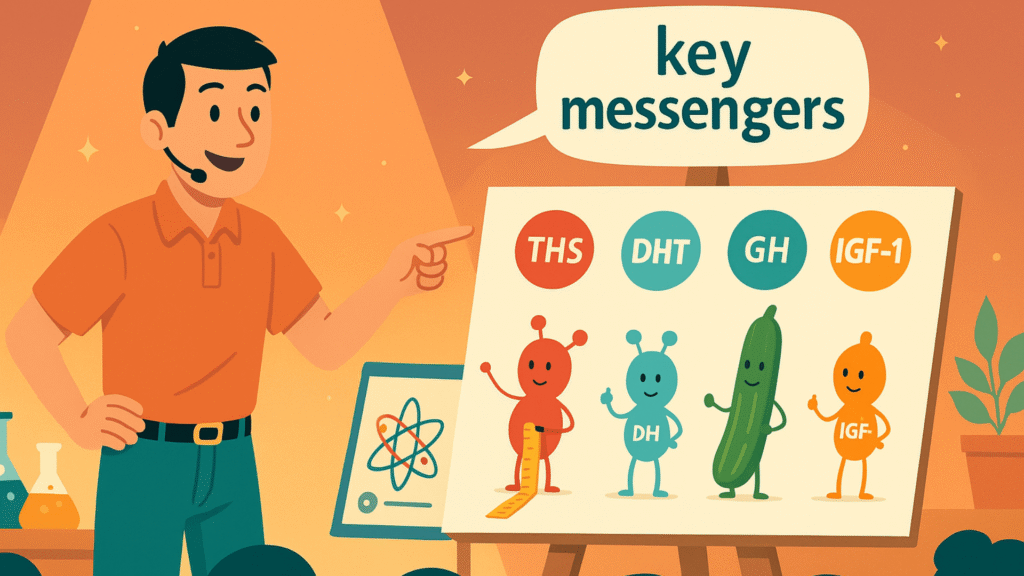
Hormones function as chemical messengers that travel through the bloodstream to instruct target tissues. Much like a key fits into a specific lock, a hormone only affects tissues with the correct receptors, ensuring its influence is targeted and precise.
The Concept of Androgen Receptors
The concept of androgen receptors is crucial, as penile tissue is rich in these receptors, which act as docking stations for male hormones. When testosterone or DHT binds to a receptor, it initiates a direct growth response in the cells. The sensitivity of these receptors, which is genetically determined, can be as important as the amount of hormone in the blood—explaining why two individuals with similar hormone levels may have different growth outcomes.
Critical Windows of Development
The influence of these hormones on penis size is most profound and largely limited to specific critical windows:
- Fetal period in the womb, where the penis forms and grows rapidly.
- Puberty, when the final adult size is reached.
Outside these windows, hormonal influence on size is minimal. The graph below illustrates these key periods of hormonal activity.
The Key Hormones Involved
The key hormones that influence penis size are the foundational androgen testosterone, its more potent derivative dihydrotestosterone (DHT), and supporting players like growth hormone (GH) and IGF-1.
Testosterone: The Foundational Male Sex Hormone
Testosterone, produced primarily in the testes, is the foundational male sex hormone responsible for initiating the development of the male reproductive system and secondary sexual characteristics, including setting the stage for penile growth. During puberty, testosterone levels can increase by up to 30 times, driving the final growth spurt of the penis.[1]
Dihydrotestosterone (DHT): The More Potent Androgen
DHT is a significantly more potent androgen, converted from testosterone by the enzyme 5-alpha reductase directly in target tissues. It is the primary hormone responsible for the external growth of the penis in the fetus. DHT is 3–10 times more potent than testosterone at the androgen receptor, making it the main driver of external genital development.[2]
Growth Hormone (GH) and IGF-1: The Supporting Players
While androgens are the primary drivers, GH and insulin-like growth factor 1 (IGF-1) promote overall body and tissue growth during childhood and puberty, working in concert with testosterone to facilitate final penile development.
Estrogen: A Surprising but Essential Role
Among these hormones, estrogen plays a surprising but essential role in penis development, helping to moderate and balance the effects of androgens for proper maturation.
Hormonal Comparison Table
| Hormone | Primary Role in Influencing Penis Size |
|---|---|
| Testosterone | Initiates male development and drives pubertal changes. |
| DHT | Potent form of testosterone that drives external genital growth, especially in the fetus. |
| Growth Hormone (GH) | Supports overall body and tissue growth, including during puberty. |
How Do These Hormones Influence Penis Size During Life Stages?
Hormones influence penis size during distinct life stages, with the most critical periods being fetal development and puberty.
During Fetal Development (First and Second Trimesters)
The fetal period is the most critical window. High fetal testosterone levels are converted to DHT, which drives the initial differentiation and growth of the penis from undifferentiated tissue.
During Infancy (“Mini-Puberty”)
In the first few months after birth, male infants experience a brief surge of testosterone—a “mini-puberty”—that causes minor but measurable penile growth.
During Puberty
Between ages 9–14, the penis undergoes its final growth spurt, driven by a sharp rise in testosterone and GH. This hormonal surge leads to noticeable changes in length, girth, and overall development, all of which are explained in how penis size changes during puberty.
Key Facts About Hormones and Penis Size
DHT is the Powerhouse: DHT is the most direct and potent hormone for external genital growth.
Timing is Everything: Hormonal influence is concentrated in the womb and during puberty.
It’s a Team of Hormones: Testosterone, DHT, GH, and IGF-1 work together for full development.
Receptors Are Crucial: Tissue sensitivity via androgen receptors determines hormonal effectiveness.
Frequently Asked Questions (FAQ)
Can low testosterone in adulthood make a penis smaller?
No. Adult testosterone levels affect libido and erectile function but do not change anatomical size after puberty.
Are there foods or supplements that can increase these hormones to grow a penis?
No. There is no scientific evidence that any food or supplement can alter the hormonal processes of fetal development or puberty to increase size.[3]
What is the HPG axis?
The Hypothalamic-Pituitary-Gonadal axis is the communication network between the brain (hypothalamus and pituitary) and the testes, regulating testosterone production. The diagram below shows how this feedback loop works.
Glossary of Key Terms
Androgen
Class of male sex hormones, including testosterone and DHT, responsible for male characteristics.
Dihydrotestosterone (DHT)
Potent testosterone derivative driving external male genital growth during fetal development.
5-alpha reductase
Enzyme converting testosterone to DHT in target tissues.
Androgen Receptor
Protein in cells acting as a docking station for androgens, triggering cellular response.
Hypothalamic-Pituitary-Gonadal (HPG) Axis
Hormonal feedback loop between the brain and gonads that regulates sex hormone production.
Conclusion
In conclusion, penis size is primarily determined by the actions of key hormones—especially DHT and testosterone—during the fetal period and puberty. This is a precisely timed cascade involving multiple hormones, receptor sensitivity, and coordinated growth signals.
At factbasedurology, our understanding of these intricate hormonal pathways informs our approach to male developmental health, reinforcing that penis growth is a normal, predetermined biological process shaped by endocrinology.
References
- Endocrine Society. (2018). Pubertal Development and Growth. Journal of Clinical Endocrinology & Metabolism.
- Wilson, J. D., George, F. W., & Griffin, J. E. (1981). The hormonal control of sexual development. Science, 211(4488), 1278-1284.
- Mayo Clinic Staff. (2022). Penis-enlargement products: Do they work?