
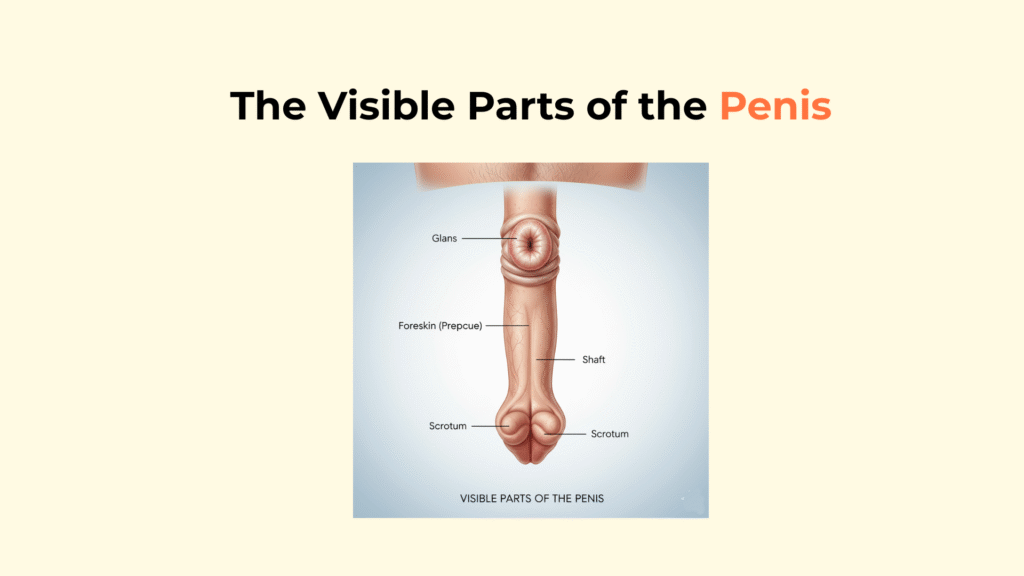
The Visible Parts of the Penis: A Labeled Guide to External Anatomy
The four main “visible parts of the penis” are the Shaft (the body), the Glans (the head), the Meatus (the opening at the tip), and, in uncircumcised males, the Foreskin (the protective covering).
While the penis is a familiar part of the body, understanding the correct names and functions of its visible parts is essential for health literacy and confident communication. Many people struggle to accurately describe potential issues to a doctor simply because they lack the correct terms for their external penis anatomy.
This guide provides a straightforward, labeled guide to the external penis anatomy. We will identify each visible part, explain its primary function, and discuss normal variations. Our goal is to demystify the body and provide you with precise language about the visible parts of the penis.
This guide offers a focused look at the visible external anatomy of the penis—including the shaft, glans, meatus, and foreskin. For a broader anatomical overview, refer to our complete penile anatomy breakdown.
Why Knowing the Visible Parts of Your Penis is Important
Knowing the “visible parts of your penis” is important because it improves health literacy for communicating with doctors, enables clearer conversations with sexual partners about pleasure, and demystifies your own body, which can reduce anxiety.
Using correct anatomical terms like “Frenulum” or “Glans” helps you accurately describe potential health issues to a physician, saving time and ensuring proper diagnosis. When you report a specific pain point or unusual change, precise language significantly aids in your health and care.
Clear language about the “visible parts of the penis” enables more confident and specific conversations with sexual partners about pleasure and comfort. Understanding the differences in sensation associated with the Shaft versus the Glans improves intimacy and mutual understanding.
Factual knowledge about penis anatomy helps normalize natural variations and reduces anxiety by replacing myths with facts. Learning the terms for the visible parts of the penis is a positive step toward feeling confident and informed about your own body.
What Are the Four Main Visible Structures of the Penis?
The four main “visible structures of the penis” are the Shaft (Corpus), the Glans (head), the Meatus (urethral opening), and the Foreskin (Prepuce) in uncircumcised males, each serving a distinct anatomical function.
The Shaft (Corpus): The Body of the Penis
The Shaft is the main, cylindrical body of the penis that connects the Glans to the rest of the body and houses the internal erectile tissues. The skin of the Shaft is typically hairless and uniquely loose, a design which allows it to accommodate significant changes in size during an erection. The Shaft contains the internal structures responsible for rigidity, which are covered in a more detailed Anatomy guide.
The Glans: The Head of the Penis
The Glans is the typically cone-shaped, highly sensitive end of the penis that functions as the primary site of sexual sensation. Among the visible parts, the Glans penis—often referred to as the head of the penis—is one of the most distinct structures. The Glans contains thousands of nerve endings, making it the epicenter of sexual pleasure.
The Glans contains thousands of nerve endings, making it the primary site for sexual sensitivity. For a deeper understanding, visit our page on the glans penis structure and sensory function.
The Meatus: The Urethral Opening
The Meatus is the slit-like opening located at the very tip of the Glans, which serves the dual function of expelling both Urine from the bladder and Semen during ejaculation. This opening is the external exit point of the Urethra. Ensuring the Meatus is kept clean is part of good genital Health.
The Meatus is the external opening of the urethra, serving both urinary and reproductive functions. Explore detailed visuals and variations of the urethral meatus and its role.
The Foreskin (Prepuce): The Protective Covering
The Foreskin, or Prepuce, is the retractable, double-layered sleeve of skin and mucous membrane that covers the Glans in uncircumcised males, serving both protective and sensory roles. Its primary function is to protect the sensitive Glans from friction and dryness when the penis is flaccid. Its inner layer is a mucous membrane, and the entire structure is rich in sensory nerves, contributing significantly to sexual sensation.
The Foreskin’s dual-layer design contributes to protection and sensitivity. Discover the full anatomy and physiology of the penile foreskin (prepuce).
What Other Key Visible Features of the Penis Should I Know?
Other key “visible features of the penis” that are important for Health and sensation include the Corona, the Frenulum, and the adjacent Scrotum.
The Corona: The Ridge of the Glans
The Corona is the rounded, raised border that separates the Glans from the Shaft, a distinct anatomical landmark whose prominence varies between individuals. It forms a ridge around the base of the head of the penis. Its shape and prominence differ greatly from person to person; for some, it is quite distinct, while for others, it is less noticeable.
The Frenulum: The Sensitive Band of Tissue
The Frenulum is the small, highly elastic band of tissue on the underside of the penis that connects the Foreskin to the Glans and is a key pleasure point due to its high concentration of nerve endings. This sensitive structure anchors the Foreskin and helps regulate its movement. Issues like a tight Frenulum can sometimes require medical attention.
A tight Frenulum can cause pain or restrict movement—often requiring evaluation. Learn about this and the anatomical features of the corona and frenulum.
The Scrotum: The Pouch Supporting the Testicles
The Scrotum is the pouch of skin that hangs below the penis, and while a separate structure, it is a key part of the visible parts of the penis area, with the critical function of holding the Testicles and regulating their temperature. This pouch keeps the Testicles at a temperature slightly cooler than the body, which is essential for optimal sperm production.
How Do the Visible Parts of the Penis Vary Between Individuals?
The “visible parts of the penis” vary significantly between individuals, with the most obvious difference being a circumcised versus uncircumcised state, alongside normal variations in color, vein prominence, and flaccid hang angle. These differences are completely normal and expected in Anatomy.
The Main Visual Difference: Circumcised vs. Uncircumcised
The main visual difference in penis anatomy is whether it is circumcised or uncircumcised; in a circumcised penis, the Glans is always exposed, while in an uncircumcised penis, the Foreskin covers the Glans when flaccid. The Foreskin retracts back over the Shaft during an Erection in uncircumcised males. Both states are considered normal and healthy.
Whether circumcised or uncircumcised, each state has distinct anatomical presentations. Compare features and health considerations in our circumcision comparison guide.
What Are Normal Variations in the Penis’s Visible Parts?
Normal variations in the penis’s “visible parts” are common and include differences in skin color, the prominence of veins on the Shaft, the natural hang angle when flaccid, and the specific shape of the Glans.
If you notice a sudden, painful, or severe curve, especially during an Erection, consult a doctor, as this could be a sign of a condition like Peyronie’s disease.
- Color: The penis and Scrotum can be a different shade (often darker) than the rest of the body’s skin due to higher concentrations of melanin, which is a common normal variation.
- Veins: The prominence of visible veins on the Shaft can vary significantly between individuals and with arousal. These are superficial veins and are a normal part of the Anatomy.
- Angle: The natural hang of the penis when flaccid (to the left, right, or center) is unique to each person.
- Shape of the Glans: The head of the penis can range from more pointed to more rounded.
A Checklist for Identifying the Visible Parts of the Penis
This simple, non-medical checklist helps you identify the “visible parts of the penis” on your own body, reinforcing the anatomical knowledge from this guide.
Quick Reference Table: The Visible Parts of the Penis
This quick reference table summarizes the main “visible parts of the penis” and their primary functions for easy review.
| Visible Part | Simple Description |
|---|---|
| Shaft | The main body of the penis. |
| Glans | The sensitive head or tip. |
| Meatus | The opening at the tip of the Glans (urethral opening). |
| Foreskin | The retractable skin covering the Glans (if uncircumcised). |
| Corona | The ridge of the glans separating the Glans and Shaft. |
| Frenulum | The sensitive tissue band on the underside. |
| Scrotum | The pouch that holds the Testicles. |
Conclusion
In conclusion, understanding the names and functions of the “visible parts of the penis” is a foundational element of men’s Health literacy, empowering individuals to have more confident and accurate conversations about their bodies with partners and medical professionals.
This simple knowledge of external penis anatomy replaces anxiety with factual understanding and improves health communication. Familiarity with your own Anatomy is a key step toward proactive health and body confidence.



One Response