Holmium laser enucleation of the prostate (HoLEP) is an endoscopic operation used to relieve obstruction caused by benign prostate enlargement and BPH. The operation separates enlarged prostate adenoma from the surrounding surgical tissue, moves the tissue into the bladder and removes it, leaving a wider channel for urine to pass through the prostate.
01. HoLEP: Indications, Technique and Treatment Role
What problem is HoLEP intended to treat?
HoLEP is used to relieve benign prostatic obstruction caused by enlarged adenomatous prostate tissue.
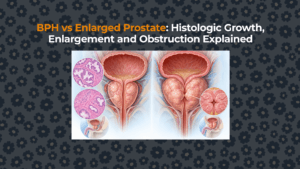
Understanding the operation starts with prostate health and prostate anatomy and function. The prostate lies below the bladder and surrounds the first portion of the urethra.
That portion of the urinary channel is the prostatic urethra. When prostate tissue grows inward, this channel can become compressed or distorted, increasing resistance to urinary flow.
Much of the benign enlargement associated with BPH develops within the transition zone of the prostate, which surrounds the proximal urethra.
This can contribute to:
- weak urinary flow;
- difficulty starting urination;
- straining;
- intermittent flow;
- incomplete bladder emptying;
- increasing residual urine;
- recurrent urinary retention;
- and other bothersome lower urinary tract symptoms.
HoLEP removes the obstructing adenoma while leaving the outer prostate tissue in place. It therefore does not remove the entire prostate.
What happens before and during HoLEP?
Before HoLEP, the urologist evaluates urinary symptoms, bladder emptying, prostate anatomy, prostate size, medical conditions and previous treatments.
The gland can be assessed using the methods described in how prostate volume is measured. Prostate volume helps determine which surgical approaches are technically appropriate.
Assessment may also include symptom scoring, urinalysis, urinary-flow testing, post-void residual measurement, PSA when appropriate, and selective cystoscopy or urodynamic testing.
For the wider treatment context, see BPH surgery and minimally invasive procedures.
02. How Is HoLEP Performed?
How does the holmium laser separate the prostate adenoma?
HoLEP is performed through the urethra, so there is no external abdominal incision.
An endoscopic instrument is passed through the urethra to the prostate. A holmium laser fiber is then used to identify and develop the tissue plane between the enlarged adenoma and the surrounding prostate.
The anatomical boundaries of the gland are discussed further in the prostate capsule anatomy guide.
What happens to the prostate tissue after it is enucleated?
After one or more portions of the adenoma have been separated, the tissue is moved into the bladder.
The pieces are usually too large to remove intact through the endoscopic instrument, so a device called a morcellator is used.
Under direct endoscopic vision, the morcellator breaks the enucleated tissue into smaller fragments and removes them from the bladder.
Which anatomy, prostate size or disease factors affect HoLEP?
A major feature of HoLEP is its ability to treat a broad range of prostate sizes, including large glands.
That differs from some other procedures whose evidence or technical use is more closely tied to particular prostate-volume ranges.
Relevant treatment factors include:
- overall prostate volume;
- amount and distribution of adenomatous tissue;
- median-lobe enlargement;
- intravesical prostatic protrusion;
- history of urinary retention;
- bladder stones;
- bladder contractility;
- previous urinary surgery;
- bleeding and anticoagulation considerations;
- and surgeon experience.
The technical learning curve is particularly important in HoLEP because successful enucleation and safe morcellation require specific endoscopic expertise.
What are the expected urinary outcomes after HoLEP?
HoLEP can substantially improve urinary symptom scores, maximum urinary flow and bladder emptying when benign prostatic obstruction is the major cause of the problem.
Comparative evidence shows urinary outcomes broadly comparable with TURP, with strong durability over long-term follow-up.
Some studies also report advantages such as reduced blood loss, shorter catheterization or shorter hospitalization, although outcomes depend on patient characteristics and the operating center.
03. HoLEP: Outcomes, Recovery and Procedure-Specific Trade-Offs
What does recovery after HoLEP usually involve?
A urinary catheter is commonly placed after HoLEP so urine can drain while swelling and the surgical cavity begin to settle.
Catheter duration and hospital stay vary according to prostate size, bleeding, medical condition, local practice and the patient’s ability to urinate after catheter removal.
Temporary postoperative effects may include:
- blood or small clots in the urine;
- burning with urination;
- urgency;
- frequency;
- temporary urinary leakage;
- pelvic or urethral discomfort;
- and temporary difficulty controlling urine.
Why can temporary urinary leakage occur after HoLEP?
Before surgery, the bladder and outlet may have adapted to years of increased resistance. After the obstructing adenoma is removed, the pressure relationships at the outlet change immediately.
Temporary leakage can also occur while the urinary sphincter and pelvic floor adapt after endoscopic manipulation.
Short-term leakage should therefore be distinguished from persistent urinary incontinence, which requires separate clinical evaluation.
Which urinary or sexual effects should be discussed before HoLEP?
Potential complications include bleeding, infection, temporary retention, urethral narrowing, bladder-neck narrowing and urinary incontinence.
Ejaculatory change is also common after standard HoLEP because tissue is removed around the bladder outlet and prostatic urethra.
Many men continue to experience orgasm but produce little or no visible semen through the penis after surgery.
Ejaculation and erection are separate outcomes. A change in semen direction or volume does not automatically mean erectile dysfunction.
04. Who Is Most Likely to Be Considered for HoLEP?
How does HoLEP compare with TURP?
HoLEP and TURP both relieve benign prostatic obstruction by removing tissue, but they do so differently.
| Feature | HoLEP | TURP |
|---|---|---|
| Basic technique | Enucleates the adenoma along an anatomical plane and removes the tissue through morcellation. | Progressively resects obstructing tissue using an electrosurgical loop. |
| Prostate size | Can be used across a broad range of prostate sizes, including large glands. | Conventionally used most often for prostates around 30–80 mL. |
| Urinary outcomes | Strong symptom, flow and emptying improvement. | Strong symptom, flow and emptying improvement. |
| Durability | Strong long-term durability. | Strong long-term clinical experience. |
| Bleeding profile | Often favorable because the laser provides simultaneous cutting and coagulation. | Depends on technique, prostate size and patient factors. |
| Ejaculation | Frequently altered after standard HoLEP. | Frequently altered after conventional TURP. |
| Technical requirements | Requires specific expertise in enucleation and morcellation. | Long-established transurethral resection technique. |
For the preceding procedure in this treatment pathway, see TURP for BPH.
When may HoLEP be unsuitable or require additional evaluation?
HoLEP may not be appropriate when urinary symptoms are not primarily caused by prostate-related outlet obstruction, when operative or anesthetic risk is unacceptable, when urethral anatomy prevents safe endoscopic access or when another treatment better matches the patient’s goals.
A large prostate alone does not prove that surgery will improve urinary function.
The relationship between prostate growth, enlargement, obstruction, symptoms and treatment is explained in the BPH and enlarged prostate guide.
Weak bladder contraction is particularly important. Removing the adenoma reduces outlet resistance, but it does not directly restore a poorly contracting detrusor muscle.
What procedure comes next in the BPH treatment series?
HoLEP removes prostate tissue. UroLift, or prostatic urethral lift, uses a very different approach by retracting prostate tissue away from the urethra rather than cutting or enucleating it.
That page is intentionally left unlinked here until its FBU page is published.
Summary
- HoLEP is an endoscopic operation used to relieve benign prostatic obstruction.
- Benign prostate enlargement commonly develops around the transition zone close to the prostatic urethra.
- HoLEP separates the adenoma from surrounding prostate tissue along an anatomical surgical plane.
- The enucleated tissue is moved into the bladder and removed using a morcellator.
- HoLEP can treat a broad range of prostate volumes, including large glands.
- Urinary flow, symptoms and bladder emptying can improve substantially when obstruction is the main problem.
- Recovery commonly involves temporary catheterization, urinary irritation and sometimes temporary leakage.
- Ejaculatory change is common after standard HoLEP.
- Surgeon experience is particularly important because both enucleation and morcellation require specialized technique.
- Prostate size alone cannot determine whether HoLEP is needed or predict the patient’s outcome.
Educational disclaimer: This article provides general medical education and does not recommend HoLEP or another surgical procedure for an individual. Procedure selection requires evaluation of urinary symptoms, prostate anatomy, bladder function, medical risk and treatment priorities by a qualified urologist.
Explore the Prostate and BPH Pathway
To understand the anatomy and disease pathway behind HoLEP, start with Prostate Health, continue through Prostate Anatomy and Function, and review BPH and Enlarged Prostate.
For the wider procedural pathway, see BPH Surgery and Minimally Invasive Procedures.
Evidence Sources
- European Association of Urology. Management of Non-neurogenic Male LUTS: Disease Management.
- National Institute of Diabetes and Digestive and Kidney Diseases. Enlarged Prostate (Benign Prostatic Hyperplasia).