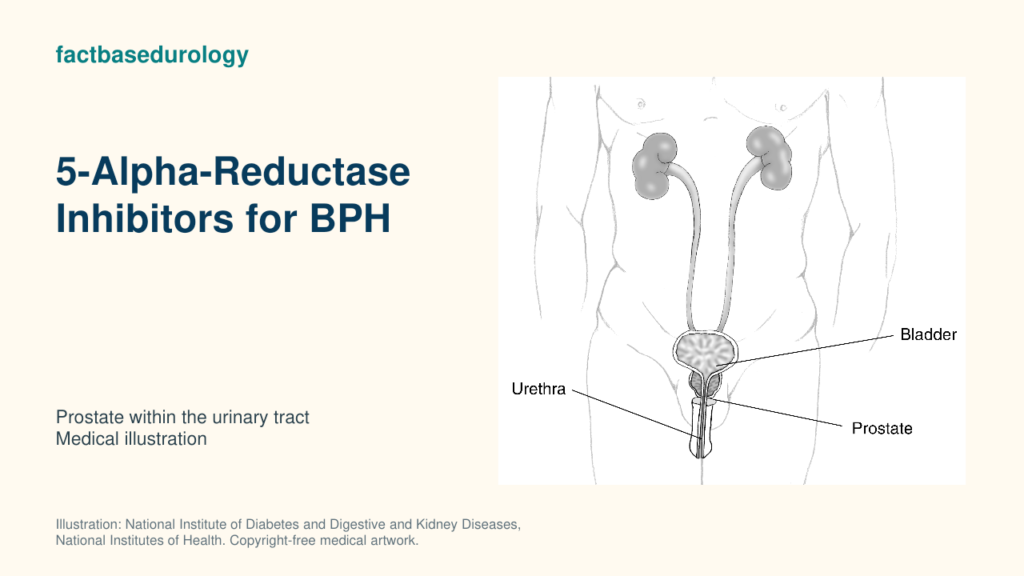
Finasteride and dutasteride reduce DHT production, gradually shrink susceptible enlarged prostates and lower BPH progression risk in selected men; clinical benefits take months and PSA interpretation changes.

01. 5-Alpha-Reductase Inhibitors: Mechanism and Role in BPH
Finasteride and dutasteride inhibit testosterone conversion to DHT, gradually reduce susceptible enlarged prostate tissue and lower BPH progression risk in appropriately selected men.
What target or pathway do 5-alpha-reductase inhibitors act on?
Five-alpha-reductase inhibitors block the enzyme that converts testosterone to DHT, reducing androgen stimulation of prostate tissue rather than providing rapid muscle relaxation. Finasteride mainly inhibits type 2 5-alpha-reductase; dutasteride inhibits types 1 and 2. Lower intraprostatic DHT promotes gradual regression of androgen-dependent tissue rather than immediate smooth-muscle relaxation.
Which prostate or urinary outcomes can 5-alpha-reductase inhibitors change?
In men with LUTS and prostate enlargement, 5-ARIs can reduce prostate volume, improve symptoms and modestly increase peak urinary flow. After two to four years, EAU evidence summaries report IPSS improvement of about 15–30% and Qmax increases of roughly 1.5–2.0 mL/s. Unlike alpha blockers, they also reduce long-term acute urinary retention and BPH-related surgery risk. The BPH medication overview explains why rapid symptom relief and progression prevention are separate treatment goals.
02. How Do 5-Alpha-Reductase Inhibitors Work for BPH?
Five-alpha-reductase inhibitors improve BPH outcomes over months as DHT suppression leads to gradual prostate-volume reduction; early symptom response is slower than with alpha blockers.
How quickly can 5-alpha-reductase inhibitors affect symptoms or measurements?
Five-alpha-reductase inhibitors require months for meaningful BPH symptom benefit, with prostate shrinkage and PSA reduction developing over approximately six to twelve months. Meaningful symptom benefit often requires at least three to six months, and prostate-volume reduction is generally assessed over six to twelve months. The effect depends on continuing therapy; prostate growth and PSA may rise again after discontinuation.
| Expected change | Typical time frame | Important limitation |
|---|---|---|
| DHT suppression | Begins early after treatment starts | Biochemical change does not equal immediate symptom relief |
| PSA reduction | Approximately 50% by 6–12 months | A new baseline is needed; a later rise remains clinically important |
| Prostate-volume reduction | Approximately 18–28% by 6–12 months | Average response; smaller glands generally gain less |
| LUTS and Qmax improvement | Gradual over months | Usually slower than an alpha blocker |
| Lower retention/surgery risk | Demonstrated with long-term treatment | Not protection from every episode or an alternative to urgent care |
Which patients are most likely to be considered for 5-alpha-reductase inhibitors?
Five-alpha-reductase inhibitors are considered for BPH-associated symptoms with demonstrable enlargement or increased progression risk; benefit is limited when the prostate is not enlarged. The EAU gives prostate volume above 40 mL as an example; the AUA uses enlargement shown by volume above 30 g, PSA above 1.5 ng/mL or palpable enlargement as selection evidence. Thresholds guide rather than replace clinical judgment, and PSA must first be interpreted in its diagnostic context.
Men who need fast relief may receive an alpha blocker initially, with the 5-ARI providing slower disease modification. The previous treatment page on terazosin illustrates the opposite profile: faster smooth-muscle relaxation without prostate shrinkage or long-term progression reduction.
03. 5-Alpha-Reductase Inhibitors: Benefits, Adverse Effects and Treatment Selection
Five-alpha-reductase inhibitors reduce prostate growth and progression risk but can affect sexual function, breast symptoms and PSA interpretation.
What adverse effects are most relevant to men using 5-alpha-reductase inhibitors?
Reduced libido, erectile dysfunction and ejaculatory dysfunction are the most relevant adverse effects. Breast tenderness or enlargement occurs in about 1–2% in EAU evidence summaries. Mood changes have also been reported; new depression or suicidal thoughts require prompt medical contact. A breast lump, nipple discharge or persistent breast change needs assessment rather than being assumed to be a medication effect.
Trials and prevention studies identified a small increase in diagnoses of high-grade prostate cancer even as total prostate-cancer diagnoses fell. Regulators added warnings, but a causal increase in lethal cancer has not been established. These medicines are not prescribed as a substitute for prostate-cancer evaluation.
How can 5-alpha-reductase inhibitors affect sexual or reproductive function?
Reduced sexual desire, erection difficulty and lower ejaculate volume can occur during treatment. Semen parameters may change, particularly in men with pre-existing fertility impairment, and often improve after discontinuation. Finasteride and dutasteride should not be handled as crushed or leaking products by someone who is or may be pregnant because exposure to a male fetus is a concern; product-specific instructions should be followed.
04. When Are 5-Alpha-Reductase Inhibitors Considered or Avoided?
Five-alpha-reductase inhibitors are considered when BPH-related enlargement and progression risk justify slow treatment; drug-specific contraindications, reproductive plans and PSA monitoring affect selection.
How do 5-alpha-reductase inhibitors compare with other treatments in the same pathway?
Five-alpha-reductase inhibitors act more slowly than alpha blockers but shrink enlarged prostate tissue and reduce progression risk; combined treatment can address both mechanisms in selected men. The individual finasteride for BPH guide addresses its dosing, PSA and adverse-effect profile, while the dutasteride for BPH guide covers dual-enzyme inhibition and drug-specific considerations. Average class efficacy does not mean the drugs are interchangeable for every patient.
Alpha blockers act faster but do not shrink the gland or reduce progression risk. Combination therapy may offer both early symptom relief and long-term risk reduction in men with bothersome LUTS and enlargement, at the cost of more adverse effects. When complications, severe obstruction or inadequate medical response make medication insufficient, procedural treatment for BPH may be more appropriate.
When should response, safety or treatment choice be reassessed?
Five-alpha-reductase inhibitor response is reviewed over months using symptoms, adverse effects and relevant prostate measurements, while PSA is interpreted against the treatment-adjusted baseline. A new PSA baseline is commonly established after six to twelve months. A confirmed rise from nadir, failure of PSA to suppress as expected, worsening symptoms or new examination findings requires review rather than reassurance based on medication use alone.
| Reassessment finding | Possible meaning | Clinical response |
|---|---|---|
| No symptom benefit after an adequate trial | Small prostate, non-prostatic LUTS, advanced obstruction or poor adherence | Recheck diagnosis, prostate size, emptying, goals and adherence |
| PSA does not fall as expected | Variable biology, nonadherence, inflammation or cancer | Repeat/interpret in context and evaluate persistent concern |
| Confirmed PSA rise from nadir | Not explained by expected medication effect | Investigate rather than simply applying a correction factor |
| Sexual or breast adverse effects | Treatment burden may outweigh benefit | Discuss continuation, alternatives and red flags |
| Retention, infection, stones or kidney effects | Complicated disease or insufficient control | Prompt urologic reassessment |
These decisions belong within the broader BPH assessment and management pathway, where symptoms, objective enlargement, obstruction, bladder function and complications are evaluated separately.
Summary
- Finasteride and dutasteride reduce DHT and gradually shrink susceptible enlarged prostate tissue.
- Average prostate-volume reduction is about 18–28%, and PSA falls about 50% after six to twelve months.
- Long-term therapy can reduce acute urinary retention and BPH-related surgery risk in appropriately selected men.
- Benefits are slow and are most relevant when enlargement or progression risk is demonstrated.
- Sexual adverse effects, breast symptoms, mood changes and altered PSA interpretation require counselling and follow-up.
Educational disclaimer: This article provides general medical education. It does not determine whether a 5-alpha-reductase inhibitor is suitable or provide an individual treatment plan.
Watch: BPH medicines: alpha blockers, 5-ARIs and tadalafil
FactBasedUrology compares BPH medicines: alpha blockers, 5-ARIs and tadalafil in an educational video that expands the treatment context of this guide.
Evidence Sources
- European Association of Urology. Management of Non-neurogenic Male LUTS: Disease Management.
- American Urological Association. Benign Prostatic Hyperplasia Guideline.
- U.S. National Library of Medicine DailyMed. Finasteride prescribing information.
- U.S. National Library of Medicine DailyMed. Dutasteride prescribing information.