Prostate Health › BPH Evaluation
What Is the IPSS? How the International Prostate Symptom Score Measures Male LUTS
The International Prostate Symptom Score (IPSS) is a short questionnaire used to record the severity of lower urinary tract symptoms (LUTS) in men. It converts seven symptom answers into a score from 0 to 35 and records urinary quality-of-life impact separately.
The IPSS helps a patient and clinician describe symptoms consistently, identify whether storage or voiding symptoms are prominent, and compare symptoms over time. Despite its name, it is not a test of prostate size, prostate tissue, urine flow or bladder outlet obstruction.
The IPSS measures how often a man experienced seven urinary symptoms during the previous month: incomplete emptying, frequency, intermittency, urgency, weak stream, straining and nocturia. Each symptom receives 0–5 points. The total is commonly grouped as 0 (no reported symptoms), 1–7 (mild), 8–19 (moderate) or 20–35 (severe). A separate quality-of-life question is scored from 0 to 6 and is not added to the 35-point symptom total.
The score is one part of a broader BPH and male LUTS diagnostic evaluation. A clinician interprets it alongside the history, examination and selected tests—not as a diagnosis by itself.
01. IPSS Measurement, Calculation and Interpretation
How is the IPSS measured or calculated?
The patient answers seven questions about urinary symptoms experienced during the preceding month. Six questions ask how often a symptom occurred; the nocturia question asks how many times the patient typically got up to urinate after going to bed. Each answer is assigned a value from 0 to 5.
The seven symptom values are added:
IPSS symptom total = incomplete emptying + frequency + intermittency + urgency + weak stream + straining + nocturia
The lowest possible symptom score is 0 and the highest is 35. A separate eighth question asks how the person would feel if the current urinary condition continued for the rest of life. This quality-of-life response runs from 0, indicating the most favorable response, to 6, indicating the least favorable response. It should be recorded beside the symptom total rather than added to it.
Which thresholds and scoring rules are used for the IPSS?
| IPSS symptom total | Common description | Clinical meaning |
|---|---|---|
| 0 | No symptoms reported | None of the seven symptoms was reported within the questionnaire period. |
| 1–7 | Mild symptoms | Symptoms are present but score within the mild range. |
| 8–19 | Moderate symptoms | Symptoms occur more often or across several items; bother and clinical context guide management. |
| 20–35 | Severe symptoms | The reported symptom burden is high, but the cause and physiologic severity still require assessment. |
These categories describe symptom burden; they are not disease stages. A score of 20 does not mean the prostate is a particular size, and it does not establish a particular degree of obstruction. Similarly, a low score does not rule out significant urinary retention or another clinically important condition.
02. What Does the IPSS Measure?
The IPSS is a patient-reported measure of male LUTS. It captures four voiding symptoms—intermittency, weak stream, straining and a sense of incomplete emptying—and three storage-related symptoms—frequency, urgency and nocturia. It is useful because it gives the patient’s experience a consistent numerical format.
What does a higher or lower IPSS value mean?
A higher total means that the seven included symptoms were reported more frequently during the preceding month. A lower total means they were reported less frequently. The score does not show which symptom is most troublesome unless the individual answers are also reviewed.
Two men can therefore have the same total but different clinical patterns. One might mainly report urgency and frequency, while another mainly reports weak stream and straining. Reviewing the item pattern helps the clinician decide whether a bladder diary, urine-flow assessment, post-void residual measurement or another evaluation would add useful information.
Symptom severity and quality-of-life impact also do not always move together. Nocturia twice each night may be tolerable to one person and highly disruptive to another. Treatment decisions should reflect both the measured symptoms and what matters to the patient.
Which factors can change or distort the IPSS?
Because the IPSS depends on recall and personal interpretation, its result can vary. Factors that may change the answers include:
- fluid intake, caffeine or alcohol use during the month;
- diuretic, decongestant, antihistamine or other medication use;
- a urinary infection or a short-lived worsening of symptoms;
- constipation, uncontrolled diabetes, sleep disturbance or reduced mobility;
- differences in language, literacy, questionnaire explanation or assistance;
- memory of symptom frequency and the conditions present when the form is completed.
The standard questions should be completed using a validated version in a language the patient understands. If reading the form is difficult, the clinician can consider an appropriately validated alternative or assisted method while avoiding answers that are inadvertently suggested by the person administering it.
03. IPSS Reference Values, Modifiers and Limitations
How should the IPSS be interpreted alongside other prostate findings?
The IPSS belongs beside—not in place of—the clinical evaluation. A clinician may compare it with the most bothersome symptom, urinary history, medication list, urinalysis, physical examination and, when indicated, measurements such as urine flow or post-void residual.
The following terms describe different findings and should not be treated as interchangeable:
| Term | What it describes | Can the IPSS establish it? |
|---|---|---|
| Lower urinary tract symptoms (LUTS) | A person’s storage, voiding and post-micturition symptoms. | It quantifies seven selected LUTS, but not every LUTS. |
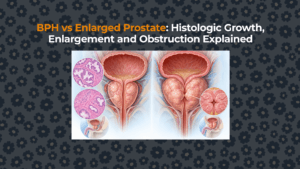
| Histologic BPH | Noncancerous proliferation of prostate stromal and epithelial tissue identified microscopically. | No. |
| Benign prostate enlargement (BPE) | An increase in prostate size considered benign. | No; the questionnaire does not measure volume. |
| Benign prostatic obstruction (BPO) | Bladder outlet obstruction attributed to benign prostate tissue or configuration. | No; symptoms alone do not demonstrate obstruction. |
These findings may overlap in one patient, but the overlap is not automatic. A man can have an enlarged prostate with few symptoms, bothersome LUTS without proven obstruction, or obstruction whose severity is not accurately reflected by the symptom score.
What can the IPSS not diagnose or prove by itself?
The IPSS cannot by itself:
- diagnose histologic BPH;
- measure prostate size or show that the prostate is enlarged;
- confirm benign prostatic obstruction or quantify bladder outlet obstruction;
- measure urine flow, bladder pressure or urine remaining after voiding;
- exclude prostate cancer, prostatitis, urinary infection, urethral stricture or bladder disease;
- fully evaluate incontinence, bladder pain or every post-micturition symptom;
- identify why nocturia occurs.
The EAU notes that the IPSS does not assess incontinence, post-micturition symptoms or the bother caused by each individual symptom. A bladder diary can add real-time information about timing and volume, especially when nocturia or frequency is important.
Other possible contributors to LUTS include overactive bladder, urinary tract infection, prostatitis, urethral narrowing, bladder stones, neurologic disease, weak bladder contraction, medication effects, diabetes and high nighttime urine production. The score shows the reported symptom burden, not which of these mechanisms is responsible. Broader explanations of urinary symptoms belong in FBU’s Urinary Health section.
Urgent assessment is appropriate if you cannot urinate, have severe lower-abdominal pain, visible blood in the urine, or painful/frequent urination with fever or chills. New weakness, numbness around the groin, or loss of bladder control also requires urgent medical evaluation.
04. How Does the IPSS Affect the Next Clinical Decision?
When should the IPSS be repeated, confirmed or combined with another test?
The score is commonly completed during the initial assessment of male LUTS and repeated during or after treatment. Repeating the same validated questionnaire allows the clinician to compare the patient’s reported symptoms over time. The timing depends on the clinical situation, the treatment used and whether symptoms are stable or changing.
A repeat result should be interpreted as a trend rather than an isolated number. A change may reflect treatment, natural fluctuation, medication changes, fluid habits or a temporary condition. Research has proposed thresholds for a patient-noticeable change, but estimates differ across populations; the numerical change should therefore be considered with the patient’s own report of benefit or worsening.
Additional assessment may be needed when symptoms are bothersome, the cause is uncertain, the score conflicts with other findings, treatment has not helped, or an invasive treatment is being considered. Depending on the presentation, the clinician may use a bladder diary, urinalysis, prostate assessment, PSA after shared discussion, uroflowmetry, post-void residual measurement, imaging, cystoscopy or selective urodynamic testing.
How does the IPSS change the next step in BPH care?
The score helps structure shared decision-making. Mild symptoms with little bother may support monitoring and conservative measures when there are no concerning findings. Moderate or severe symptoms, substantial quality-of-life impact, complications or treatment failure may justify a fuller evaluation and discussion of medication or procedures.
There is no single IPSS number that automatically selects a drug or makes surgery necessary. Treatment choices also depend on symptom pattern, prostate size and configuration, flow and emptying findings, complication risk, other health conditions, sexual priorities, medication effects and patient preference.
After the questionnaire, the next mapped examination topic is the digital rectal exam of the prostate, which provides physical findings that the IPSS cannot measure.
Summary
- The IPSS is an eight-item questionnaire: seven symptom questions plus one separate urinary quality-of-life question.
- The seven symptoms produce a 0–35 total, commonly grouped as none, mild, moderate or severe.
- It measures patient-reported male LUTS and can help monitor change over time.
- It does not diagnose BPH, measure prostate enlargement or prove benign prostatic obstruction.
- The individual symptom pattern, quality-of-life impact, examination and appropriate tests matter more than the total alone.
- Urgent symptoms should receive medical assessment regardless of the IPSS result.
Evidence Sources
- European Association of Urology. Management of Non-neurogenic Male LUTS: Diagnostic Evaluation.
- NIDDK. BPH and Male LUTS: Intersection Between Pathology and Disease.
- National Institute of Diabetes and Digestive and Kidney Diseases. Enlarged Prostate (Benign Prostatic Hyperplasia).
- Barry MJ, Fowler FJ Jr, O’Leary MP, et al. The American Urological Association symptom index for benign prostatic hyperplasia. Journal of Urology. 1992;148(5):1549–1557.