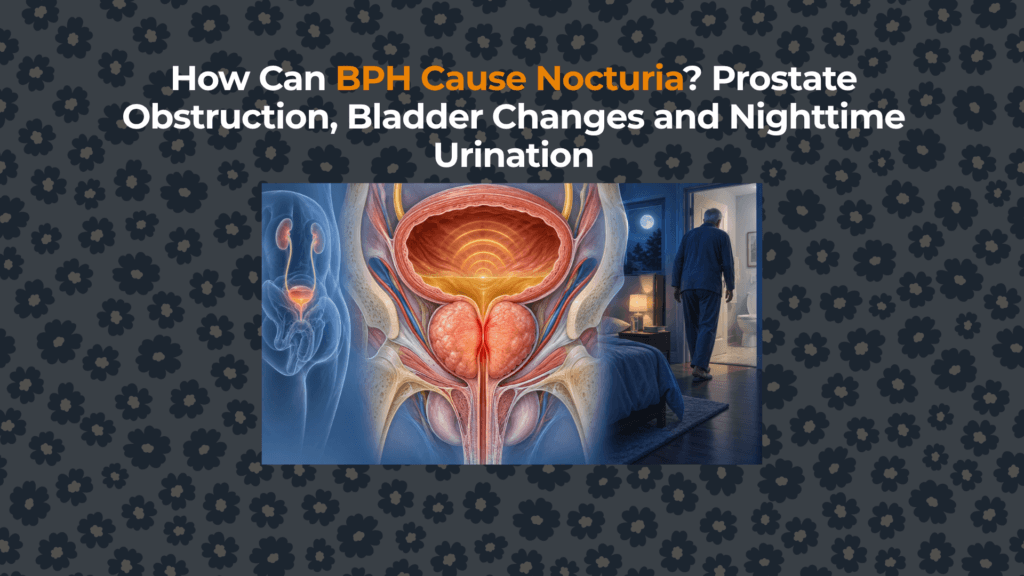
How Can BPH Cause Nocturia? Prostate Obstruction, Bladder Changes and Nighttime Urination
Nocturia means waking during the main sleep period to pass urine, with sleep before and after each void. BPH can contribute—but the mechanism is usually reduced nighttime storage or incomplete emptying, not necessarily excess urine production.
The prostate can affect capacity without creating more urine
The prostate surrounds the urethra below the bladder. Transition-zone growth and smooth-muscle tone can narrow the outlet. If voiding leaves urine behind, less capacity remains before the next urge. Longstanding resistance may also alter detrusor behavior, creating urgency or smaller functional voided volumes. These mechanisms connect the BPH disease hub to nocturia.
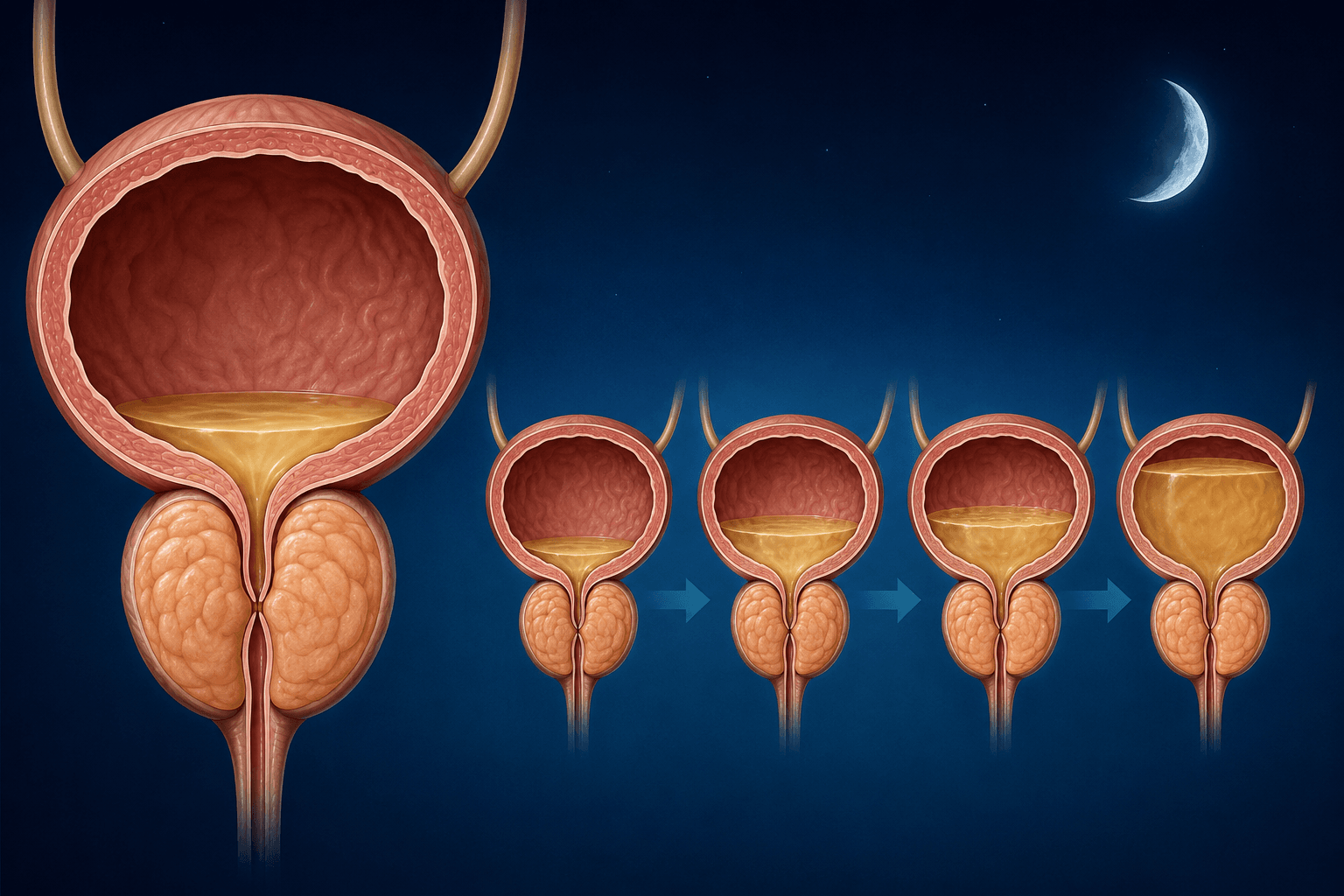
Four prostate-linked routes
| Route | Entity relationship | Diary/test clue | Evidence boundary |
|---|---|---|---|
| Incomplete emptying | Outlet resistance → residual urine → less available capacity | Elevated PVR plus small subsequent voids | PVR can also reflect weak detrusor contraction |
| Reduced functional capacity | Earlier urgency at lower volume | Repeated low nighttime voided volumes | Not specific to BPH |
| Detrusor overactivity | Outlet stress may coexist with involuntary bladder contractions | Urgency/frequency; selected urodynamics | Symptoms do not prove overactivity |
| Sleep fragmentation | Urinary urge may wake the patient—or waking may prompt a convenience void | Very small voids after awakenings | The sequence cannot be inferred from count alone |
Nocturia has three major mechanism families
A prostate-only explanation is often incomplete. The clinically useful question is whether the night produces too much urine, the bladder stores too little, or sleep breaks first. More than one mechanism can coexist.
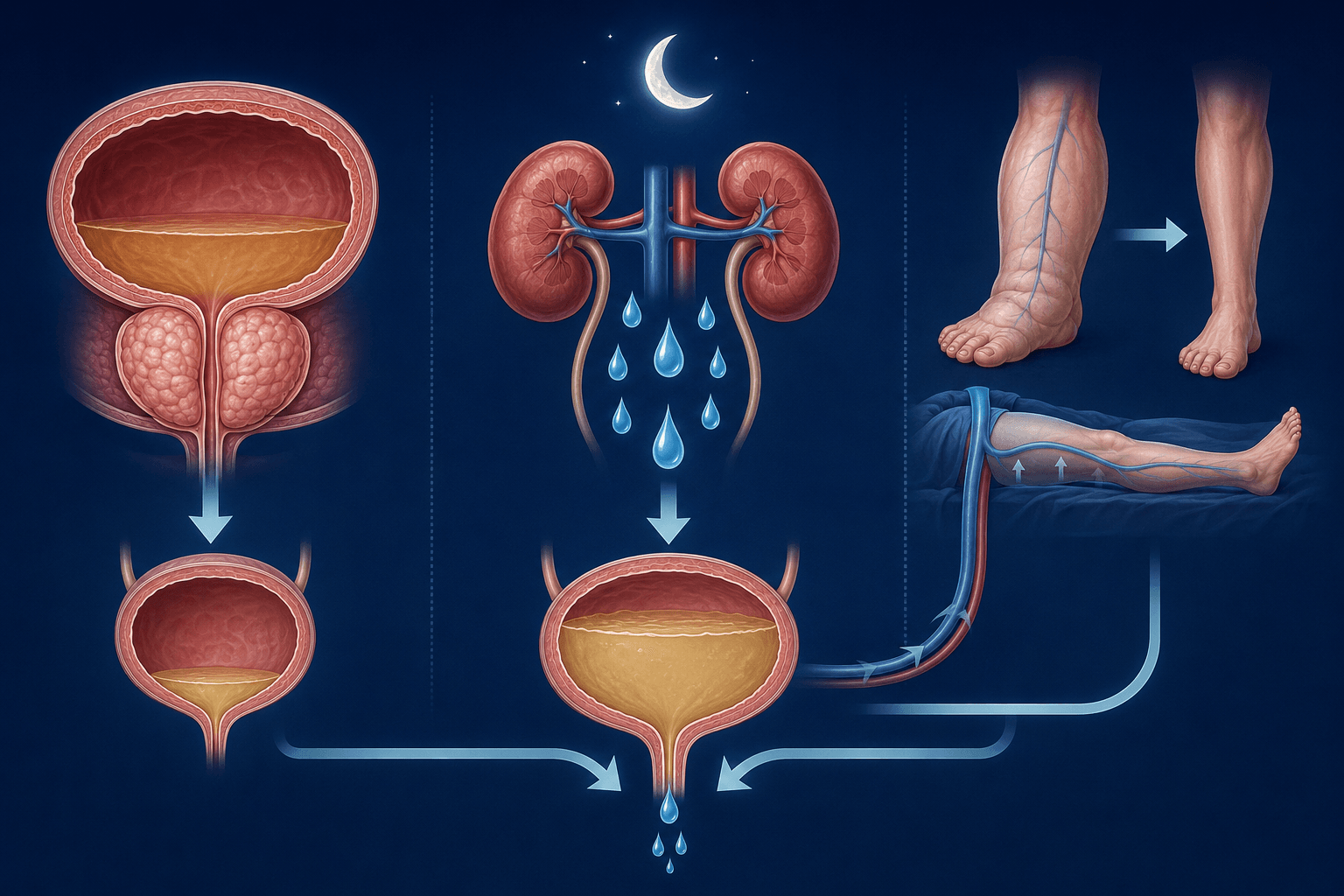
| Mechanism family | What is abnormal? | Examples | Expected diary pattern |
|---|---|---|---|
| Reduced storage/emptying | Functional bladder capacity is reached sooner | BPH/BPO, overactive bladder, inflammation, residual urine | Nighttime volumes often small relative to maximum voided volume |
| Nocturnal polyuria | Disproportionate 24-hour urine is produced at night | Sleep apnea, edema/fluid redistribution, altered circadian antidiuresis | Large nocturnal urine volume and elevated nocturnal polyuria index |
| Global polyuria | Total 24-hour urine output is excessive | Diabetes mellitus/insipidus, excessive intake, selected medicines | High day and night output; ICS consensus uses >40 mL/kg/day |
| Sleep-first awakening | Sleep disruption precedes voiding | Insomnia, pain, environmental disturbance | Small “convenience” voids may follow awakenings |
The three-day bladder diary is the decisive dataset
The EAU gives a strong recommendation to use a bladder diary for male LUTS—particularly nocturia—and to record at least three days. A useful record includes sleep and wake times, every void time and volume, fluid intake, urgency, leakage and the first morning void. The first morning void is included in nocturnal urine volume because it was produced during sleep.
Four measurements turn symptoms into mechanisms
| Metric | Calculation | What it tests | Limitation |
|---|---|---|---|
| Nocturnal urine volume (NUV) | All sleep-period voids + first morning void | Amount produced during the night | Depends on accurate diary timing/volume |
| Nocturnal polyuria index (NPi) | NUV ÷ 24-hour urine volume × 100 | Night’s share of total production | Age-dependent reference limits remain imperfect |
| Maximum voided volume (MVV) | Largest single diary void | Functional capacity benchmark | Not identical to anatomical bladder capacity |
| Nocturia index | NUV ÷ MVV | Whether nighttime production exceeds capacity | Does not identify why either value is abnormal |
Traditional ICS reference framing treats an NPi above about 20% in younger adults and above 33% in older adults as nocturnal polyuria; middle-age boundaries are less clear. These are classification aids, not universal disease thresholds.
Why common prostate tests cannot explain nocturia alone
Prostate volume shows tissue size, not night urine production. Symptom scores quantify burden, not cause. Post-void residual may support impaired emptying but can also reflect detrusor underactivity. Uroflowmetry documents flow, while pressure–flow testing distinguishes obstruction from weak contraction when that distinction changes treatment. The preceding weak-stream article explains these measurements.
The distinction between tissue growth, enlargement and functional obstruction is central: BPH is not synonymous with measured BPO.
Will treating BPH stop nighttime urination?
It can reduce nocturia when prostate-related resistance, residual urine or bladder dysfunction is an important driver. Alpha blockers target dynamic outlet tone; 5-alpha-reductase inhibitors target progression in selected enlarged glands; procedures widen the channel. But response may be limited when a diary shows nocturnal polyuria, global polyuria or sleep-first awakenings. Treatment should follow the mechanism rather than the assumption that every nighttime void comes from the prostate.
The next bridge separates this symptom from daytime patterns: how BPH can contribute to frequent urination.
When does nocturia need prompt assessment?
Evidence synthesis
BPH can cause or worsen nocturia by increasing outlet resistance, leaving residual urine and reducing functional storage through bladder remodeling or urgency. Yet nocturia is a final symptom shared by prostate, bladder, kidney-output and sleep mechanisms. A representative three-day bladder diary—paired with clinical assessment, urinalysis, PVR and selected flow/anatomy testing—separates these pathways better than prostate size or nocturia count alone.
Educational information only. Diagnosis and treatment require individualized clinical assessment.
Evidence sources
- EAU Guidelines: Diagnostic Evaluation of Non-neurogenic Male LUTS.
- International Continence Society: Terminology for Nocturia and Nocturnal Lower Urinary Tract Function.
- ICS Consensus on Diagnosis and Treatment of Nocturia.
- American Urological Association: BPH Guideline (2026).
- NIDDK: Enlarged Prostate (Benign Prostatic Hyperplasia).