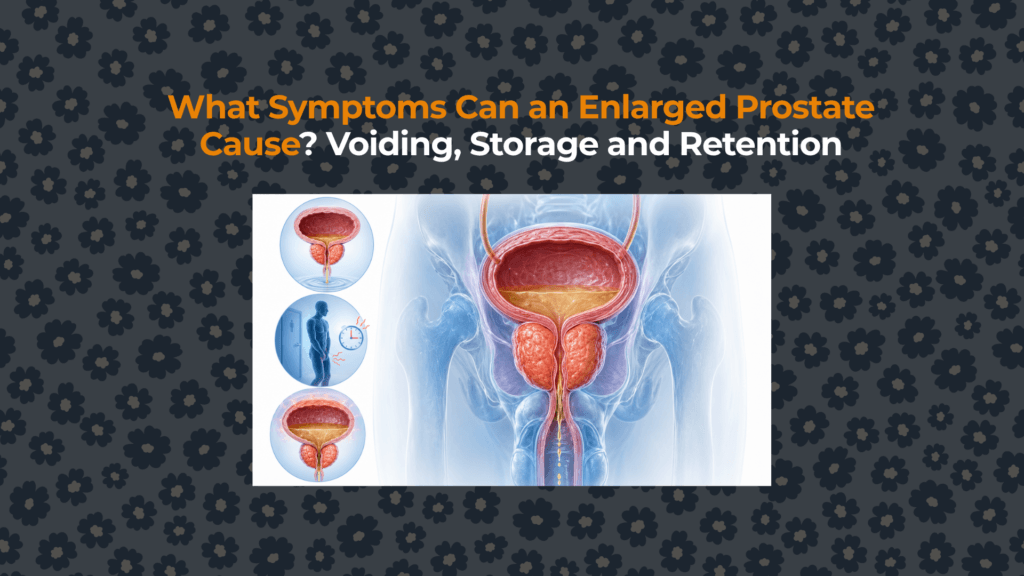
What Symptoms Can an Enlarged Prostate Cause? Voiding, Storage and Retention
Urinary symptoms are signals from a system—not a label for one organ. Their timing, combinations, measurements and trajectory matter more than calling every symptom “BPH.”
during flow
during filling
after flow
emptying failure
01. Enlarged-Prostate Symptoms Are LUTS, Not a Diagnosis
Histologic benign prostatic hyperplasia (BPH), anatomical benign prostate enlargement, benign prostatic obstruction (BPO) and symptom experience are related but non-equivalent entities. Growth may alter the bladder outlet; resistance may then change flow and bladder behavior; the patient experiences symptoms at the end of that chain. Each link can be absent.
The BPH evidence hub defines that chain. The practical rule here is narrower: describe the symptom first, then test the mechanism instead of inferring the cause from the symptom name.
02. Voiding Symptoms Describe Difficulty During Urine Flow
Which symptoms belong to the voiding domain?
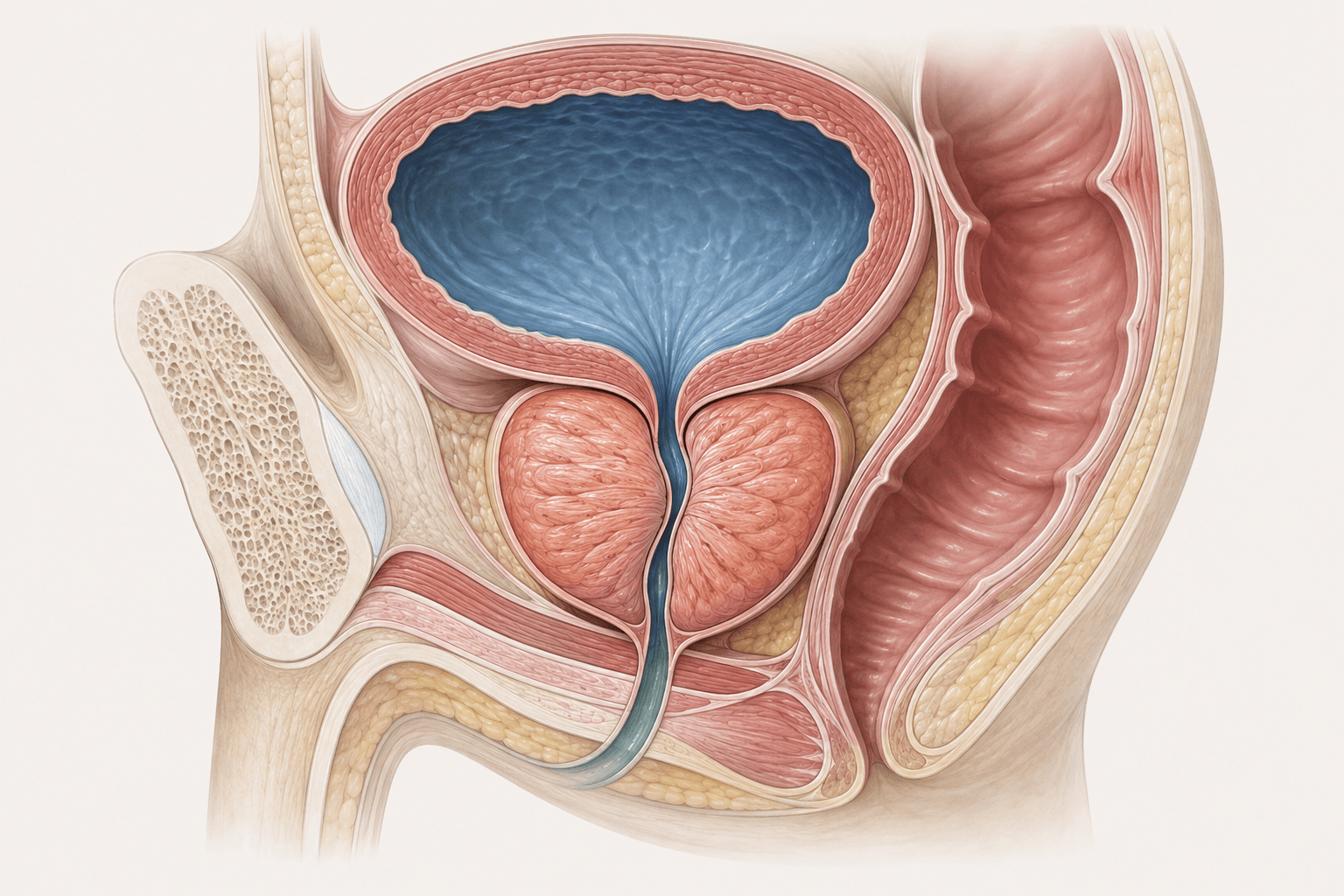
Slow stream, splitting or spraying, hesitancy, intermittency, straining and terminal dribble occur during urination. Prostate-related outlet resistance can contribute, but a symptom does not measure resistance. The next mapped article owns the mechanics and measurement of a weak urinary stream.
Why can a weak stream occur without prostate obstruction?
Flow also depends on detrusor contraction, urethral caliber, voided volume and voluntary sphincter relaxation. Detrusor underactivity, urethral stricture, medicines and neurologic disease can produce a similar pattern. Conversely, a man may compensate for outlet resistance with higher bladder pressure and report less dramatic symptoms.
03. Storage Symptoms Occur While the Bladder Is Filling
Which symptoms belong to the storage domain?
Urgency, increased daytime frequency, nocturia and urgency urinary incontinence describe bladder filling. Chronic outlet resistance can be associated with detrusor remodeling and overactivity, but storage symptoms can persist independently of the prostate and may dominate quality-of-life burden.
Why is nocturia not automatically a prostate symptom?
Nocturia can reflect reduced bladder capacity, nocturnal polyuria, sleep apnea, edema redistribution, diabetes, diuretics, evening fluid intake or sleep disruption. A frequency-volume diary records voiding time and volume and is more informative than assuming every night-time awakening originates at the outlet.
04. Post-Micturition Symptoms Occur After Urination
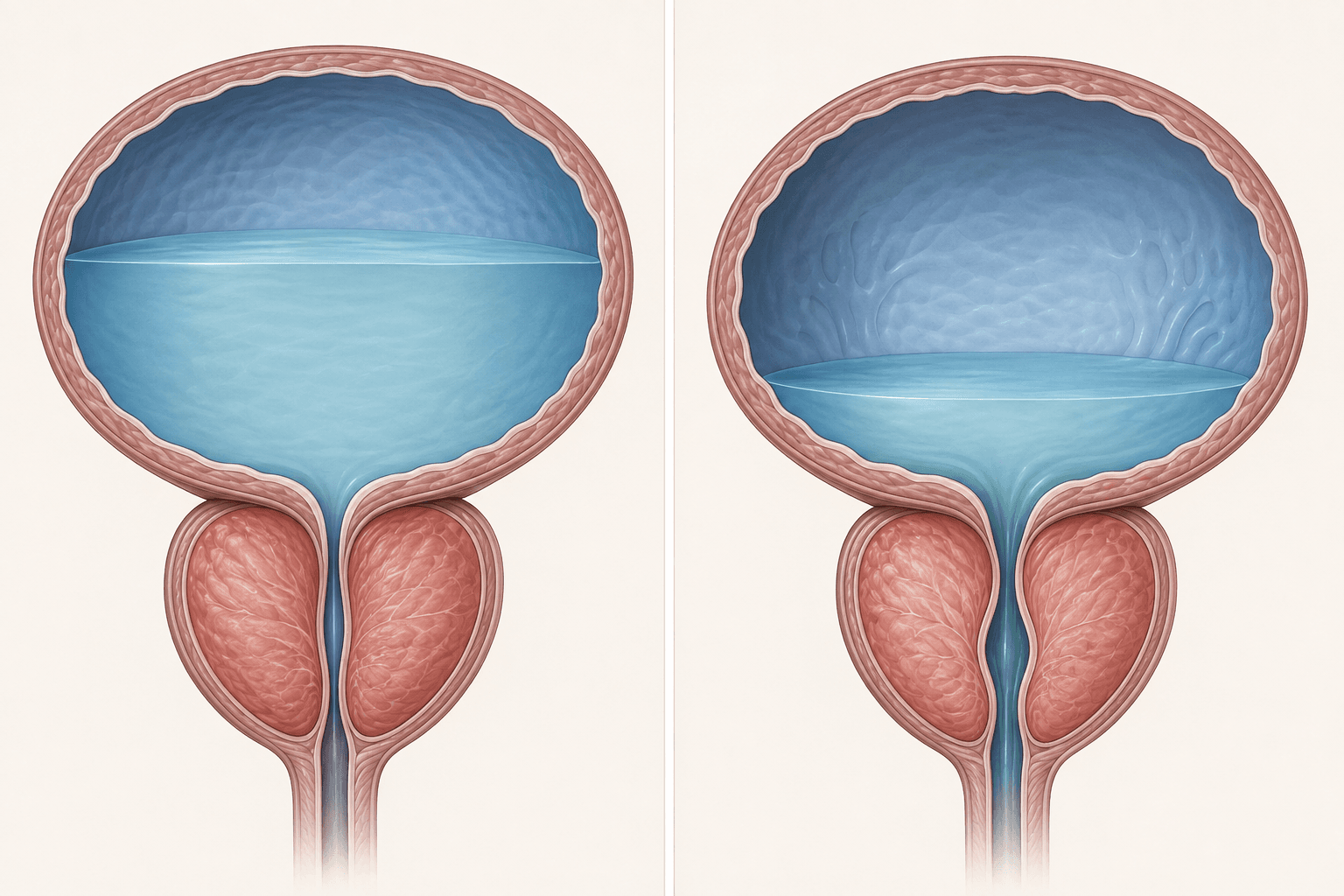
Post-micturition dribble is urine leakage after the main stream has ended. The sensation of incomplete emptying is a perception; it may occur with a low or high post-void residual (PVR). PVR is measured in millilitres by ultrasound or catheterization and must not be replaced by the symptom phrase “I still feel full.”
| Signal | Domain | What it reports | Important alternatives |
|---|---|---|---|
| Hesitancy / slow stream | Voiding | Delayed or reduced flow experience | BOO, weak detrusor, stricture, low voided volume |
| Urgency / frequency | Storage | Filling-phase sensation or control | Overactive bladder, infection, excess urine production |
| Nocturia | Storage/time-defined | Waking to void during the main sleep period | Nocturnal polyuria, sleep disorder, edema, diabetes |
| Incomplete-emptying sensation | Post-micturition | Subjective feeling after voiding | May occur with low or high PVR |
| Retention | Emptying outcome | Inability or failure to empty adequately | Obstruction, underactivity, neurologic or medication causes |
05. Retention Is an Emptying Failure, Not Simply a Severe Symptom Score
What distinguishes acute from chronic urinary retention?
Acute urinary retention is a sudden inability to urinate, often with painful bladder distension, and requires urgent assessment and bladder drainage. Chronic retention develops more gradually and may be painless; possible signals include frequent small voids, overflow leakage, recurrent infection or renal effects. Definitions and PVR thresholds vary, so one residual value must be interpreted with symptoms, renal risk and trend.
The IPP measurement guide explains one anatomical predictor of obstruction and retention risk without treating it as a diagnostic verdict.
06. IPSS Quantifies Seven Symptoms but Does Not Locate Their Cause
The International Prostate Symptom Score asks about incomplete emptying, frequency, intermittency, urgency, weak stream, straining and nocturia. Each item scores 0–5, producing 0–35. Conventional bands are 0–7 mild, 8–19 moderate and 20–35 severe; a separate quality-of-life question captures bother.
IPSS is useful for baseline severity and response over time. It is not a prostate-size measurement or obstruction test. A JAMA evidence review found an IPSS of at least 20 only modestly increased the likelihood of bladder outlet obstruction (positive likelihood ratio about 1.5).
07. Symptom Severity, Prostate Size and Obstruction Can Be Discordant
| Observed pattern | Possible interpretation | What remains unknown |
|---|---|---|
| Large prostate + mild LUTS | Limited outlet effect or effective bladder compensation | Pressure, flow and future progression |
| Small prostate + severe LUTS | Bladder dysfunction, stricture, dynamic tone or other cause | Whether the prostate is causal |
| Severe LUTS + low PVR | High burden without major residual retention | Storage vs outlet mechanism |
| Mild LUTS + high PVR | Reduced sensation, underactivity or compensated obstruction | Renal risk and mechanism |
This is why the prostate-size versus symptom analysis keeps millilitres, symptom scores and emptying measurements in separate columns.
08. Pattern and Time Course Change the Differential Diagnosis
Gradual mixed LUTS in an older man can be compatible with BPH/BPE, but sudden dysuria and frequency raise infection or inflammation; pelvic pain and painful ejaculation shift attention toward prostatitis; polyuria suggests excess urine production; new neurologic symptoms raise a neurologic cause. Medicines—including decongestants, anticholinergic drugs and opioids—can worsen emptying in susceptible patients.
09. Red Flags Need Prompt or Emergency Assessment
| Finding | Why it matters | Action level |
|---|---|---|
| Unable to urinate, especially with painful lower-abdominal swelling | Possible acute urinary retention | Emergency/urgent care now |
| Fever, chills, vomiting or systemic illness with urinary symptoms | Possible serious infection | Urgent same-day assessment |
| Visible blood in urine | Needs evaluation; not a routine BPH assumption | Prompt medical assessment |
| Flank pain, kidney impairment, recurrent infection or bladder stones | Possible upper-tract or complicated emptying problem | Prompt clinician/urology review |
| New leg weakness, saddle numbness or loss of bowel control | Possible neurologic emergency | Emergency assessment |
10. Evaluation Connects Symptoms to Measurements Before Treatment
A focused history classifies timing and bother; examination and urinalysis screen for alternatives; a bladder diary quantifies frequency and volume; uroflowmetry records Qmax in mL/s; PVR estimates urine remaining after voiding; prostate imaging measures volume and geometry. Pressure–flow studies are reserved for selected cases when the obstruction question could change an invasive decision.
For overlapping bladder and urinary causes, continue to the urinary-health hub. A clinician should interpret persistent, bothersome or changing LUTS rather than assigning them to the prostate by default.