
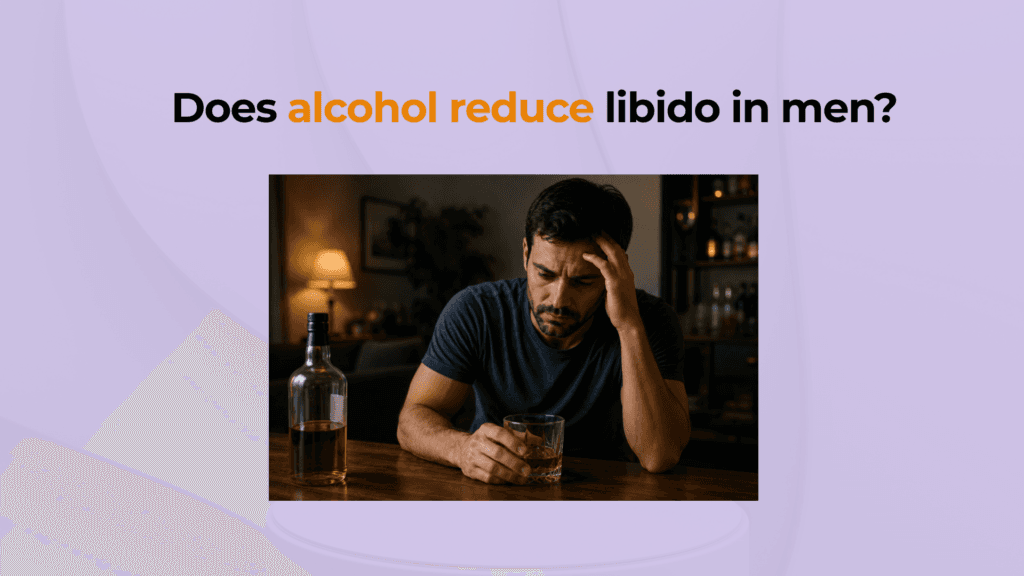
Does Alcohol Reduce Libido in Men? Examining the Evidence on Consumption and Sexual Drive
Alcohol can reduce male libido through acute central nervous system depression and dose-dependent testosterone effects, with impact scaling to consumption frequency and quantity, though moderate intake typically allows hormonal recovery within 24 to 48 hours.
Medical Disclaimer: This content is for informational purposes only and does not constitute medical advice. Consult a healthcare provider for personal health concerns regarding alcohol use or sexual dysfunction.
What Is the Direct Relationship Between Alcohol Consumption and Male Libido?
The direct relationship between alcohol consumption and male libido demonstrates dose-dependent effects, where increased intake correlates with decreased sexual desire and performance capacity in many cases. While individual variability exists, the physiological impact of ethanol on the central nervous system and endocrine function creates a predictable pattern of suppression at higher doses. It is crucial to distinguish between the transient effects of occasional drinking and the cumulative damage associated with chronic consumption.
How Does Acute Alcohol Intake Affect Sexual Desire Immediately?
Acute alcohol intake affects sexual desire through central nervous system depression and potential temporary testosterone changes following consumption. Within hours of drinking, ethanol acts as a depressant on the central nervous system (CNS), dampening the neural pathways responsible for sexual arousal and motivation.
The mechanism involves ethanol metabolism which can lead to GABA receptor activation, inducing a state of relaxation that paradoxically inhibits sexual excitation. Furthermore, at higher doses, acute intake can trigger a transient suppression of testosterone. The semantic triple of this interaction is clear: Ethanol absorption leads to CNS depression and potential testosterone inhibition at high doses, resulting in reduced sexual motivation and arousal capacity.
However, this immediate suppression must be contrasted with the typical recovery window. For moderate consumption, hormonal levels and neural function typically normalize within 24 to 48 hours. It is important to note that low doses may not produce measurable hormonal disruption in healthy males; one drink does not necessarily eliminate libido because research shows moderate single-serving intake produces minimal measurable hormonal disruption in healthy males. Understanding hormone recovery timelines is essential for distinguishing between temporary intoxication effects and lasting health issues.
| Consumption Level | Expected Libido Impact | Recovery Window |
|---|---|---|
| 1-2 Standard Drinks | Minimal to None | 12-24 Hours |
| 3-5 Standard Drinks | Moderate Suppression | 24-48 Hours |
| 6+ Standard Drinks (Binge) | Significant Suppression | 48-72+ Hours |
What Are the Long-Term Effects of Chronic Drinking on Testosterone and Desire?
Long-term effects of chronic drinking on testosterone and desire include sustained hormonal disruption, testicular function impairment, and potential structural libido pathway damage . Unlike acute effects, regular heavy drinking creates cumulative hormonal damage that extends beyond temporary suppression.
The mechanism involves direct toxicity to Leydig cells in the testes, which are responsible for testosterone production. Chronic ethanol exposure also increases aromatase activity, an enzyme that converts testosterone into estrogen, further skewing the hormonal balance. Additionally, the burden on liver metabolism disrupts the Hypothalamic-Pituitary-Gonadal (HPG) axis. The logic follows: Chronic ethanol exposure leads to Leydig cell damage and increased estrogen conversion, resulting in sustained testosterone deficiency and libido loss.
It is vital to contrast this chronic damage with the potential for reversibility. While significant harm occurs, clinical evidence shows significant hormonal recovery occurs within 3-6 months of sustained abstinence in most cases . However, one must avoid claiming all damage is permanent because recovery is possible. Men with established heavy drinking patterns should monitor for signs requiring urologist consultation if symptoms persist.
Self-Assessment Checklist
- ☐ Assess Consumption Pattern: Track drinks per week over 30 days minimum .
- ☐ Monitor Recovery: Note libido changes after 2-week abstinence periods .
- ☐ Evaluate Additional Symptoms: Check for fatigue, muscle loss, or mood changes indicating broader hormonal issues .
- ☐ Consult Medical Provider: Seek evaluation if libido does not improve after 4 weeks of reduced consumption .
Can Libido Recover After Reducing or Stopping Alcohol Consumption?
Libido can recover after reducing or stopping alcohol consumption, with many men experiencing measurable improvement within 2 to 6 weeks of sustained reduction or abstinence . This reversibility message is critical for reducing anxiety and encouraging positive behavior change.
What Timeline Should Men Expect for Sexual Health Recovery?
Men should expect a sexual health recovery timeline ranging from 2 weeks for acute effects to 6 months for chronic hormonal restoration following alcohol cessation . The physiological restoration process involves the normalization of testosterone levels and the recalibration of CNS receptors.
The logic of recovery is straightforward: Alcohol cessation allows for HPG axis recovery and receptor normalization, leading to progressive libido restoration over weeks to months. However, optimistic recovery timelines must be contrasted with cases requiring medical intervention due to permanent damage or co-occurring conditions. One must avoid guaranteeing full recovery for all men because individual factors like age, drinking duration, and pre-existing conditions create variable outcomes. Those needing personalized assessment should consider the option to schedule a sexual health evaluation.
| Cessation Period | Expected Recovery Milestone | Action Required |
|---|---|---|
| Week 1-2 | CNS Depression Lifts | Monitor sleep and energy |
| Week 3-6 | Testosterone Begins Normalizing | Track libido changes |
| Month 2-3 | HPG Axis Stabilization | Evaluate sustained improvement |
| Month 4-6 | Full Hormonal Restoration | Consult if no improvement |