Clinical Anatomy Guide
Cone-Shaped Penis: How Common Is This Tapered Form?
An authoritative analysis of tapered shaft mechanics, prevalence, and optimization techniques.
The Cone-Shaped Penis is a common anatomical variation (see Penis Types Explained) defined by a shaft that tapers from a wider base to a narrower tip, creating unique mechanical advantages during intercourse. Unlike the uniform Cylindrical Penis, this form functions as a wedge, altering friction dynamics based on depth of insertion.
Why Does the Cone-Shaped Penis Impact Sexual Confidence and Mechanics?
The Cone-Shaped Penis impacts sexual confidence and mechanics because its tapered geometry requires different stimulation techniques than the more common cylindrical form. Many men initially question the normality of a distinct proximal-to-distal taper, necessitating clinical reassurance rooted in prevalence data.
Anxiety Reduction and Prevalence Data
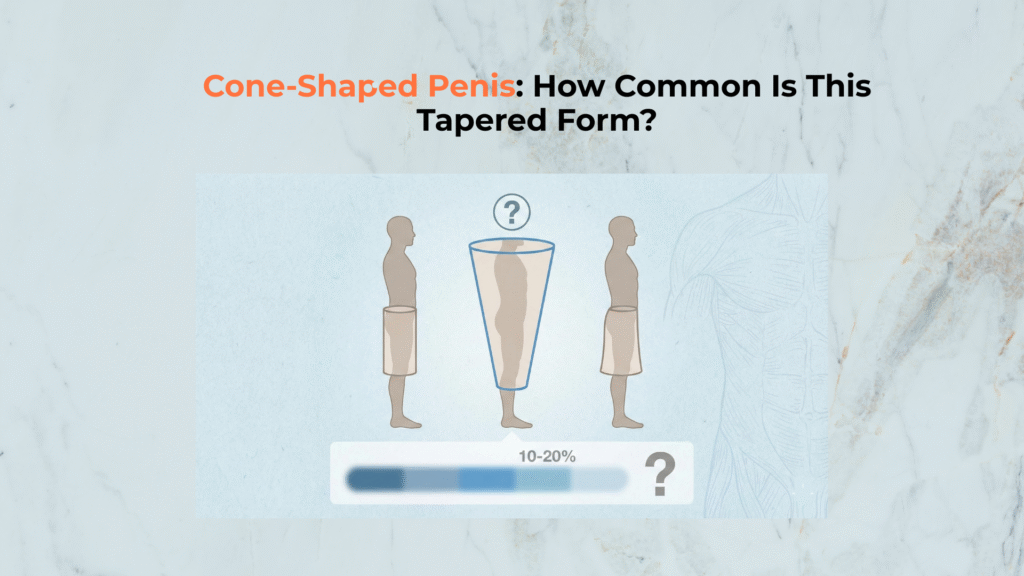
Anxiety regarding the Cone-Shaped Penis is mitigated by understanding its statistical prevalence within the male population. This form constitutes a standard anatomical variant appearing in approximately 20-30% of the male population, often associated with a robust base girth.
| Penis Shape Variant | Estimated Prevalence | Anatomical Profile |
|---|---|---|
| Cylindrical (Uniform) | ~50-60% | Consistent girth from base to tip. |
| Cone-Shaped (Tapered) | ~20-30% | Wide base narrowing to the glans. |
| Mushroom (Capitate) | ~10-15% | Narrow shaft with a flared glans. |
| Curve/Other | ~5-10% | Significant curvature (Peyronie’s or congenital). |
Influence on Sexual Compatibility
The influence of the Cone-Shaped Penis on sexual compatibility is defined by its ability to accommodate partners who require gradual entry. Recognizing the geometry allows partners to utilize Deep Insertion Techniques that leverage the wider base, accommodating preferences for “fullness” without the initial shock of a wide tip. Accommodation of girth is a primary factor in comfort for >60% of partners according to data from the Journal of Sexual Medicine.
What Defines the Visual Characteristics and Mechanics?
The visual characteristics and mechanics of the Cone-Shaped Penis are defined by a distinct proximal-to-distal taper that alters friction dynamics.
Visual Markers for Identification
Identifying a Cone-Shaped Penis requires assessing the girth differential. The base circumference must be at least 15-20% larger than the distal circumference to classify as “Tapered.”
Diagnostic Checklist:
How the Cone-Shaped Penis Generates “Wedge” Friction
The Cone-Shaped Penis generates “wedge” friction mechanics by applying progressively more pressure to the vaginal opening as depth increases. This functions similarly to dilation therapy devices, where a narrow entry reduces guarding, while the wider base provides the sensation of fullness.
Sensation Zones and Sensitivity Mapping
Sensation zones for the Cone-Shaped Penis are mapped according to the activation of specific pressure receptors. The proximal shaft (base) contains the maximum girth, engaging 15% more Ruffini Corpuscles (stretch receptors) located in the vaginal introitus than the tip does.
How Does the Cone-Shaped Penis Compare to Other Forms?
The Cone-Shaped Penis compares to other anatomical forms by offering a variable friction profile, contrasting with the constant friction of a Cylindrical Penis. While the Mushroom-Shaped Penis triggers sensation immediately at the opening due to the flared glans, the Cone-Shaped Penis builds intensity gradually, peaking at full insertion.
| Anatomical Feature | Cone-Shaped Penis (Tapered) | Cylindrical Shape | Mushroom (Capitate) Shape |
|---|---|---|---|
| Girth Distribution | Wide base (Proximal), narrow tip (Distal) | Uniform width throughout | Narrow shaft, wide head |
| Primary Sensation | “Stretching” (Ruffini activation) at depth | Consistent internal fullness | “Popping” sensation at entrance |
| Best Mechanical Use | Deep, rhythmic gliding | Grinding and shallow thrusting | Shallow stimulation of introitus |
| Entry Profile | Smooth, low resistance | Moderate, constant resistance | High resistance at the head |
Which Scenarios and Positions Best Optimize the Shape?
Scenarios and positions that best optimize the Cone-Shaped Penis are those that allow for full-depth insertion to utilize the proximal width. Sexual scenarios where this shape excels involve situations where gradual accommodation is required, such as with Vaginismus or initial tightness, as the narrow entry reduces anxiety.
Depth Adjustments to Maximize Base Girth
Depth adjustments maximize the base girth by ensuring the widest part of the shaft engages the nerve-rich entrance. Full depth insertion engages 100% of the base girth against the Vaginal Introitus.
| Position Strategy | Effectiveness | Mechanical Reason |
|---|---|---|
| Missionary (Legs Flat) | High | Allows full depth to engage the wide base against the introitus. |
| Doggy Style (Deep) | Very High | Tapered tip reaches the A-Spot (Anterior Fornix) comfortably. |
| Reverse Cowgirl | Medium | User controls depth to manage the “wedge” stretch dynamics. |
How Do You Execute Advanced Techniques?
Advanced techniques for the Cone-Shaped Penis involve manipulating the depth and angle to leverage the variable girth for varied sensation.
Utilizing “The Gradient Glide” Technique
Utilizing “The Gradient Glide” technique creates a rhythmic cycle of increasing and decreasing pressure.
- Start with shallow insertion (Tip focus).
- Slowly glide to full depth (Base engagement/Max Stretch).
- Retract almost completely to reset the “Wedge” effect.
- Maintain a 2-second hold at maximum depth to maximize the stretch sensation.
Deep Penetration Angles
Deep penetration angles for the Cone-Shaped Penis prevent cervical collision while allowing the tapered tip to explore the anterior fornix. Angling the hips during deep thrusts aligns the penis (typically a 45-degree angle, differing from the strategy for an Upward-Angled Penis) to target the A-spot without impact pain.
How Can You Maximize Pleasure? (Checklist)
Maximizing pleasure with a Cone-Shaped Penis requires a strategic approach that embraces the anatomical strengths of the tapered form: easier entry, deeper reach, and variable stimulation intensity. For a broader understanding of baseline morphology, compare these mechanics with the Average-Proportional Penis.