
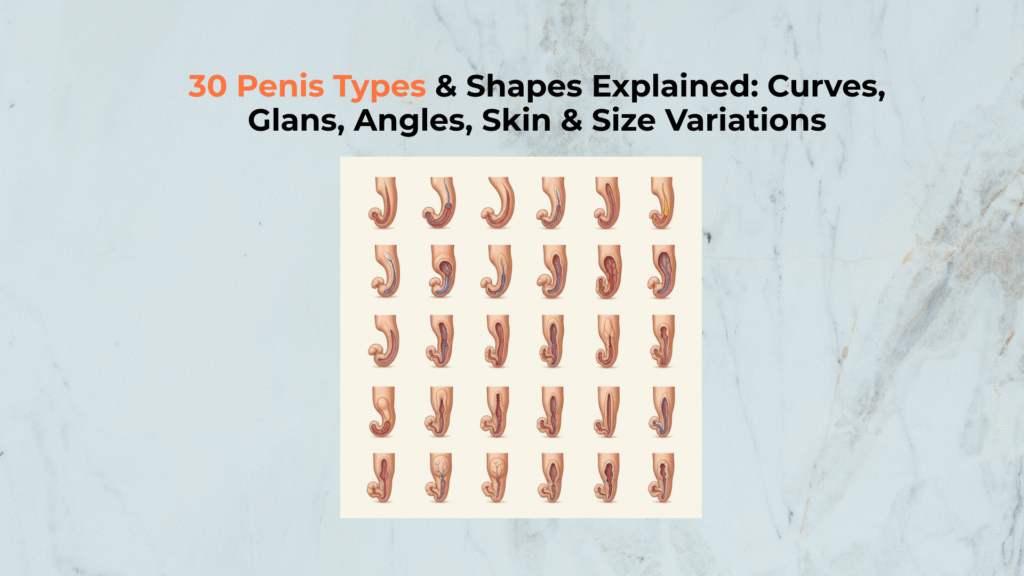
30 Penis Types & Shapes Explained: Curves, Glans, Angles, Skin & Size Variations
The penis is a highly variable organ, and anatomical diversity is the norm; this guide details 30 penis types and shapes, proving that the vast majority of curves, glans, and proportional variations are entirely normal.
The 30 Types Covered in This Guide:
- Cylindrical Penis
- Cone-Shaped Penis
- Mushroom / Bell-Shaped Penis
- Tapered Penis
- Upward-Angled Erection
- Straight / Horizontal Erection
- Downward-Angled Erection
- Left-Curved Penis
- Right-Curved Penis
- Upward-Curved Penis
- Downward-Curved Penis
- Peyronie’s-Type Curved Penis
- Large Glans Penis
- Small Glans Penis
- Pronounced Corona Penis
- Smooth Corona Penis
- Circumcised Penis
- Uncircumcised Penis
- Partially Circumcised Penis
- Tight Foreskin / Phimosis Type
- Long & Thin Penis
- Short & Thick Penis
- Average-Proportioned Penis
- Micropenis
- High-Rigidity Penis
- Venous-Leak Penis
- Cold-Glans Penis
- Veiny Penis
- Smooth-Surface Penis
- Thick Raphe Penis
Mainstream media often portrays only one specific shape—the straight, cylindrical ideal—which can lead to unnecessary anxiety. Our primary task here is to educate you that natural variations are common and statistically expected. This guide provides a comprehensive framework for understanding penis shapes and types, categorizing variations in geometry, angles, and functional traits, and clearly defining the few clinically relevant conditions.
This information is for educational purposes only. If you experience pain, severe curvature, or an inability to achieve a stable erection, consult a urologist immediately to rule out a pathological condition (e.g., Peyronie’s Disease).
Key Takeaways: Normalizing Diversity
- The Goal: Normalizing anatomical diversity is the primary goal.
- Normalization Fact: A slight curve (10-15 degrees) is considered normal and present in the majority of men.
- Clinical Threshold: Size variations outside the average range (5.1–5.7 inches erect) only become clinically relevant at the micropenis threshold.
- The Core Rule: Curves are normal; Painful curves are Peyronie’s Disease and require medical consultation.
- Categorization: The 30 types are categorized based on Shaft Geometry, Angulation, Glans Anatomy, and Functional traits.
Why Is Understanding Penis Shapes and Variations Important?
Understanding penis shapes and variations is important because anatomical diversity is the norm, and this knowledge empowers individuals to replace media-driven anxieties with scientific fact.
The Task: Normalizing Anatomical Diversity
The primary task of this guide is normalizing anatomical diversity, educating users that the vast range of penis shapes they observe are common. Understanding the range of normal variations (Entity) reduces body dysmorphia and anxiety (Action), leading to better sexual confidence (Result). Erectile tissue is highly plastic and changes shape based on genetics, blood pressure, and ligamentous support.
Defining Key Categorization Parameters
The 30 variations covered in this guide are categorized based on four key parameters: Shaft Geometry, Angulation/Curve, Glans Anatomy, and Functional/Surface traits.
What Are the Main Variations in Shaft Geometry and Size Proportion?
Variations in shaft geometry and proportion define the penis’s cross-sectional shape and the ratio of its size parameters (length to girth), with most falling within the statistically normal range.
- Cylindrical Penis: Even diameter from base to tip (the assumed standard).
- Cone-Shaped Penis: Gradually narrows from a wide base to a narrow glans.
- Mushroom / Bell-Shaped Penis: Defined by a large, flared glans relative to the shaft.
- Tapered Penis: Diameter consistently reduces as it moves from base to glans.
- Long & Thin Penis: High length-to-girth ratio. The long and thin configuration represents the opposite end of the size spectrum when compared with short and thick types.
- Short & Thick Penis: Low length-to-girth ratio (often described as “can”).
- Average-Proportioned Penis: Falls within the 2.5th to 97.5th percentiles (e.g., 5.1–5.7 inches erect).
- Micropenis: A clinically defined condition (length more than 2.5 standard deviations below the mean, usually < 2.8 inches erect). To understand how micropenis is defined clinically, it helps to compare it against what’s considered average size using standardized medical measurements.
How Do Penile Angles and Curvatures (Angulation) Vary?
Penile angles and curves are common and are primarily determined by the ligamentous support and the slight natural asymmetry between the corpora cavernosa.
Variations in Erect Angle (The Stance)
The erect angle is determined by the suspensory ligament and the tension of the fascia anchoring the penis to the pelvis.
- Upward-Angled Erection: Points strongly towards the abdomen (most common). Certain thrust mechanics overlap between stockier builds and curved shafts, especially when comparing optimal angles to upward-angled erection positions.
- Straight / Horizontal Erection: Points perpendicular to the body.
- Downward-Angled Erection: Points towards the legs (least common).
Variations in Curvature (The Bend)
A slight curve is considered a normal variation; only severe, painful curves are pathological. A slight curve (10-15 degrees) is considered normal and present in the majority of men due to unequal corpora cavernosa size (Source: NCBI).
Most right-curved penises fall within the range of normal anatomical asymmetry, but when the curvature becomes painful or sharply angled, it may resemble pathological curves like Peyronie’s.
- Left-Curved Penis / Right-Curved Penis: Lateral (side-to-side) curvature.
- Upward-Curved Penis / Downward-Curved Penis: Vertical curvature (can be normal).
- Peyronie’s-Type Curved Penis: A pathological curve (often severe, painful, and associated with hardening/plaque in the Tunica Albuginea).
What Personalization Factors Affect Glans and Foreskin Anatomy?
Anatomical personalization factors affect the size and appearance of the glans (Corpus Spongiosum expansion) and the presence of the foreskin.
Glans and Corona Variations (The Head Anatomy)
The glans penis is an extension of the corpus spongiosum, and its relative size and the prominence of the corona vary widely.
- Large Glans Penis / Small Glans Penis: Variations in the size of the Corpus Spongiosum distal expansion.
- Pronounced Corona Penis: A sharply defined corona (ridge) separating the glans from the shaft. The ridge prominence seen in this variation is formed by the same structures described in the anatomy of the coronal ridge and frenulum.
- Smooth Corona Penis: A less distinct, gentler slope at the corona.
Foreskin and Circumcision Status
The most significant visual anatomical distinction in the penis is the circumcision status, which also influences the texture of the glans (keratinization).
- Circumcised Penis: Prepuce tissue is removed. The defining difference in circumcised anatomy is the permanent absence of the tissue described in the foreskin anatomy.
- Uncircumcised Penis: Prepuce remains.
- Partially Circumcised Penis: Variations where some prepuce tissue remains.
- Tight Foreskin / Phimosis Type: A pathological condition (Phimosis) where the prepuce opening is too narrow to retract fully. When foreskin tightness causes pain, hygiene difficulty, or restricted retraction, the condition is medically classified as Phimosis.
How Do Surface Features and Functional Variations Present?
Surface features and vascularity present as variations in skin texture, visibility of the superficial veins, and localized thermal differences.
Variations in Surface Texture and Vascularity
The visibility of veins and the texture of the skin are determined by fascial thickness and subcutaneous tissue density.
- Veiny Penis: Pronounced, visible superficial veins (Superficial Dorsal Vein).
- Smooth-Surface Penis: Less visible vascularity due to tighter skin/fascia.
- Thick Raphe Penis: A prominent, raised seam of tissue running ventrally along the underside of the shaft and scrotum (embryological fusion line).
Thermal Variations (Functional/Circulatory)
Localized thermal variations are common and reflect differences in circulatory pressure gradients rather than a pathological issue.
- Cold-Glans Penis: The glans (Corpus Spongiosum) feels colder than the shaft (Corpora Cavernosa) due to different circulatory pressure gradients and minimal insulation.
What Functional Variations Impact Rigidity and Erection Stability?
Functional variations impacting rigidity and erection stability are tied directly to the efficiency of the veno-occlusive mechanism and intracavernosal pressure.
- High-Rigidity Penis: Achieves high intracavernosal pressures (suprasystolic) resulting in maximum firmness (high veno-occlusion). Extreme firmness during erection is primarily controlled by the tensile compression generated by the tunica albuginea’s role in rigidity.
- Venous-Leak Penis: A functional pathology where the Tunica Albuginea fails to compress the emissary veins effectively, causing blood to escape and preventing full rigidity. Because venous leak prevents stable pressure retention during erection, many patients explore structured recovery via the treatment pathway for venous leak.
The efficacy of the Veno-Occlusive Mechanism (Entity) determines the internal pressure achieved (Action), defining the rigidity type (Result).
[Checklist] Key Takeaways for Understanding Penis Variations
This final audit checklist summarizes the key takeaways for normalizing anatomical diversity and identifying when a variation requires medical attention.
- ☑ Self-Acceptance: Is your variation covered by the 30 types? (The vast majority are).
- ☑ Functional Check: Does the shape variation interfere with sex, urination, or comfort? (If no, it’s normal).
- ☑ Pathology Screening: Did you notice any signs of Phimosis, Peyronie’s (painful, severe curve), or consistent Venous-Leak (failing to stay hard)?
- ☑ Safety Rule: Curves are normal; Painful curves are Peyronie’s and require medical consultation.
- ☑ Conclusion: The central entity (penis) is highly diverse; function is more important than form.
Glossary of Clinical Terms
To ensure full clarity, this glossary defines the key clinical and anatomical terms used throughout this guide.
| Term | Definition |
|---|---|
| Micropenis | A clinically defined condition where the erect penis length is 2.5 standard deviations below the mean for age. |
| Peyronie’s Disease | An acquired disease causing a painful, severe curve due to scar tissue formation in the Tunica Albuginea. |
| Veno-Occlusive Mechanism | The physiological process of trapping blood in the corpora cavernosa to maintain rigidity. |
| Phimosis | A pathological condition where the foreskin opening is too narrow to retract fully. |
| Keratinization | The process where the delicate surface of the glans thickens and dries out due to exposure (e.g., after circumcision). |
Conclusion
In conclusion, the penis exhibits a profound range of anatomical diversity, covering 30 types and shapes that are almost universally normal and functional. Anatomical diversity is the norm, and the only factors requiring medical attention are functional impairment (pain, inability to have sex) or clinical pathologies (Micropenis, Peyronie’s Disease).
At FactBasedUrology, we believe that anatomical truth is the key to body confidence. Self-acceptance begins with factual knowledge: your penis is healthy, functional, and statistically normal.
If you want to see how this balanced structure compares across the full anatomical spectrum, you can explore all 30 penis types explained.
3 Responses