
How Do Autonomic Nerves Control Blood Flow to the Penis?
Autonomic nerves control blood flow to the penis through a delicate balance between the sympathetic nervous system, which maintains flaccidity by constricting arteries, and the parasympathetic nervous system, which triggers erection by dilating them.
This neural control system acts like a “brake and gas” mechanism for penile blood flow. This guide details the specific neurotransmitters, receptors, and anatomical pathways involved in the autonomic regulation of erection and flaccidity.
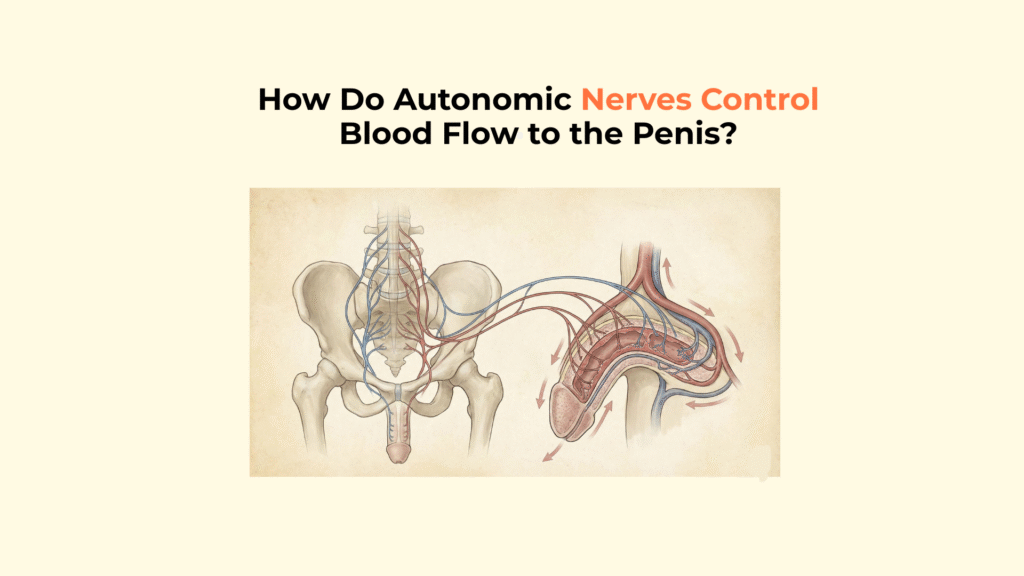
The full neurological command is converted into a hemodynamic response along the complete penile vascular pathway, integrating arterial inflow, cavernous filling, and venous compression.
Important Medical Disclaimer
This information is for educational purposes only and is not a substitute for professional medical advice, diagnosis, or treatment. Consult with a qualified healthcare provider regarding any medical condition or concerns about your health.
Key Neurological Facts: Autonomic Control
- The Balance: Erection is a result of parasympathetic activation (“Gas”) overcoming sympathetic tone (“Brake”).
- The Brake: Sympathetic nerves release Norepinephrine to keep smooth muscles contracted and the penis flaccid.
- The Gas: Parasympathetic nerves release Nitric Oxide (NO) to relax smooth muscles and allow blood inflow.
- The Wiring: Nerves travel from the spinal cord through the Pelvic Plexus and along the prostate as the Cavernous Nerves.
- The Impact of Stress: Anxiety spikes the sympathetic system, physically preventing the blood vessels from opening (Psychogenic ED).
What Is the Functional Balance of Autonomic Nerve Control?
The functional balance of autonomic nerve control in the penis operates on a “Brake and Gas” principle, where the sympathetic and parasympathetic systems work in opposition to regulate vascular resistance.
The “Brake and Gas” Analogy
To understand penile function, visualize the Sympathetic System as the “Brake” and the Parasympathetic System as the “Gas.”
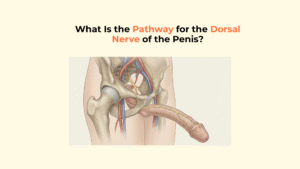
Although erection is chemically initiated through autonomic signaling, tactile stimulation must first be encoded by the dorsal nerve of the penis, which transmits high-resolution sensory input from the glans into the spinal reflex arc.
- Sympathetic Role: It is tonically active during the flaccid state. Its job is to keep the “valves” (arteries) closed.
- Parasympathetic Role: It is activated during arousal. Its job is to release the brake and actively open the “valves.”
The balance between sympathetic constriction and parasympathetic relaxation determines the specific volume of blood entering the penis.
How Does the Sympathetic Nervous System Maintain Flaccidity?
The Sympathetic Nervous System maintains flaccidity through the Alpha-Adrenergic mechanism, which uses the neurotransmitter norepinephrine to keep penile smooth muscle in a constant state of contraction.
The Alpha-Adrenergic Mechanism
This mechanism originates in the thoracolumbar spinal cord (T11-L2) and targets the smooth muscle of the helicine arteries and trabeculae.
- Neurotransmitter: Norepinephrine.
- Receptor: Alpha-1 Adrenergic Receptors.
- Action: Binding causes calcium influx → Smooth muscle contraction → Arterial constriction.
Source: NCBI – Physiology of Erection
The Impact of Stress (Psychogenic ED)
Psychological stress or performance anxiety triggers a “Fight or Flight” response, which spikes sympathetic output and can physically prevent an erection.
The ‘Brake’ is slammed down hard, overpowering any pro-erectile signals, causing immediate loss of erection. This explains the physiological basis of “stage fright” in the bedroom.
How Does the Parasympathetic Nervous System Trigger Erection?
The Parasympathetic Nervous System triggers erection through the release of Nitric Oxide (NO), a potent vasodilator that initiates the biochemical cascade required for smooth muscle relaxation.
The Nitric Oxide (NO) Pathway
Originating from the sacral spinal cord (S2-S4), parasympathetic nerves release Acetylcholine and Nitric Oxide (NO) via specialized NANC (Non-Adrenergic Non-Cholinergic) nerves.
- Chemistry: NO diffuses into smooth muscle cells → Activates Guanylate Cyclase → Increases cGMP → Lowers Calcium.
- Action: Smooth muscle relaxation (Vasodilation).
Source: NCBI – Biochemistry of Erection
The “Pro-Erectile” Cascade
Parasympathetic firing releases Nitric Oxide causing helicine arteries to uncoil and dilate, flooding the sinusoids with high-pressure blood.
Once parasympathetic activation occurs, Nitric Oxide acts directly on the smooth muscle contained within the corpora cavernosa, triggering rapid sinusoidal expansion and arterial inflow.
This vasodilatory response is delivered through the specialized helicine arteries, which function as dynamic pressure regulators during the transition from flaccid to erect states.
Functional erection stability depends on compression of the penile venous network, preventing premature outflow once intracavernosal pressure rises.
This pressure is structurally retained by the tensile resistance of the tunica albuginea, which acts as the final mechanical constraint preventing venous collapse.
What Is the Anatomical Pathway of the Autonomic Cavernous Nerves?
The anatomical pathway of the autonomic nerves involves a complex route from the spinal cord to the pelvic plexus, eventually forming the delicate cavernous nerves that enter the penis.
The Pelvic Plexus (The Mixing Pot)
The Pelvic Plexus is a nerve center located lateral to the rectum and prostate, serving as the “mixing pot” where sympathetic and parasympathetic fibers merge.
This is where the Sympathetic nerves (coming down from T10-L2) and Parasympathetic nerves (coming up from S2-S4) combine before sending signals to the penis.
The Cavernous Nerves (The Final Wiring)
The Cavernous Nerves travel from the pelvic plexus, running intimately along the surface of the Prostate Gland before entering the Corpora Cavernosa at the crura.
Clinical Relevance: This anatomical proximity is why “Nerve-Sparing” Radical Prostatectomy is critical to preserving erectile function; damage to these nerves cuts the wire to the ‘Gas pedal’.
Learn more about Nerve-Sparing Surgery
Comparison: Sympathetic vs. Parasympathetic Control
This table provides a direct comparison of the opposing roles and mechanisms of the two autonomic systems in penile function.
| System | Role | Neurotransmitter | Smooth Muscle Effect |
|---|---|---|---|
| Sympathetic | Maintenance of Flaccidity (The Brake) | Norepinephrine | Contraction / Constriction |
| Parasympathetic | Induction of Erection (The Gas) | Nitric Oxide (NO) / Acetylcholine | Relaxation / Dilation |
[Checklist] Verifying Autonomic Nerve Control Mechanisms
Use this checklist to verify your understanding of the neurological control of erection.
- The Brake: Is the Sympathetic system identified as the force keeping the penis flaccid?
- The Gas: Is the Parasympathetic system identified as the trigger for erection?
- Chemicals: Are Norepinephrine (Anti-erectile) and Nitric Oxide (Pro-erectile) correctly listed?
- Anatomy: Is the Pelvic Plexus identified as the junction where these nerves meet?
- Surgery: Is the Cavernous Nerve’s path along the prostate noted as a risk factor?
Glossary of Neurological Terms
To ensure full clarity, this glossary defines the key neurological terms used throughout this guide on autonomic control.
| Term | Definition |
|---|---|
| Autonomic Nervous System | The part of the nervous system that controls involuntary bodily functions, including heart rate and digestion. |
| Sympathetic Nervous System | The “fight or flight” system that releases norepinephrine to constrict blood vessels and maintain flaccidity. |
| Parasympathetic Nervous System | The “rest and digest” system that releases Nitric Oxide to dilate blood vessels and cause erection. |
| Nitric Oxide (NO) | A gas molecule that acts as a signaling messenger to relax smooth muscle cells. |
| Cavernous Nerves | The delicate nerves that travel along the prostate to the penis, carrying the signals for erection. |
| Pelvic Plexus | A network of nerves in the pelvis where sympathetic and parasympathetic fibers combine. |
Conclusion
In conclusion, the autonomic control of blood flow to the penis is a sophisticated balancing act where the “brake” of the sympathetic nervous system must be released and the “gas” of the parasympathetic nervous system engaged to achieve a functional erection.
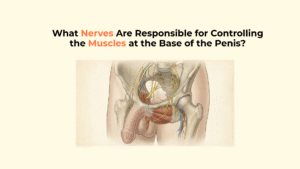
Additional rigidity support is provided by autonomic-driven contraction of the base muscles of the penis, which elevate intracavernosal pressure above systolic levels.
These neurological and vascular forces jointly orchestrate the transition described in the flaccid-to-erect bloodflow transformation, where vascular resistance is biochemically overridden.
However, when autonomic relaxation becomes asymmetrically opposed by fibrotic remodeling, curvature disorders such as Peyronie’s disease emerge through distorted pressure vectors and impaired cavernous expansion.
At Factbasedurology, we believe that understanding the neurology of intimacy is the key to overcoming sexual health challenges.
This neurological dance is the foundation of male sexual physiology.
One Response