
What Is the Primary Function of the Helicine Arteries?
The primary function of the helicine arteries is to act as the physiological “resistance valves” of the penis, regulating erectile state by constricting to limit blood flow during flaccidity and dilating to flood the erectile tissue during arousal.
These microscopic vessels act as the final gatekeepers that determine whether an erection physically occurs or if the penis remains in its default, non-erect state.
While the Deep Artery provides the main supply line, it is the helicine arteries that control the pressure. This guide details the unique “corkscrew” anatomy of these vessels, their role in maintaining high vascular resistance, and the critical function of their internal intimal cushions.
Important Medical Disclaimer: This information is for educational purposes only and is not a substitute for professional medical advice, diagnosis, or treatment. Consult with a qualified healthcare provider regarding any medical condition or concerns about your health.
Key Functional Facts: Helicine Arteries
- The Definition: Helicine arteries are tiny, coiled branches of the deep artery that open directly into the erectile tissue spaces.
- The Shape: They are “corkscrew-shaped” (helicine) when flaccid, which physically restricts blood flow.
- The “Valve” Role: They act as resistance vessels. High resistance = Flaccid; Low resistance = Erect.
- The Control: Their tone is controlled by the nervous system: Sympathetic signals keep them closed; Parasympathetic signals (and Nitric Oxide) open them.
- The Gatekeepers: They contain internal ridges called intimal cushions that help block blood flow.
What Is the Structural Definition of the Helicine Arteries?
The structural definition of the helicine arteries is that they are small, tortuous (twisted) terminal branches of the Cavernosal (Deep) Artery that feed directly into the sinusoids of the corpora cavernosa. These are not straight pipes; they are designed with a complex geometry that directly influences their physiological capability.
These vessels originate as terminal branches of the deep cavernosal artery system , making them uniquely positioned to switch the penis from a low-pressure nutritional state to a high-pressure erectile state.
The “Corkscrew” Anatomy
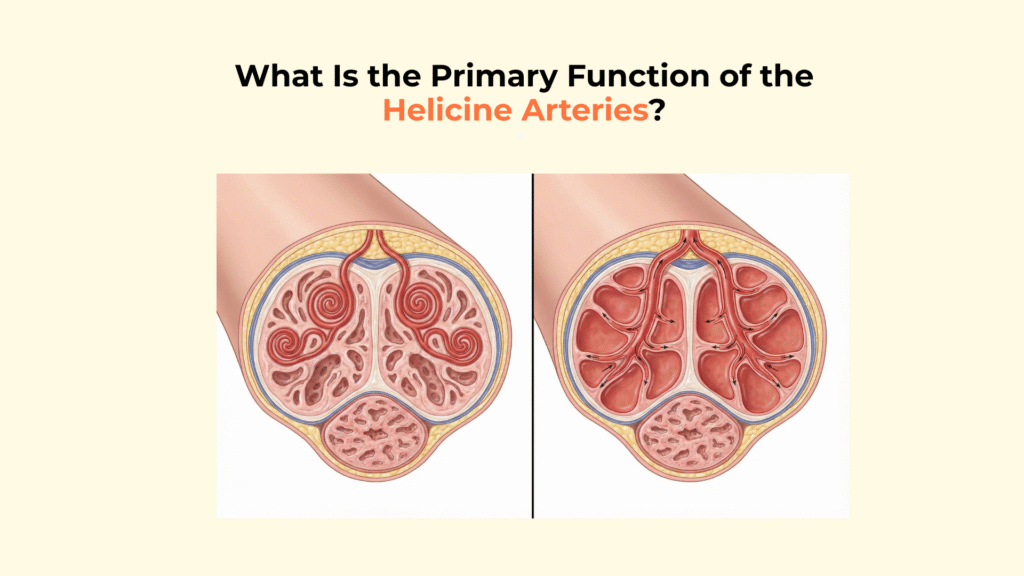
These vessels are named “helicine” after the Greek word for “helix” because they possess a distinct, corkscrew-like shape when the penis is in its flaccid state. This is not merely a cosmetic feature; the shape itself is functional.
Because they are tortuous—meaning full of twists and turns—the physical path of the blood is convoluted. These coiled vessels branch off from the larger cavernosal artery and open directly into the Lacunar Spaces (sinusoids) of the erectile tissue. In a resting state, this coiling acts much like a kinked hose, physically impeding the forward momentum of arterial blood.
The sinusoids that receive this flow are embedded within the trabecular network of the erectile smooth muscle tissue , which must relax in tandem with helicine dilation for expansion to occur.
How Do the Helicine Arteries Function as the “Resistance Valves”?
The helicine arteries function as the “resistance valves” of the penis by altering their muscular tone to either block arterial inflow (creating high resistance) or allow a rapid surge of blood (creating low resistance). This regulation of penile blood flow is the central hemodynamic mechanism of erection.
The ability of the helicine arteries to constrict or relax is directly tied to the contractile behavior of the corpora cavernosa , since these sinusoids are the primary destination for their outflow. Any impairment in cavernosal smooth muscle alters how effectively the helicine system can regulate resistance.
Flaccid (Left): The smooth muscle mesh (pink) contracts, forcing the artery into a coil. Resistance is high, blood flow is blocked.
Erect (Right): Parasympathetic signals relax the mesh. The artery uncoils and dilates, allowing rapid blood flow (red particles) to fill the space.
The Flaccid State (High Resistance)
In the flaccid state, sympathetic tone (driven by norepinephrine) keeps the smooth muscle of the helicine arteries functionally contracted. This state of contraction creates a specific physiological chain reaction: The corkscrew shape tightens (Entity) → creating high resistance to blood flow (Action) → restricting arterial inflow to a trickle for nutritional purposes only (Result).
When the smooth muscle surrounding these arteries is contracted, the coiling pattern becomes even tighter. This compressed geometry limits flow long before it reaches the cavernosal drainage plane , preventing intracavernosal pressure from rising.
The Erect State (Low Resistance)
In the erect state, sexual stimulation triggers the release of Nitric Oxide (NO). This chemical signal initiates a rapid reversal. The smooth muscle relaxes and the arteries uncoil (Entity) → drastically lowering resistance (Action) → allowing high-pressure arterial blood to surge into the sinusoids (Result).
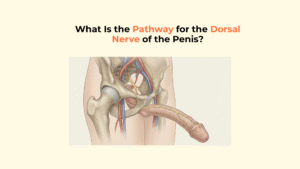
Sensory modulation of arterial tone is strongly influenced by the dorsal penile nerve , which coordinates with autonomic pathways to trigger nitric-oxide-dependent vasodilation within the helicine system.
As dilation progresses, the tunical envelope plays a structural role. The collagenous layers of the tunica albuginea help convert rising intracavernosal pressure into axial rigidity by constricting emissary veins as the compartments fill.
Source: Physiology of Erection Studies
What Is the Role of “Intimal Cushions”?
The intimal cushions are specialized ridges of smooth muscle and collagen located inside the lumen (opening) of the helicine arteries that act as physical stoppers to fine-tune blood flow.
These structures function as micro-anatomical gatekeepers. The contraction of intimal cushions obstructs the arterial lumen, ensuring the penis remains flaccid by mechanically blocking flow. This allows for very precise control over the exact amount of blood entering the tissue.
Comparison: Helicine Arteries vs. Nutrient Arteries
| Vessel Type | Destination | Primary Function | State Behavior |
|---|---|---|---|
| Helicine Arteries | Cavernous Sinusoids | Filling / Erection | Dilates massively during erection |
| Nutrient Arteries | Trabecular Tissues / Tunica | Oxygenation / Nutrition | Remains relatively constant |
How Does Dysfunction of the Helicine Arteries Lead to ED?
Dysfunction of the helicine arteries, often termed arteriogenic erectile dysfunction, occurs when these vessels become stiff or clogged and lose their ability to dilate. When the resistance vessels cannot lower their resistance, the hydraulic system fails.
Arteriogenic Erectile Dysfunction
This condition is typically caused by atherosclerosis (plaque buildup) or endothelial damage from diabetes or smoking. The pathology follows a clear sequence: The helicine arteries become stiff or plaque-filled → they cannot uncoil or dilate sufficiently → preventing the rapid inflow needed to compress the veins. This results in a failure to achieve or maintain rigidity.
When arterial disease develops—especially early arteriogenic erectile dysfunction—the first measurable deficit is often reduced dilation of the helicine network. This occurs long before significant plaque forms in the larger penile vascular pathway .
In conditions like Peyronie’s disease , tunical plaques distort the normal alignment of the helicine–sinusoid interface. This can create asymmetric inflow, contributing to curvature or localized filling defects.
Because these arteries empty directly into the cavernous sinusoids, the efficiency of their dilation determines how quickly inflow can overwhelm venous outflow. If they fail to generate sufficient force, blood escapes through the venous pathways faster than it arrives, creating the classic pattern of venous-leak-like ED despite a primary arterial cause.
In severe cases, structural stiffening of the arterial wall or loss of endothelial function prevents the helicine arteries from uncoiling fully. This dysfunction limits the pressure needed to compress the pelvic anchoring structures , resulting in incomplete rigidity even when stimulation is adequate.
☑ Verifying the Function of Helicine Arteries
Glossary of Physiological Terms
| Helicine Arteries | Small, coiled arteries in the penis that regulate blood flow into the erectile tissue. |
| Intimal Cushions | Thickened ridges of smooth muscle inside the helicine arteries that act as valves to block blood flow. |
| Sympathetic Tone | The baseline level of nervous system activity that keeps smooth muscles contracted and the penis flaccid. |
| Vasodilation | The widening of blood vessels, which decreases resistance and increases blood flow. |
Frequently Asked Questions: Helicine Arteries
How do PDE5 inhibitors (like Viagra) affect helicine arteries?
PDE5 inhibitors do not directly open the arteries. Instead, they prevent the breakdown of the chemical messenger (cGMP) that tells the smooth muscle of the helicine arteries to relax. This makes it easier for the arteries to uncoil and dilate in response to sexual stimulation.
Why does stress cause temporary ED?
Stress activates the sympathetic nervous system (“fight or flight”), which releases norepinephrine. This chemical binds to receptors on the helicine arteries, forcing them to contract and coil tightly, physically blocking blood inflow regardless of arousal.
Do helicine arteries exist elsewhere in the body?
Yes, similar spiral-shaped arteries are found in the uterus and ovaries. However, the helicine arteries of the penis are unique in their specialized association with erectile tissue (sinusoids) and their role in hydraulic rigidity.
Can smoking permanently damage these arteries?
Yes. Smoking damages the endothelial lining of the helicine arteries, reducing their ability to produce Nitric Oxide. Over time, this leads to structural stiffening (fibrosis) of the vessel walls, preventing them from uncoiling fully.
Conclusion
In conclusion, the helicine arteries are the microscopic but powerful “gatekeepers” of erectile function, using their unique coiled structure and internal cushions to precisely control the flow of blood into the penis. Their primary function is a duality: they act as a high-resistance barrier to maintain flaccidity and a low-resistance conduit to facilitate erection. It is their ability to relax, uncoil, and dilate that serves as the fundamental trigger for rigidity.
At Factbasedurology, we believe that understanding the microscopic details of your anatomy is the key to understanding your overall health. These tiny vessels bridge the gap between the nervous system’s signals and the physical reality of an erection.
One Response