What Is the Structure and Function of the Intracavernosal Struts of the Penis?
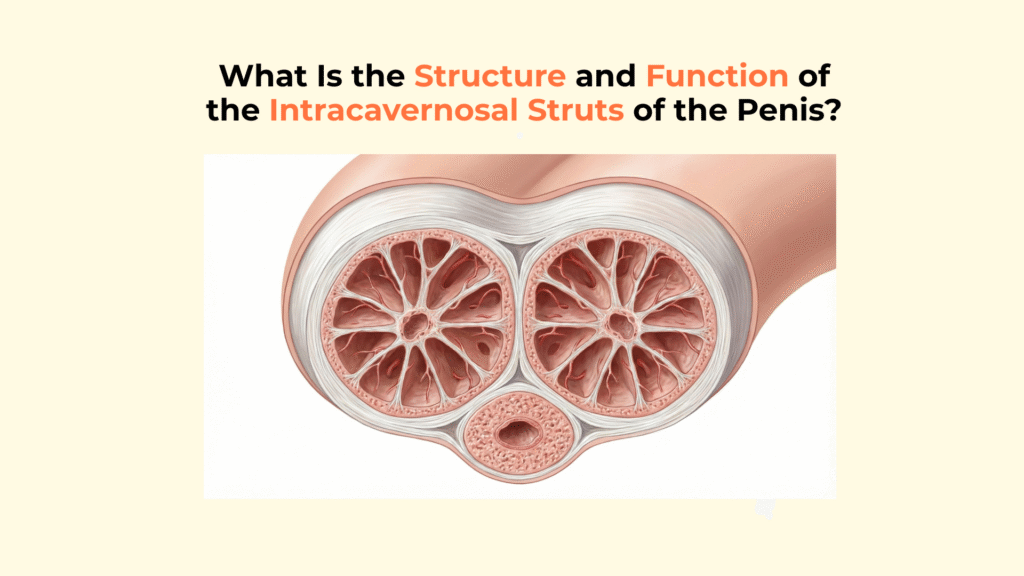
The intracavernosal struts are robust, internal bundles of smooth muscle and collagen that traverse the interior of the corpora cavernosa, acting as structural tethers to maintain the penis’s cylindrical shape and provide axial stability during an erection.
Without these critical internal supports in the corpus cavernosum, the high hydraulic pressure generated during an erection would force the penis to balloon into an unstable, spherical shape rather than a functional rod.
This guide details the architectural role of the “intracavernosal struts,” explaining their composition, their critical function in determining penile geometry, and how they support the biochemistry of erection.
Important Medical Disclaimer: This information is for educational purposes only and is not a substitute for professional medical advice, diagnosis, or treatment. Consult with a qualified healthcare provider regarding any medical condition or concerns about your health related to erectile function.
Key Anatomical Facts: Intracavernosal Struts
- The Definition: Intracavernosal struts are the internal “beams” or columns within the erectile tissue that help maintain the shape of the corpora cavernosa of the penis.
- The Composition: They are a balanced mix of smooth muscle (for contraction) and collagen (for strength), contributing to the overall function of the septum of the penis.
- Function & Rigidity: The Function of the elastic fibers in penile tissue and their role in the rigidity of the human penis: They act as tethers connecting the dorsal (top) and ventral (bottom) walls of the Tunica Albuginea.
- The Result: The management of erectile dysfunction is crucial for overall sexual health. This internal tension prevents ballooning, forcing the penis into a flattened cylinder shape.
- The Physiology: The physiology of the human penis includes the interaction between the blood supply to the penis and the surrounding tissues. They vastly increase the surface area of endothelium available to release Nitric Oxide, which is crucial for the spongy tissue to fill with blood.
What Is the Structural Definition of Intracavernosal Struts?
The structural definition of intracavernosal struts is that they are the specific, organized columns of the trabeculae that form the “internal skeleton” of the erectile chambers.
The “Internal Skeleton” Architecture
Architecturally, these struts run vertically and obliquely, connecting the inner dorsal wall of the Tunica Albuginea directly to the inner ventral wall and the midline septum.
This arrangement creates a visual and functional internal support system that remains hidden from external view, crucial for the erectile function of the penile shaft. These structures are most prominent and densely packed in the distal (front) shaft of the penis, extending from the glans penis to the proximal shaft, where they provide essential rigidity and shape control to the penile tip.
Composition: Strength vs. Compliance
The composition of the struts is a precisely balanced mixture of connective tissue (collagen and elastin) for tensile strength and smooth muscle for functional contractility, providing support to the erectile tissue. This dual-material construction is essential for their operation.
The collagen provides the passive strength to act as a tether, preventing over-expansion, while the smooth muscle allows the strut to relax (lengthen) during erection to accommodate blood flow and contract (shorten) during flaccidity to maintain a compact state.
How Do Intracavernosal Struts Determine Penile Shape?
The intracavernosal struts determine penile shape by exerting internal tension that resists the outward force of blood pressure, constraining the expansion into a functional cylinder of the corpus spongiosum.
The “Air Mattress” Analogy (Geometric Control)
The function of the struts is best understood through the “Air Mattress” analogy: without internal supports, an inflated rubber tube balloons into a sphere, but with internal stitching (struts), it maintains a flat, stable shape.
This interaction forms a critical biomechanical sequence: the tension of the intracavernosal struts resists the outward force of blood pressure, constraining the erection into a flattened cylinder rather than a sphere.
Maintenance of Axial Stability
Mechanically, by tethering the walls together, the struts significantly increase the axial stability and rigidity of the cylinder (its moment of inertia) in the corpus cavernosum, contributing to the overall health of the tissue of the corpora cavernosa.
This structural reinforcement prevents the penis from buckling or bending easily under the axial loads (pushing forces) experienced during intercourse, ensuring the organ remains effective for penetration without collapsing.
How Do Intracavernosal Struts Support Erectile Physiology?
Beyond biomechanics, the intracavernosal struts support erectile physiology by providing the physical platform for the endothelium and smooth muscle cells that drive the erection process.
Practical Illustration in Animation 3D: Increasing Endothelial Surface Area
The complex, branching structure of the struts vastly increases the internal surface area available to be lined by endothelium. This maximized surface area allows for a massive release of Nitric Oxide (NO), the chemical messenger required to trigger smooth muscle relaxation and initiate blood flow to the cavernous tissue. For a deeper understanding of this chemical process, refer to studies on Nitric Oxide function in the corpus cavernosum erectile tissue.
The Role in Detumescence (Going Flaccid)
During detumescence, the smooth muscle within the struts contracts under sympathetic nerve stimulation, impacting the blood supply to the penis. This active contraction pulls the sinusoidal walls inward, mechanically helping to expel blood from the cavernosa and collapse the erectile chambers back to a flaccid state in the corpus spongiosum, affecting the blood supply to the penis.
Comparison: Struts vs. Septum vs. Tunica
This comparison matrix differentiates the intracavernosal struts from the other key structural components of the penis.
| Component | Location | Primary Geometric Role |
|---|---|---|
| Tunica Albuginea | External Envelope of the human penis | Limits overall expansion; Creates pressure. |
| Penile Septum and its importance in the structure of the human penis | Midline Wall of the human penis | Equalizes pressure; Central support. |
| Intracavernosal Struts | The internal pillars/beams of the tunica albuginea of the corpora cavernosa and corpus spongiosum play a vital role in maintaining the structural integrity of the penis to the proximal crura. | Maintains flat/cylindrical shape; prevents ballooning, which is crucial for the function of the paired corpora cavernosa. |
How Do Pathologies Affect the Intracavernosal Struts?
Pathologies like cavernosal fibrosis or Peyronie’s disease directly attack the integrity or elasticity of the intracavernosal struts , leading to geometric deformity and functional erectile changes.
Cavernosal Fibrosis: When the Struts Become Too Stiff
In cavernosal fibrosis , healthy smooth muscle within the corpora cavernosa is progressively replaced by inelastic scar tissue. The struts lose their ability to relax, so the erectile chambers cannot fully expand, resulting in a measurable loss of penile length, girth, and rigidity.
Peyronie’s Disease: Distortion of the Tunica and Strut Attachments
In Peyronie’s disease , plaque formation in the tunica albuginea deforms the attachment points of the internal intracavernosal struts . Because the struts are part of the internal “skeleton” of the penis anatomy , asymmetric restriction on one side produces the classic curvature, indentation, or hourglass deformity seen during erection.
Clinically, these changes link the microscopic architecture of the corpora cavernosa to visible surface deformities. Understanding how intracavernosal struts maintain a cylindrical shape helps explain why the same plaque burden can cause very different angular deformities in different patients with Peyronie’s disease .
☑ Identifying the Intracavernosal Struts
Use this checklist to verify your understanding of the critical role played by the intracavernosal struts in supporting the erectile function of the penile shaft, particularly in the management of erectile dysfunction.
Glossary of Anatomical Terms
To ensure full clarity, this glossary defines the key anatomical terms used throughout this guide, including those related to the albuginea of the corpus spongiosum and the dorsum of the penis.
| Intracavernosal Struts | The internal columns of tissue within the corpora cavernosa of the penis that connect the walls and maintain shape are crucial for erectile function. |
| Trabeculae | The general term for the beam-like structural framework of the erectile tissue, of which struts are a specific type. |
| Tunica Albuginea | The tough fibrous sheath surrounding the corpora cavernosa; the struts attach to its inner surface. |
| Endothelium | The layer of cells lining the blood vessels and sinusoids in the walls of the corpora; responsible for releasing Nitric Oxide in the corpus cavernosum. |
| Axial Stability | The ability of the erect penis to resist bending or buckling when pressure is applied to the tip is essential for maintaining the integrity of the two corpora cavernosa. |
| Cavernosal Fibrosis | The replacement of healthy smooth muscle in the penis with inelastic scar tissue is often seen in Peyronie’s disease. |
Frequently Asked Questions: Intracavernosal Struts
Are intracavernosal struts the same as the penile septum?
No. The septum is a central, midline wall that divides the two corpora cavernosa. Intracavernosal struts are separate, vertical pillars distributed throughout the erectile tissue that connect the top and bottom walls to maintain shape.
Can penile exercises strengthen the intracavernosal struts?
There is no clinical evidence that mechanical exercises can “strengthen” these microscopic structures. However, maintaining good cardiovascular health ensures the smooth muscle within the struts remains functional and elastic.
Do intracavernosal struts break during a penile fracture?
A “penile fracture” is primarily a tear in the outer Tunica Albuginea. However, the sudden force can also damage the internal struts and smooth muscle, potentially leading to internal scarring (fibrosis) that may affect future function.
Why are they called “struts”?
In engineering, a strut is a structural component designed to resist longitudinal compression. Anatomically, they act more like tethers (resisting tension) against blood pressure, but the term highlights their role in maintaining the structural integrity of the erectile chambers.
Conclusion
In conclusion, the intracavernosal struts act as the hidden “internal skeleton” of the penis, playing an indispensable role in shaping the erection, maintaining stability for intercourse, and facilitating the biochemical processes of arousal.
They function as critical tethers; without them, the erection would simply be a pressurized sphere rather than a functional cylinder, affecting penile rigidity. At Factbasedurology, we believe that seeing the “blueprint” of your anatomy, including the glans penis and the two corpora, is essential for understanding your sexual health and the function of the paired corpora cavernosa. These microscopic beams are the unsung heroes of penile geometry and play a vital role in the analysis of the penis.