
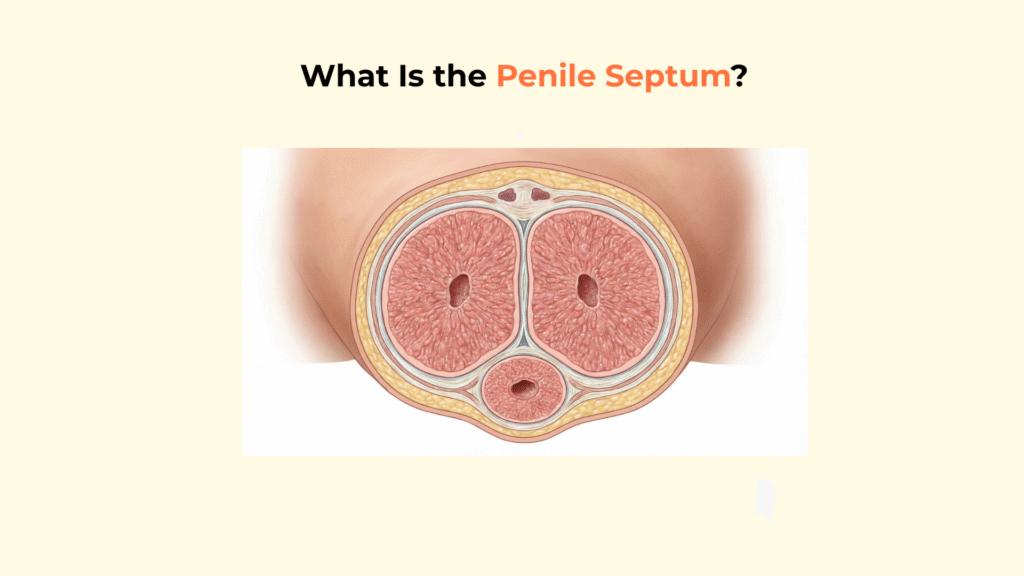
What Is the Penile Septum?
The penile septum is the incomplete, comb-like midline partition formed by the fusion of the inner layers of the Tunica Albuginea where the two Corpora Cavernosa meet, serving as a central structural strut that allows for equalized blood flow.
While the term “septum” typically implies a solid wall separating two chambers, the human penile septum functions more like a permeable grid that enables the lengthening of the penis and simultaneous filling. This unique architecture is critical for male sexual function, as it allows the two erectile cylinders to communicate fluidly, ensuring a unified and symmetrical erection.
This guide provides a detailed anatomical explanation of the “penile septum,” detailing its unique pectiniform structure, its role in equalizing intracavernosal pressure, and its importance in urological surgery.
Important Medical Disclaimer
The information provided should be considered in the context of the anatomy of the penis – dissection of the penile septum in 10 formalized bodies.
This information is for educational purposes only and is not a substitute for professional medical advice, diagnosis, or treatment regarding the glans penis. Consult with a qualified healthcare provider regarding any medical condition or concerns about your health.
Key Anatomical Facts: Penile Septum
The Definition: The anatomical structures, including the corpus spongiosum and the tunica albuginea in the normal human anatomy, are essential for understanding function. The penile septum is the internal wall separating the two erectile chambers (corpora cavernosa) and serves as a continuation of the albuginea of the corpora cavernosa, highlighting its crucial role in penile function.
The Structure: The anatomy of the tunica albuginea includes the septum of the penis, which is vital for erectile function, as highlighted in the edition of Gray’s Anatomy. In humans, the pectinate septum is incomplete and “pectiniform” (comb-like), consisting of vertical strands with open spaces (fenestrations).
The Source: It is formed by the fusion of the Tunica Albuginea layers, which play a crucial role in the anatomy of the penis – dissected the penile septum to reveal its complexities. The septum forms where the deep circular fibers of the tunica albuginea fuse along the midline, creating the central partition between the corpora.
The Function: The function of the penis or the pectiniform septum is crucial for the overall anatomy of the human penis. Its holes allow blood to flow freely between the chambers, ensuring the penis expands symmetrically with equal pressure, influenced by the median flow.
Clinical Note: Understanding the anatomy of the tunica albuginea is essential for assessing erectile function. Its permeability is why draining one side of the penis (for priapism) effectively drains both sides.
What Is the Structural Definition of the Penile Septum?
The structural definition of the penile septum is a fibrous midline partition that arises from the deep surface of the Tunica Albuginea, characterized in humans by its permeable, strand-like architecture.
The septum sits deep to the penile fascial layers, tethered between Buck’s fascia and the inner lamella of the tunica albuginea.
Interactive 3D View
Click & Drag to Rotate
The “Shared Wall” Architecture
The septum forms where the deep circular fibers of the tunica albuginea fuse along the midline, creating the central partition between the corpora.
Its ability to withstand intracavernosal pressure depends heavily on the tensile strength of the tunica albuginea, which anchors the septal fibers during erection.
In cross-sectional anatomy, the septum defines the boundary between the cavernosa while preserving communication with the corpus spongiosum system during erectile changes.
Think of it as the I-beam in the center of a double-barreled shotgun, connecting the two barrels into a single unit. It is not a distinct tissue inserted between the chambers; rather, it is a continuation of the same collagenous envelope that encases the erectile tissue.
The Pectiniform (Comb-Like) Structure
A crucial anatomical distinction is that the human penile septum is incomplete, specifically described as pectiniform (comb-like), meaning it is composed of vertical strands of collagen separated by open windows called fenestrations.
The vertical collagen bands of the septum also help stabilize the surrounding erectile muscle tissue, ensuring uniform expansion during tumescence.
Proximally, its fibers taper toward the region where the corpora diverge into the crura and bulb, anchoring the erectile bodies to the pelvis.
These fenestrations are most prominent in the distal (front) shaft, allowing for substantial free communication between the left and right sides of the corpora cavernosa, which is separated by the septum of the penis.
How Does the Penile Septum Function Hemodynamically?
Hemodynamically, the penile septum functions as a pressure equalizer, ensuring that the rapid inflow of blood during erection is distributed evenly across the entire diameter of the penis.
The “Pressure Equalizer” Mechanism
Because the septum joins both sides of the corpora cavernosa, its fenestrations allow the penis to behave as a single hydraulic chamber instead of two independent compartments.
Equal pressure transmission across the septum is driven by synchronized inflow from the helicine arteries, which rapidly distribute blood throughout both cavernous chambers.
Fenestrated septal architecture allows autonomic hemodynamic adjustments controlled through autonomic bloodflow mechanisms to equalize pressure across both chambers.
Its porous architecture ensures that the left and right sides remain hemodynamically unified within the broader penile vascular pathway.
During detumescence, venous return through the cavernous drainage pathways empties both compartments simultaneously because the septum is incompletely fenestrated.
The “Structural Strut” Role
Mechanically, the septum acts as a central vertical pillar or strut that ties the dorsal (top) and ventral (bottom) aspects of the tunica albuginea together, impacting the function of the corpora cavernosa and the corpus spongiosum.
Its central position complements the load-bearing role of the intracavernosal struts, which distribute tension across the cavernous bodies during erection.
Along its ventral edge, the septum stabilizes the interface between the cavernosa and the spongiosum–urethra complex, maintaining alignment during axial loading.
This midline reinforcement contributes to the stability of the penile root, especially where the erectile columns transition into their fixed attachments.
Although not directly part of the septum, its alignment influences the distribution of sensation conducted by the dorsal nerve along the dorsal midline.
How Does the Penile Septum Impact Surgical Procedures?
The anatomy of the penile septum significantly impacts urological surgeries, particularly the placement of Inflatable Penile Prostheses (IPP) and the management of priapism, by influencing the blood flow through the deep dorsal veins.
Implications for Inflatable Penile Prosthesis (IPP)
Surgeons rely on its midline integrity to prevent prosthetic cylinder crossover during IPP placement, a step guided by the natural barrier formed by the tunica albuginea.
If the septum is perforated or too weak (crossover), the cylinders may touch or twist, potentially affecting the cosmetic result. Surgeons navigate this anatomy carefully to ensure the cylinders sit parallel to one another, utilizing the pectinate septum as a guide rail.
Implications for Priapism Shunts (Winter’s Shunt)
Emergency shunts used in ischemic priapism exploit the septum’s permeability, allowing unilateral drainage to decompress both sides through the established venous channels.
During this procedure, a needle is passed through the glans of the penis into one side of the right corpora cavernosa to drain blood. Because the septum penis is incomplete and allows cross-flow, draining one side effectively drains both sides, simplifying the emergency procedure.
Comparison: Complete vs. Incomplete Penile Septum
This table compares the characteristics and functional results of a complete versus an incomplete (human) penile septum, highlighting the importance of the septum pectiniforme in the lengthening of the penis.
| Septum Type | Structure | Hemodynamic Result | Species Example |
|---|---|---|---|
| Complete Pectinate Septum | Solid, impermeable wall of collagen, crucial for the anatomy of the tunica albuginea. | Independent pressure chambers; no cross-flow, as seen in the arrangement of the intercavernous septum. | Canines (Dogs), Equines (Horses). |
| Incomplete (Pectiniform) Septum | Vertical strands with fenestrations (holes) are part of the structure of the septum enabling the lengthening of the penile body. | Single pressure chamber; free cross-flow through the transverse cross-section through the penile body. | Humans. |
[Checklist] Identifying the Key Features
- Composition: The part of the pectiniform septum is essential for the overall structure of the penis and its function. Is it identified as a midline fusion of the anterior part of the pectiniform septum that joins the two corpora cavernosa?
- Permeability: Is the pectinate septum incomplete (fenestrated), allowing relationship between corpora cavernosa and corpus spongiosum?
- Hemodynamics: Does it equalize pressure to ensure symmetrical distribution within the corpora cavernosa and the corpus spongiosum?
- Geometry: Is it described as “pectiniform” (comb-like) rather than a solid sheet?
- Support: Does it function as a central strut to define penile shape?
Glossary of Anatomical Terms
- Penile Septum
- The midline partition separating the two corpora cavernosa, formed by the tunica albuginea.
- Pectiniform
- Resembling a comb; used to describe the strand-like structure of the human penile septum, which plays a role in the organization of the corpora cavernosa and the corpus spongiosum.
- Fenestrations
- Natural openings or holes within a tissue (like the septum) that allow for the passage of fluid.
- Tunica Albuginea
- The tough fibrous sheath that surrounds the erectile tissues and forms the septum penis.
- Priapism
- A prolonged, often painful erection that is not caused by sexual stimulation and requires medical treatment can be linked to issues with the base of the septum.
- Hemodynamics
- The study of blood flow forces; in this context, how blood moves and creates pressure within the body of the penis.
Conclusion
In conclusion, the penile septum is a specialized, comb-like extension of the Tunica Albuginea that plays a vital role in ensuring the structural integrity and hemodynamic symmetry of an erection. While often visualized as a wall, it is functionally a permeable grid that connects the two corpora cavernosa into a single operating unit.
At Factbasedurology, we believe that understanding the hidden architecture of your body, including the nerves of the penis, is the key to appreciating its function. Even unseen structures like the part of the pectiniform septum are essential for the complex mechanics of male health.
One Response