
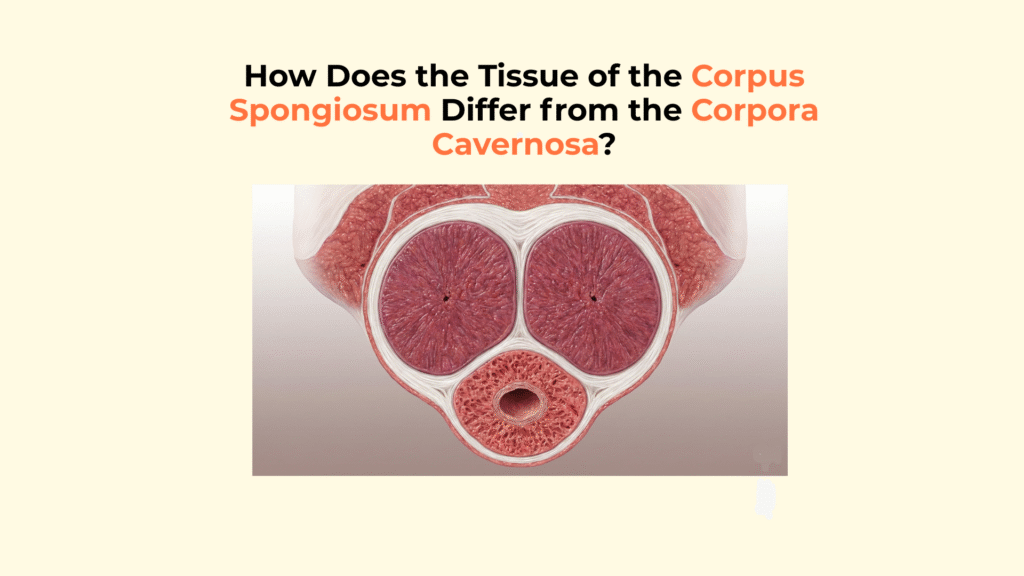
How Does the Tissue of the Corpus Spongiosum Differ from the Corpora Cavernosa?
The tissue of the Corpus Spongiosum differs from the Corpora Cavernosa primarily in the thickness of its outer sheath (Tunica Albuginea) and its internal pressure handling, designed to remain pliable for urethral patency rather than becoming rigid for penetration.
While both structures are classified as “erectile tissues,” they serve opposing biomechanical goals. The Corpora Cavernosa act as a rigid beam to support the penis, whereas the Corpus Spongiosum acts as a protective cushion. This guide provides a detailed histological comparison of the Corpus Spongiosum and Corpora Cavernosa, dissecting their structural differences, pressure systems, and functional roles.
Important Medical Disclaimer: This information is for educational purposes only and is not a substitute for professional medical advice, diagnosis, or treatment. Consult with a qualified healthcare provider regarding any medical condition or concerns about your health.
Key Tissue Differences at a Glance
- The Primary Difference: The Tunica Albuginea of the Corpus Spongiosum is thin and elastic, while that of the Corpora Cavernosa is thick and non-compliant.
- Pressure Systems: The Cavernosa is a high-pressure system (>100 mmHg) for rigidity. The Spongiosum is a low-pressure system (~30-50 mmHg) to protect the urethra.
- Structural Role: The Cavernosa provides axial stiffness (the “rod”). The Spongiosum ensures the urethra remains open for ejaculation (the “garden hose” effect).
- The Glans: The head of the penis (glans) is an extension of the Corpus Spongiosum, which is why it remains softer than the shaft during an erection.
What Are the Fundamental Structural Differences?
The fundamental structural differences lie in the thickness and elasticity of the Tunica Albuginea and the composition of the internal sinusoids and trabeculae.
The Tunica Albuginea Thickness (The Primary Differentiator)
The most critical difference is the Tunica Albuginea: the Corpora Cavernosa are encased in a thick, bi-layered, non-compliant sheath, while the Corpus Spongiosum is encased in a thin, highly elastic sheath.
Anatomical studies indicate that the tunica of the Corpora Cavernosa is approximately 2-3mm thick, consisting of tough inner circular and outer longitudinal bundles. In contrast, the tunica of the Corpus Spongiosum is significantly thinner, typically around 0.5mm. This structural variance is the defining factor in penile mechanics.
The thin tunica of the spongiosum allows for expansion without extreme rigidity, preventing the urethra from being crushed during erection. In clinical terms, “compliance” refers to the ability of a tissue to stretch and expand under pressure. The Spongiosum possesses high compliance, whereas the Cavernosa demonstrates low compliance at high volumes, forcing the internal pressure to rise rapidly for hardness.
• The tunica thickness difference becomes clearer when viewed through the tunica albuginea structure.
Sinusoid Architecture and Trabeculae
The internal architecture also differs, with the Corpora Cavernosa containing larger sinusoids and thick smooth muscle trabeculae designed for pressure retention, while the Corpus Spongiosum contains smaller, more uniform sinusoids.
The trabeculae within the Corpora Cavernosa are robust, composed of roughly 40-50% smooth muscle, which is essential for controlling the massive influx of blood during the erectile process. Conversely, the trabeculae of the Spongiosum contain a higher ratio of elastic fibers and less smooth muscle. This design is optimized for rapid filling (glans engorgement) but not for sustaining the high-pressure rigidity needed for penetration.
• The high-pressure rigidity of the cavernosa is explained in detail in the corpora cavernosa anatomy.
How Do the Hemodynamic Capabilities Differ?
Hemodynamically, the Corpora Cavernosa function as a high-pressure system to create stiffness, while the Corpus Spongiosum functions as a low-pressure system to maintain flow.
High-Pressure vs. Low-Pressure Systems
The Corpora Cavernosa (“The Engine”) operate at pressures often exceeding 100 mmHg (suprasystolic), while the Corpus Spongiosum (“The Cushion”) operates at much lower pressures, typically one-third to one-half that of the cavernosa.
This pressure differential is a critical safety mechanism. If the spongiosum reached the same extreme pressure as the cavernosa, it would occlude (crush) the urethra, mechanically blocking the passage of semen during ejaculation. The physiological limit of the spongiosum pressure ensures the channel remains patent.
• The pressure shift during erection is governed by the inflow system shown in helicine artery function.
Venous Drainage Pathways
The Corpora Cavernosa rely heavily on the sub-tunical veno-occlusive mechanism to trap blood, whereas the Corpus Spongiosum has a less effective occlusive mechanism, allowing for freer drainage.
While the Cavernosa compress the emissary veins against the tunica to maintain an erection, the Spongiosum allows blood to drain more freely via the deep dorsal vein and circumflex veins. This constant flow prevents the dangerous pressure buildup that would otherwise harm the sensitive urethral tissue.
• The reason the cavernosa can trap blood—but the spongiosum cannot—is covered in cavernosa venous drainage.
Comparative Matrix: Corpus Spongiosum vs. Corpora Cavernosa
| Feature | Corpora Cavernosa | Corpus Spongiosum |
|---|---|---|
| Tunica Albuginea | Thick, bi-layered, rigid (2-3mm) | Thin, elastic, compliant (~0.5mm) |
| Pressure System | High-Pressure (>100 mmHg) | Low-Pressure (30-50 mmHg) |
| Primary Function | Structural Stiffness (The Rod) | Urethral Patency & Protection |
| Urethra | Absent | Contains and protects the urethra |
How Does the Functional Role Dictate Tissue Composition?
The specific tissue composition of each structure is dictated by its functional role: axial rigidity for the Cavernosa and urethral patency for the Spongiosum.
The Role of “Axial Rigidity” (Cavernosa)
The goal of the Corpora Cavernosa is to create a stiff, non-buckling rod essential for vaginal penetration. To achieve this, the tissue requires high collagen content, a thick tunica, and a strong veno-occlusive seal. Without these specific histological features, the penis would buckle under the axial forces generated during intercourse.
The Role of “Urethral Patency” (Spongiosum)
The goal of the Corpus Spongiosum is to keep the urethral tube open (“patent”) for the passage of semen, functioning like a pressurized garden hose that stays open even when bent.
This requires high elasticity and a low-pressure “cap” to prevent collapse. The Glans Penis (head) is an extension of the Corpus Spongiosum. This is why the head of the penis remains softer than the shaft during erection—to act as a shock absorber during thrusting, protecting the female partner from injury.
• The spongiosum’s role in protecting the urethra is expanded in the spongiosum–urethra relationship.
Summary and Resources
[Checklist] Key Differences in Structural Composition
- Tunica Check: Is the Cavernosa tunica thick/bi-layered? Is the Spongiosum tunica thin?
- Pressure Check: Is the Cavernosa high-pressure (Rigid)? Is the Spongiosum low-pressure (Soft)?
- Urethra Check: Does the Spongiosum surround the urethra to protect it?
- Glans Connection: Is the Glans identified as part of the Spongiosum system (soft tissue)?
- Function Check: Cavernosa = Stiffness; Spongiosum = Patency/Protection.
Glossary of Anatomical Terms
| Term | Definition |
|---|---|
| Corpora Cavernosa | The two main, high-pressure erectile chambers responsible for penile rigidity. |
| Corpus Spongiosum | The single, low-pressure erectile chamber that surrounds the urethra and forms the glans. |
| Tunica Albuginea | The fibrous sheath encasing the erectile tissues; it is thick on the cavernosa and thin on the spongiosum. |
| Urethral Patency | The state of the urethra being open and unobstructed, allowing for the flow of urine or semen. |
| Trabeculae | The internal framework of smooth muscle and connective tissue within erectile tissue. |
| Sinusoids | The vascular spaces within erectile tissue that fill with blood during an erection. |
Conclusion
In conclusion, while both the Corpus Spongiosum and Corpora Cavernosa are erectile tissues, their distinct structural differences—specifically in tunica thickness and pressure limits—allow them to perform the separate but complementary functions of providing rigidity and ensuring safe ejaculation.
One structure provides the hardness required for intercourse, while the other ensures the necessary flow and protection to complete the reproductive act. This biological engineering prevents the urethra from being crushed during sex.
At factbasedurology, we believe that understanding these precise anatomical mechanisms is key to appreciating male sexual health. This perfect balance of rigidity and pliability is what makes normal sexual function possible.
2 Responses