
How Does the Tunica Albuginea Contribute to the Structure of the Erectile Tissue?
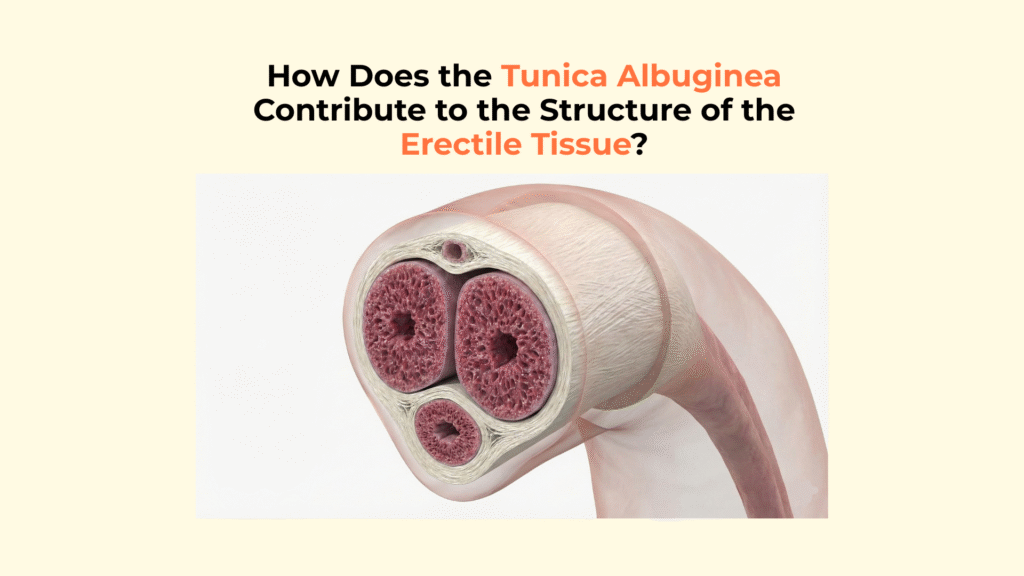
The Tunica Albuginea contributes to the structure of the erectile tissue by acting as a high-strength, bi-layered fibrous container that resists expansion to generate the high intracavernosal pressure required for a rigid erection.
Without this tough, fibrous envelope, the penis would not be able to become hard. It would act instead like a balloon that expands without rigidity; the volume would increase, but the structure would remain flaccid. This guide provides a detailed biomechanical explanation of the Tunica Albuginea, dissecting its collagen composition, its two distinct layers, and its critical role in the veno-occlusive mechanism.
Important Medical Disclaimer: This information is for educational purposes only and is not a substitute for professional medical advice, diagnosis, or treatment. Consult with a qualified healthcare provider regarding any medical condition or concerns about your health.
Key Structural Facts: Tunica Albuginea
- The “Container”: The Tunica Albuginea is a bi-layered, dense fibrous sheath that encases the Corpora Cavernosa.
- Composition: It is composed of approximately 95% collagen (for strength) and 5% elastin (for stretch).
- The Trap: It is the structural key to the veno-occlusive mechanism, compressing veins to trap blood inside the penis.
- The Layers: It has an Inner Circular Layer (for containment) and an Outer Longitudinal Layer (for stability).
- The Limit: Its low elasticity sets a “limit” on expansion, converting blood flow into pressure and rigidity.
What Is the Fundamental Structural Role of the Tunica Albuginea?
The fundamental structural role of the Tunica Albuginea is to serve as a non-compliant, bi-layered container that determines the shape, length, and rigidity of the penis when filled with blood.
Defining the “Bi-Layered Container”
The Tunica Albuginea is not merely a skin but a dense, bi-layered fibrous envelope that encases the corpora cavernosa, thereby determining the structural limits and shape of the erection.
This anatomical structure achieves its function through a highly specific composition. Research indicates that the tunica is composed of approximately 95% collagen fibers (primarily Type I and III) and 5% elastin. You can review the specific histological composition in this NCBI study.
This specific ratio creates a structure that is extensible enough to allow size increase during the initial phase of an erection, but rigid enough to provide immense strength once that limit is reached.
The Task: Providing Structural Integrity Under Pressure
Without the Tunica Albuginea, the erectile tissue would expand uncontrollably like a weak vein; with it, the tissue becomes a rigid, pressurized column capable of supporting axial loads.
The biomechanics here rely on the concept of tensile strength, a clinical term referring to the maximum stress a material can withstand while being stretched before breaking. The tunica’s high tensile strength withstands high intracavernosal pressure, allowing the penis to become rigid without rupturing.
What Are the Specific Layers of the Tunica Albuginea?
The Tunica Albuginea is composed of two distinct layers with different fiber orientations: an Inner Circular Layer that contains the tissue and an Outer Longitudinal Layer that provides stability.
| Layer | Fiber Orientation | Structural Function |
|---|---|---|
| Inner Circular Layer | Perpendicular (Ring-like) around the shaft | Contains the cavernous tissue; “Hoop strength.” |
| Outer Longitudinal Layer | Parallel (Lengthwise) to the shaft | Prevents buckling; Axial stability. |
The Inner Circular Layer (The Compressor)
The Inner Circular Layer consists of fibers running perpendicular to the penile shaft, creating distinct compartments for each corpus cavernosum.
It embraces and contains the cavernous tissue directly. It provides the “hoop strength” needed to resist radial expansion, acting much like the metal bands on a barrel that keep the contents pressurized and contained.
The Outer Longitudinal Layer (The Stabilizer)
The Outer Longitudinal Layer consists of fibers running parallel to the penile shaft, forming a unified sheath that bundles the two corpora together.
It prevents buckling and provides axial stability during intercourse. It is important to note that this layer is shared between the two corpora, structurally linking them together into a single unit, which ensures the penis moves as one cohesive structure rather than two separate cylinders.
How Does the Tunica Albuginea Structurally Enable the Veno-Occlusive Mechanism?
The Tunica Albuginea structurally enables the veno-occlusive mechanism by acting as a firm backstop against which the expanding erectile tissue compresses the draining veins, trapping blood inside.
The “Emissary Vein Trap” Mechanism
The “Emissary Vein Trap” is the tunica’s most critical contribution to erection maintenance, leveraging its anatomical position to physically block blood outflow.
Anatomically, the emissary veins, which are responsible for draining blood from the penis, pass obliquely (at an angle) through the fibrous layers of the Tunica Albuginea. As the erectile tissue fills and expands, it pushes against the non-compliant inner wall of the tunica. This pressure compresses the veins against the tunica wall, effectively trapping the blood inside. This explains exactly why blood doesn’t just flow back out immediately during sexual arousal.
The Role of Compliance and Extensibility
The Tunica Albuginea allows for rapid expansion initially due to high compliance, but it hits a structural ‘limit’ where it becomes non-compliant, causing intracavernosal pressure to spike.
If the tunica were too stretchy (high compliance), compression of the veins would never occur, leading to Venous Leak. Conversely, if it were too stiff (low compliance), expansion would be mechanically impossible or painful. The tissue sits in a precise “Goldilocks” zone of elasticity that permits function.
How Do Structural Defects in the Tunica Albuginea Affect Function?
Structural defects in the Tunica Albuginea, such as scar tissue formation or loss of elasticity, directly impair its ability to expand evenly or trap blood, leading to conditions like Peyronie’s disease or venous leak.
Peyronie’s Disease (The Scar Tissue Defect)
Peyronie’s disease is caused by the formation of a fibrous plaque (scar tissue) on the Tunica Albuginea, usually due to micro-trauma.
When this plaque forms, the scar tissue loses elasticity. This acts as a tether during expansion, restricting that specific area of the tunica while the rest expands, causing curvature and deformity. For a deeper clinical understanding, refer to this guide on Peyronie’s Disease.
Venous Leak (The Compliance Defect)
Venous leak (veno-occlusive dysfunction) occurs when the Tunica Albuginea is too porous or the smooth muscle cannot expand enough to press against it efficiently.
In this scenario, the structural impact is immediate: the emissary veins are not fully compressed, allowing blood to escape and preventing full rigidity.
Summary and Resources
[Checklist] Key Structural Contributions
- Containment: Does it successfully encase the corpora cavernosa to define shape?
- Protection: Does the collagen framework protect the delicate erectile tissue from trauma?
- Occlusion: Does the structure allow for the compression of emissary veins (Veno-Occlusive Mechanism)?
- Limit Setting: Does the low-elastin composition prevent over-expansion and rupture?
- Stability: Do the longitudinal fibers prevent buckling under axial load?
Glossary of Anatomical Terms
| Term | Definition |
|---|---|
| Tunica Albuginea | The tough, bi-layered fibrous sheath that surrounds the corpora cavernosa of the penis. |
| Collagen | The main structural protein found in the tunica albuginea, providing strength and rigidity. |
| Elastin | A protein that allows tissues to stretch and return to their original shape, present in small amounts in the tunica. |
| Veno-Occlusive Mechanism | The physiological process where veins are compressed to trap blood in the penis, maintaining an erection. |
| Emissary Veins | Veins that pass through the tunica albuginea to drain blood from the erectile tissue. |
| Intracavernosal Pressure | The fluid pressure within the corpora cavernosa, which creates hardness. |
Conclusion
In conclusion, the Tunica Albuginea is the unsung hero of erectile function, acting as the critical structural container that converts blood flow into the rigidity necessary for sexual activity.
We have explored how this bi-layered sheath of collagen and elastin works to contain pressure and stabilize the penis. Its interaction with the veno-occlusive mechanism is what makes an erection physically possible; without it, the physiology of blood flow would fail to produce mechanical hardness. At Factbasedurology, we believe that understanding the biomechanics of your body is the first step to maintaining its health.
It is a marvel of biological engineering—a flexible skin that becomes a rigid column on demand.
5 Responses