
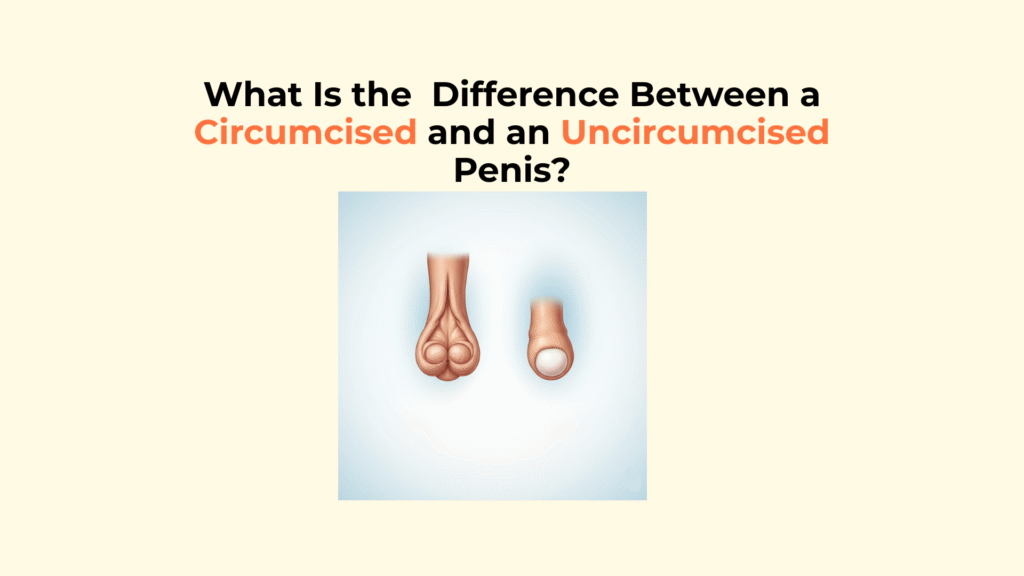
What Is the Anatomical Difference Between a Circumcised and an Uncircumcised Penis?
The primary anatomical difference between a circumcised and an uncircumcised penis is the surgical removal (circumcised) or presence (uncircumcised) of the foreskin, a distinction that leads to secondary changes in the glans and frenulum.
This single primary difference leads to several other distinct anatomical and functional variations concerning the glans, the frenulum, and routine hygiene practices.
This guide provides a detailed, medically accurate, and neutral comparison of ‘circumcised vs uncircumcised’ penis anatomy to support your health knowledge.
For a broader understanding of penile anatomy, visit our complete guide to penile anatomy.
Key Anatomical Differences at a Glance
- The Foreskin: An uncircumcised penis has a foreskin (prepuce); a circumcised penis does not.
- The Glans: The glans (head) of an uncircumcised penis is covered by the foreskin and remains a moist mucosal surface. The exposed glans of a circumcised penis undergoes keratinization (becomes drier, tougher skin).
- The Frenulum: The frenulum (a sensitive band of tissue) is left intact in an uncircumcised penis but is typically removed or altered during circumcision.
- Hygiene: An uncircumcised penis requires retraction of the foreskin to clean smegma (a natural buildup) from the glans.
What Is the Primary Anatomical Distinction?
The primary anatomical distinction is the presence of the foreskin (prepuce) in the uncircumcised state and its absence following surgical removal in the circumcised state.
The Uncircumcised State: The Foreskin (Prepuce)
In an uncircumcised penis, the foreskin is a retractable, double-layered sleeve of skin and mucous membrane that covers the glans penis. Its primary functions are to protect the delicate mucosal surface of the glans from friction and drying and to provide natural lubrication.
The foreskin is also a primary erogenous zone, not just excess skin. It is densely populated with specialized nerve endings, including Meissner’s corpuscles (fine-touch receptors), which contribute to sexual sensation.
To learn more about the structure and sensory function of the foreskin, see the foreskin anatomy guide.
The Circumcised State: Surgical Removal
A circumcised penis is one where the foreskin has been surgically removed, a procedure which permanently exposes the glans. Circumcision is the surgical excision of the prepuce.
This is a common procedure performed for religious, cultural, or medical reasons, but this article’s focus is only on the resulting anatomical differences.
How Does the Glans (Head of the Penis) Differ?
The glans penis differs significantly in its surface tissue characteristics between a circumcised and an uncircumcised state due to its constant exposure or protection by the foreskin.
The glans, central to both circumcised and uncircumcised anatomy, is discussed further on our glans penis anatomy page.
- Uncircumcised Penis: The glans is covered by the moist, mucosal inner layer of the foreskin. Its surface remains a smooth, thin, non-keratinized mucosal membrane.
- Circumcised Penis: The glans is permanently exposed to the external environment, including air and friction from clothing. This constant exposure causes keratinization. Keratinization is a natural physiological response where the surface epithelium thickens, becomes drier, and develops a tougher texture more similar to regular skin. This histological change is a key anatomical difference in a circumcised penis.
How Does the Frenulum Differ Anatomically?
The penile frenulum, a highly sensitive band of tissue connecting the foreskin to the glans, is significantly altered or absent in a circumcised penis compared to an uncircumcised penis.
The Frenulum in an Uncircumcised Penis
In an uncircumcised penis, the penile frenulum is the small, elastic, V-shaped band of tissue on the underside (ventral aspect) of the penis, connecting the inner foreskin directly to the glans just below the meatus. It has a high concentration of nerve endings, making it a key erogenous zone.
For more detail on how the corona and frenulum connect functionally, refer to our corona and frenulum anatomy section.
How Circumcision Affects the Frenulum
During most standard circumcision procedures, the penile frenulum is either partially excised or completely removed along with the foreskin tissue.
This removal permanently alters the structure on the underside of the glans in a circumcised penis, eliminating this specific point of connection and sensory input. This is different from Frenulum Breve, which is a medical condition where an intact frenulum is naturally too short. A short frenulum can cause pain or tearing during retraction or intercourse and may be treated with a procedure called a frenuloplasty.
A short or tight frenulum causing pain is referred to as frenulum breve.
What Functional Differences Exist?
The anatomical difference of the foreskin’s presence or absence leads directly to functional differences between a circumcised and an uncircumcised penis, primarily concerning hygiene routines and the specific profile of sexual sensation.
How Does Hygiene Differ?
Hygiene practices differ because the presence of the foreskin in an uncircumcised penis creates a space where smegma can accumulate, requiring specific daily cleaning.
Smegma is a natural, harmless buildup composed of shed skin cells, oils (sebum), and moisture. An intact foreskin can trap smegma underneath it, which requires a specific hygiene routine of regular, gentle retraction and washing with warm water to prevent odor or irritation.
Poor hygiene and the buildup of smegma can create an environment for Balanitis, which is an inflammation of the glans. A circumcised penis, lacking the foreskin, does not accumulate smegma. The exposed glans is cleaned by simple washing.
Inflammation of both the glans and foreskin is known as balanoposthitis, often due to poor hygiene or infection.
How Does Sensation Differ?
Sensation profiles differ because the foreskin and frenulum, which are removed during circumcision, are densely populated with specialized nerve endings that contribute to sexual pleasure.
The anatomical fact is that the foreskin and frenulum contain thousands of specialized nerve endings (e.g., Meissner’s corpuscles) that are absent in a circumcised penis.
However, while the types of sensory input are anatomically different, studies comparing overall sensitivity or sexual satisfaction are complex, often have conflicting results, and are subject to many confounding factors.
Comparison Matrix: Anatomy of a Circumcised vs. an Uncircumcised Penis
This table provides a direct, scannable comparison of the key anatomical and functional differences between a circumcised and an uncircumcised penis.
| Anatomical Feature | Uncircumcised Penis | Circumcised Penis |
|---|---|---|
| Foreskin (Prepuce) | Present; a double-layered, retractable fold of skin and mucous membrane. | Surgically removed; absent. |
| Glans Surface | Smooth, moist, mucosal tissue (when covered). | Keratinized, dry, thicker skin due to permanent exposure. |
| Frenulum | Intact; connects foreskin to glans. A key sensory point. | Partially or completely removed. |
| Hygiene Need | Requires daily retraction to clean smegma buildup. | Simple washing of the exposed glans and shaft. |
| Key Sensation Tissues | Glans, frenulum, and the highly innervated inner foreskin itself. | Glans, shaft, and circumcision scar line. |
| Common Associated Condition | Phimosis (tight foreskin), Paraphimosis (trapped foreskin). | Meatal Stenosis (narrowing of the opening, prevalence 0.65%-11% in boys). (Source: NCBI) |
A narrowing of the urethral opening is medically termed meatal stenosis, which can interfere with normal urination and often presents after circumcision.
Conclusion: Key Anatomical Distinctions
In conclusion, the defining anatomical difference between a circumcised and an uncircumcised penis is the absence or presence of the foreskin, a single distinction that results in a cascade of secondary variations. The removal of the foreskin is the single initiating anatomical difference.
This primary change leads directly to subsequent anatomical differences in the glans surface (keratinization) and the frenulum (removal), which consequently create functional differences related to hygiene needs and the specific profile of sensory structures.
Understanding these anatomical differences allows for informed personal health choices and proper care. We believe that providing neutral, factual anatomical information is the best way to support health literacy.
Glossary of Clinical Terms
To ensure full clarity, this glossary defines the key anatomical terms used throughout this guide.
| Term | Definition |
|---|---|
| Foreskin (Prepuce) | The dual-layered, retractable fold of skin and mucous membrane that covers the glans in uncircumcised males. |
| Glans Penis | The sensitive, cone-shaped head or tip of the penis. |
| Keratinization | A physiological process where the moist, mucosal surface of the glans thickens and dries into tougher skin after being permanently exposed by circumcision. |
| Frenulum | The elastic band of tissue on the underside of the penis, connecting the glans to the foreskin. |
| Smegma | A natural, harmless substance made of shed skin cells and oils that can build up under the foreskin. |
| Phimosis | A condition where the foreskin is too tight to be retracted back over the glans. |
| Paraphimosis | A urological emergency where the retracted foreskin becomes trapped behind the glans, cutting off blood flow. |
| Meatal Stenosis | An abnormal narrowing of the urethral meatus (the opening of the penis), most commonly seen as a complication of circumcision in boys. |
One Response