The Kinesthetic Control Protocol: Your 4-Week Mission to Build a High-Performance Body
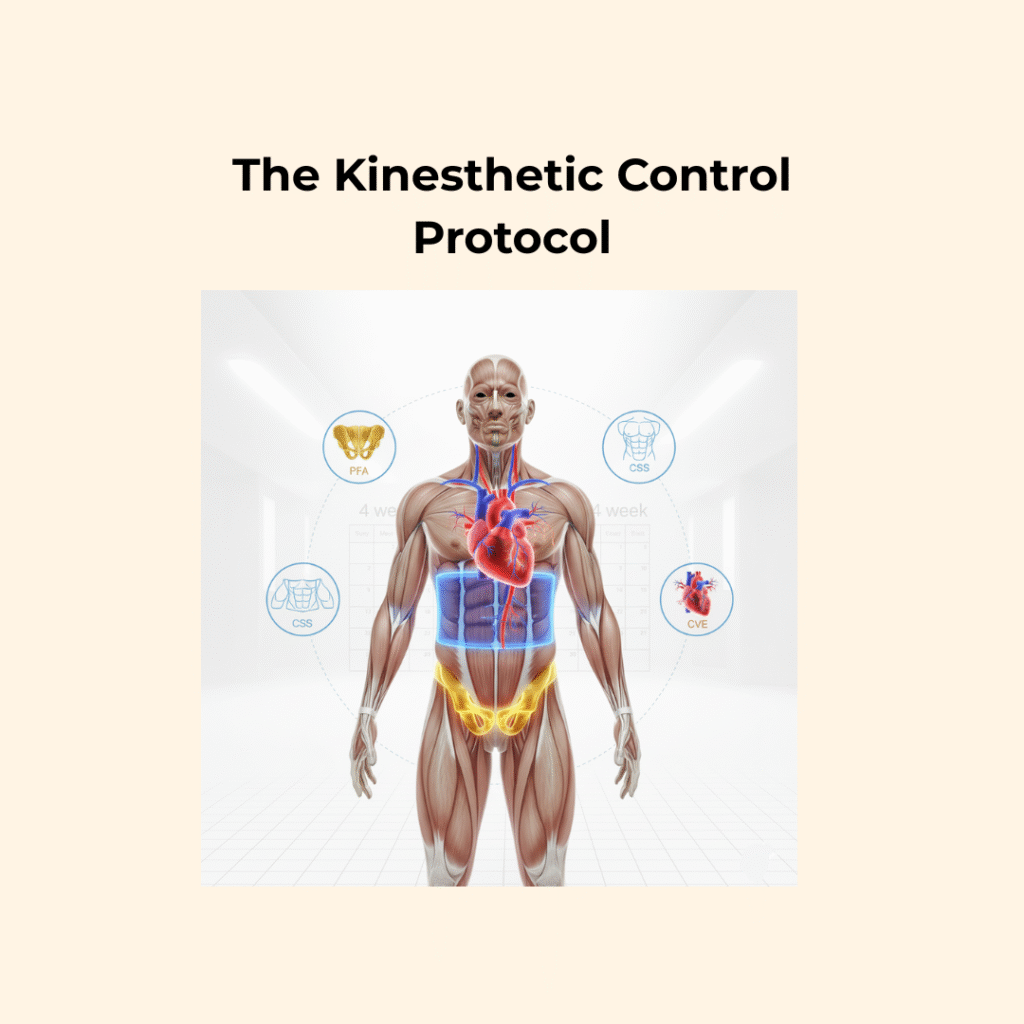
The Kinesthetic Control Protocol is a 4-week, science-backed training mission designed to systematically upgrade your body’s three core performance systems—the pelvic floor, the core, and the cardiovascular engine—for superior control, stamina, and confidence.
Your mission, should you choose to accept it, is to forge a superior physical engine. This guide provides a complete guide to the ‘Kinesthetic Control Protocol,’ the science behind it, and the tools to track your progress and analyze your results.
Important Medical Disclaimer
This fitness protocol is for informational purposes only. Consult with a physician or qualified physical therapist before beginning any new exercise program, especially if you have pre-existing health conditions. The information provided herein is not intended to be a substitute for professional medical advice, diagnosis, or treatment.
Mission Briefing: Why This Protocol is the Key to Kinesthetic Mastery
This protocol is the key to kinesthetic mastery because it develops “kinesthetic control”—the ability to translate raw strength into precise, functional movement—by targeting the three interconnected systems that govern physical performance: the Pelvic Floor, the Core, and the Cardiovascular Engine.
This mastery begins with proprioception, the body’s subconscious “sixth sense” that provides a constant stream of information from mechanoreceptors in muscles and joints to the central nervous system, detailing limb position and movement. Improved proprioception leads to enhanced kinesthetic awareness (the conscious ability to sense your body in space) and greater neuromuscular efficiency (the ability of the nervous system to coordinate muscle fibers effectively).
From Unconscious Signal to Conscious Control
Before Training
Inefficient, noisy neuromuscular signals.
After Training
Efficient, direct mind-muscle connection.
Targeted exercise protocols → systematically upgrade your body’s three core performance systems → leading to superior control, stamina, and confidence.
The Protocol Library: The “Why” and “How” Behind Your Training
The Protocol Library details the “why” and “how” of your training, breaking down the three core protocols—Pelvic Floor Activation (PFA), Core Stability & Strength (CSS), and the Cardiovascular Engine (CVE)—into specific objectives and exercises.
Protocol 1: Pelvic Floor Activation (PFA) for Precision Control
The objective of Pelvic Floor Activation (PFA) is to develop a powerful mind-muscle connection with the pelvic floor muscles, enabling conscious command over functions like erectile rigidity and ejaculatory control. A landmark trial in the British Journal of General Practice found that 40% of participants with ED regained normal function after a structured Pelvic Floor Muscle Exercise (PFME) program.
How to Perform the Key PFA Exercises
- ➤Kegels: Contract the muscles you would use to stop the flow of urine. Hold for 3-5 seconds, then relax. This targets the bulbospongiosus and ischiocavernosus muscles.
- ➤Reverse Kegels: Gently bear down as if initiating urination, feeling a lengthening or dropping of the pelvic floor. This promotes relaxation, which is crucial for blood flow.
- ➤Power Kegels (Flicks): Perform a series of quick, strong contractions and relaxations of the pelvic floor muscles. This trains the fast-twitch muscle fibers essential for ejaculatory control.
Protocol 2: Core Stability & Strength (CSS) for Power Transfer
The objective of Core Stability & Strength (CSS) is to build a stable core that allows for the efficient transfer of power from the hips and legs, which is critical for improving functional strength and physical stamina. A strong core acts as a rigid “force transmission cylinder” by generating Intra-Abdominal Pressure (IAP). A 2008 study found an 8-week core program improved vertical jump height by ~10%.
Illustrative data showing performance increase after an 8-week core stability program.
How to Perform the Key CSS Exercises
Plank: Hold a straight line from head to heels, engaging your abs and glutes.
Glute Bridge: Lie on your back, knees bent. Drive through your heels to lift your hips until your body forms a straight line from shoulders to knees.
Bodyweight Squat: Stand with feet shoulder-width apart. Lower your hips back and down as if sitting in a chair, keeping your chest up.
Protocol 3: Cardiovascular Engine (CVE) for Relentless Stamina
The objective of the Cardiovascular Engine (CVE) protocol is to enhance endothelial function and Nitric Oxide bioavailability using the most efficient methods, like High-Intensity Interval Training (HIIT), to improve systemic blood flow. A 2022 meta-analysis showed HIIT was more effective than moderate-intensity training for improving vascular health. Studies also show HIIT can increase VO2 Max by up to 7.2% in 8 weeks.
HIIT shows a greater improvement in Flow-Mediated Dilation (FMD) compared to Moderate-Intensity Continuous Training (MICT).
How to Perform a Basic HIIT Session
- Warm-up: 5 minutes of light jogging or jumping jacks.
- Work Interval: 30 seconds of maximal effort (e.g., sprinting in place, burpees).
- Rest Interval: 60 seconds of active rest (e.g., walking).
- Repeat: Complete 8-10 cycles of Work/Rest intervals.
Your Mission Log: The 4-Week Training Matrix
The “4-Week Training Matrix” is your personal mission log, a simple tool to track your consistency and ensure you are performing each protocol with the right frequency for optimal adaptation and recovery. Aim for 2-3 sessions of each protocol (PFA, CSS, CVE) per week on non-consecutive days.
| Week | Mon | Tue | Wed | Thu | Fri | Sat | Sun |
|---|
How to Conduct Your Performance Debrief (After 4 Weeks)
The “Performance Debrief Matrix” is the analysis phase of your mission, a structured process to review your training log and identify which protocol had the most significant positive impact on your real-world performance outcomes. For each protocol, check the box that best describes its impact.
| Key Training Protocol | Impact on Stamina | Impact on Control | Impact on Confidence |
|---|---|---|---|
| Consistent PFA (>2x/wk) | S M N | S M N | S M N |
| Consistent CSS (>2x/wk) | S M N | S M N | S M N |
| Consistent CVE (>2x/wk) | S M N | S M N | S M N |
S = Strong Positive, M = Minor Positive, N = No Effect
Your Most Impactful Protocol
How to Design Your Next Training Cycle for Continuous Improvement
The “Next Cycle’s Strategic Focus” table is the final step, designed to help you transform the insights from your debrief into a concrete, personalized training plan for the next four weeks.
| My Area of Greatest Opportunity Is: | My Measurable Objective for Next Cycle Is: | The Specific Action I Will Take Is: |
|---|---|---|
A Checklist for Your First Kinesthetic Control Mission
Frequently Asked Questions
Glossary of Clinical & Technical Terms
| Term | Definition |
|---|---|
| Kinesthetic Control | The ability to consciously sense and command body position and movement with precision and efficiency. |
| Proprioception | The body’s subconscious ability to sense its own position, motion, and equilibrium. |
| Neuromuscular Efficiency | The ability of the nervous system to properly recruit and coordinate muscles to produce and reduce force. |
| Intra-Abdominal Pressure (IAP) | The pressure within the abdominal cavity, created by the co-contraction of core muscles to stabilize the spine. |
| High-Intensity Interval Training (HIIT) | A training protocol involving short bursts of intense anaerobic exercise with less-intense recovery periods. |
| VO2 Max | The maximum rate of oxygen the body can utilize during intense exercise; the gold-standard measure of cardiovascular fitness. |