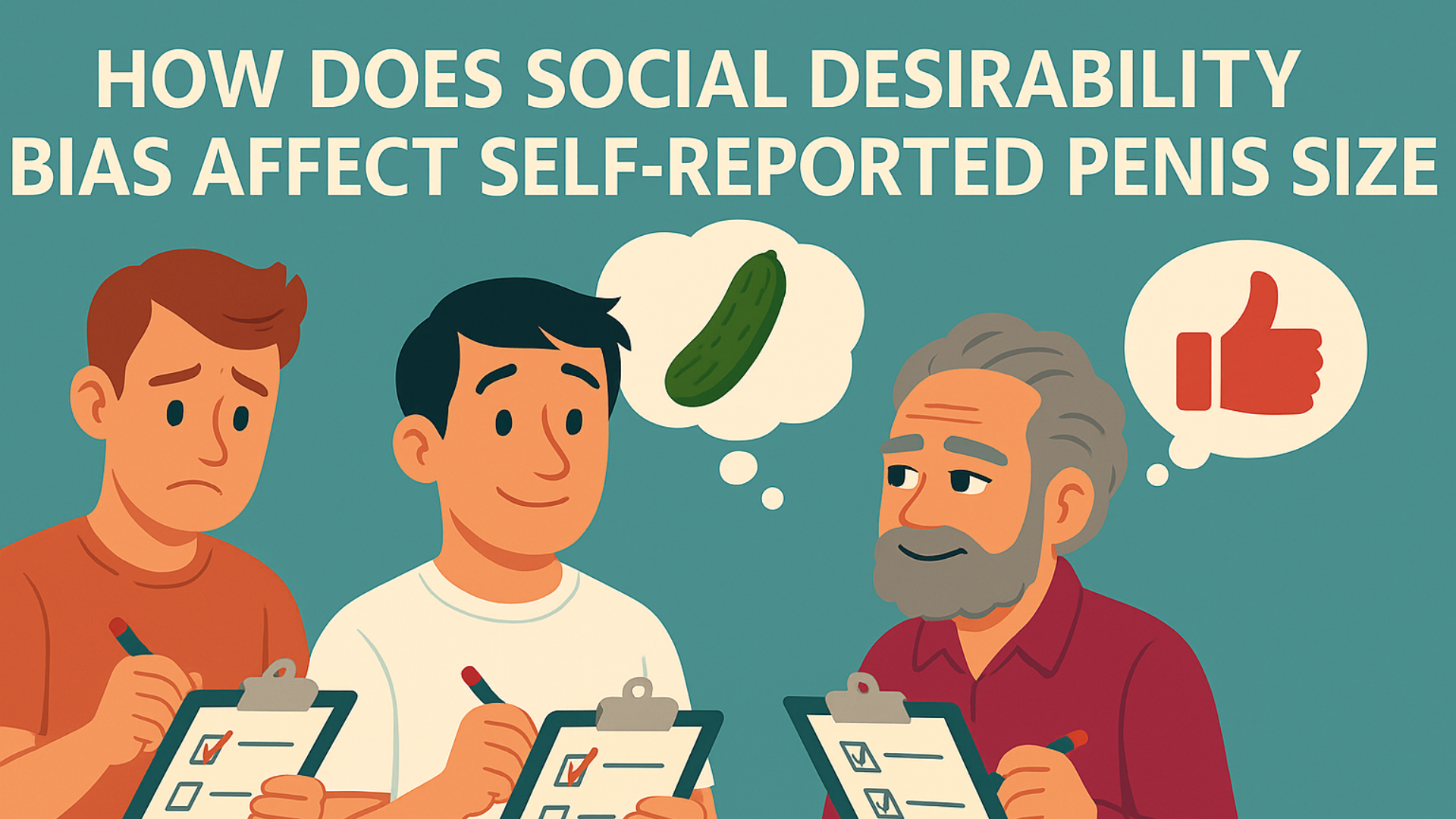
“Social desirability bias” significantly affects self-reported penis size by compelling individuals to consciously or unconsciously inflate their measurements to align with perceived social ideals of masculinity and desirability, leading to skewed and unreliable data.
For a comparison based on clinician-measured data rather than stereotypes or self-reports: use the evidence-based penis size calculator.
In psychological research, it is a well-known issue that self-reported information is often inaccurate, particularly when the topic is as sensitive and culturally loaded as erect penis size, necessitating a measure of social desirability.
This discrepancy creates a significant gap between anecdotal claims and scientific reality, fueling anxiety and social comparison based on flawed information.
The connection between social desirability bias and penis size reporting is not just a statistical curiosity; it’s a critical factor in understanding men’s health and psychology, particularly regarding their sexual partners.
This guide explains how ‘social desirability bias affects self-reported penis size.’
We will define this psychological bias, explore why it’s so powerful in this context, and detail how it skews data related to sexual behavior surveys, particularly in relation to the Marlowe-Crowne social desirability scale.
Our analysis will maintain a clinical tone, focused squarely on the cognitive bias at play and its measurable impact. Understanding the mechanics of social desirability bias and penis size is essential for interpreting survey results and appreciating the difference between cultural perception and clinical fact, especially in light of the number of sexual partners reported.
What Is the Psychological Concept of Social Desirability Bias?
The psychological concept of “social desirability bias” is the common human tendency for individuals to answer questions and report information in a manner that will be viewed favorably by others, often prioritizing social acceptance over complete accuracy.
It is a form of response bias, known as social desirability response bias, that contaminates the results of surveys and self-assessments on a wide range of topics, including sexual behavior.
Defining Social Desirability Bias
“Social desirability bias” is formally defined as the tendency of survey respondents or individuals in self-assessment to answer questions in a way they believe will make them look good, rather than answering with complete, unvarnished honesty.
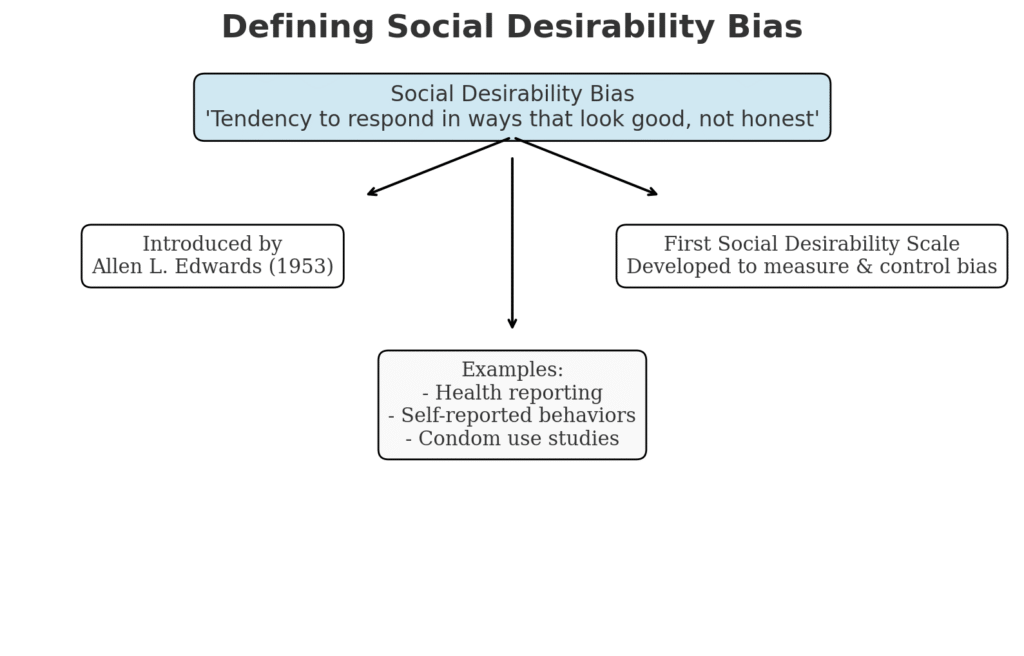
This cognitive bias is a well-documented phenomenon in psychological and social research that can render self-reported data unreliable, particularly on subjects related to health, behavior, and personal attributes.
The concept was formally introduced to psychology by Allen L. Edwards in 1953.
He recognized that individuals’ responses to personality test items were often influenced by the perceived social desirability of the traits in question, similar to self-reported condom use, which is also affected by social desirability response bias.
To address this, he developed the first Social Desirability Scale to measure and control for its confounding effect in research on self-reported sexual behaviors.
The Two Types of Biased Responding
Social desirability bias manifests in two primary ways: conscious “impression management,” where an individual deliberately misrepresents themselves to create a better impression, and unconscious “self-deception,” where they genuinely hold an inflated or overly positive view of themselves.
This distinction is based on the influential two-component model developed by psychologist Delroy L. Paulhus, which separates the motivation for the biased response.
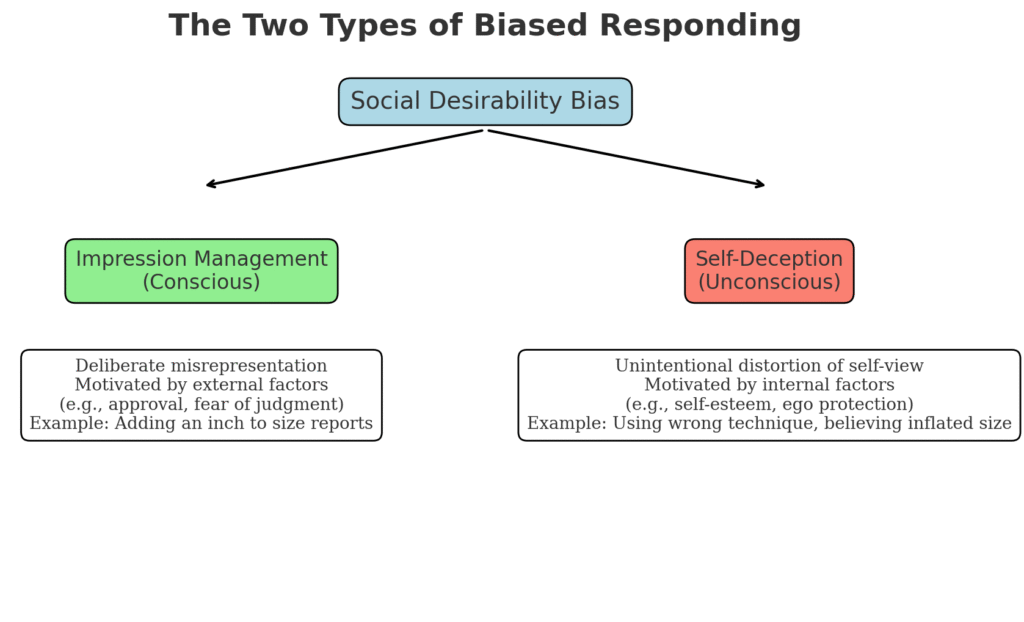
Impression Management can lead to inflated self-reported and measured penis length and circumference among men self-reported data. Self-deception is a conscious, intentional act of deception that can affect self-reported behaviors.
This behavior is motivated by external factors, such as the desire for social approval or the fear of judgment from others. When an individual knowingly adds an inch to their self-reported penis size, they are engaging in impression management.
Self-Deception is an unconscious or unintentional distortion of one’s own self-perception. This is motivated by internal factors, such as the need to protect one’s self-esteem or ego, which can influence social desirability responding.
A person might use an incorrect measurement technique that yields a larger number and accept it as true because it aligns with their desired self-image, an act of self-deception influenced by the level of social desirability.
Why This Bias is Common in Surveys and Self-Reporting
This bias is common in surveys and self-reporting because the fundamental human drive for social acceptance and the desire to avoid negative judgment can often override the desire for accuracy, especially when the topic is sensitive and anonymity is not fully trusted.
The impulse to present an idealized version of oneself is a powerful motivator that can influence responses on any topic related to perceived social status, competence, or desirability, including a measure of social desirability.
While anonymous surveys can reduce conscious impression management, they are largely ineffective against unconscious self-deception. This distinction explains why self-reported penis size remains inflated even in anonymous online studies, reflecting the influence of social desirability on sexual behavior surveys. Seeing how social desirability bias influences self-reported penis size can help explain what psychological factors drive penis size concerns.
Why Does Social Desirability Bias So Strongly Affect Penis Size Reporting?
“Social desirability bias” so strongly affects penis size reporting because the trait is deeply and culturally linked to perceived masculinity and virility, creating immense social pressure to report a size that aligns with a desirable masculine ideal and to avoid the fear of negative judgment. This transforms a simple request for data into a high-stakes question about personal adequacy and the influence of social desirability.
The Link to Perceived Masculinity and Virility
Because penis size is so powerfully linked culturally to concepts of masculinity, virility, and competence, there is significant social pressure for men to report a size that aligns with what they perceive to be a desirable and “manly” ideal, directly fueling social desirability bias.
This cultural equation transforms a request for a physical measurement into a psychological query about one’s adequacy as a man.
This identity threat can have real-world health consequences. Research indicates that discomfort and anxiety over penis size can lead to avoidance of crucial medical examinations for serious conditions like testicular cancer, as men may fear judgment or embarrassment from healthcare professionals.
The Fear of Negative Judgment
The fear of negative judgment is a core driver, as individuals worry that reporting a smaller or even statistically average penis size could lead to being judged by others as less of a man, less sexually competent, or generally less desirable.
This fear is about avoiding a negative social outcome and the associated feelings of shame or inadequacy, influenced by social desirability on sexual behavior.
This concern is rooted in real psychosocial harm associated with socially desirable responding.
A study published on men who have sex with men found that those who perceived their penis as below average reported significantly lower life satisfaction and higher levels of stigma.
This demonstrates that the fear of judgment is not abstract but is connected to tangible negative experiences.
Understanding how the influence of social desirability affects self-reported penis size can provide perspective on sexual behavior. How penis size dissatisfaction is linked to mental health can be understood through the lens of social desirability on sexual behavior, particularly in a national survey of sexual attitudes..
The Influence of Unrealistic Media Standards
Unrealistic media standards, particularly from sources that emphasize the desirability on sexual behavior surveys, can distort perceptions of adequacy in self-reported sexual behaviors, further complicating the accuracy of self-reported data.
Pornography can create unrealistic expectations regarding the average-size erect penis, impacting self-reported behaviors and contributing to participation bias., heavily influence “social desirability bias” by creating a skewed and inflated perception of what is “normal,” making many men feel that their actual, average size is socially undesirable and must be exaggerated in self-reports.
Men often believe the average erect penis is over 6 inches, a perception reinforced by media and the bias and social desirability that shapes their self-reported behaviors.
In contrast, large-scale clinical data, like the systematic review of over 15,000 men self-reported erect penis lengths, offers a more objective perspective. BJU International is a leading journal that publishes research related to sexual behavior and health, often including studies on self-reported sexual behaviors., places the average erect length between 5.1 and 5.5 inches.
This leads to a predictable psychological process:
1) Exposure to false norms in sexual behavior, which is correlated with social desirability. Pornography l
eads to 2) Internalization of the false norm regarding sexual behavior.
This is followed by 3) Social comparison and dissatisfaction, which ultimately motivates
4) Biased reporting to close the perceived gap.
Examining how social desirability bias shapes self-reported penis size creates a natural path to exploring the impact of measures of social desirability responding on accuracy. whether penis size affects sexual performance.
How Does Social Desirability Bias Manifest in Self-Reported Penis Size Data?
Social desirability bias manifests in self-reported penis size data through several distinct mechanisms, including conscious exaggeration of measurements, unintentional measurement errors driven by wishful thinking, and the common tendency to round up numbers to a more desirable figure.
These manifestations combine to create a significant and consistent upward skew in non-clinical data.
Manifestation 1: Conscious Exaggeration
The most direct manifestation of social desirability bias is conscious exaggeration, an act of impression management where an individual knowingly and deliberately adds an inch or more to their self-reported measurement to sound more impressive or align with perceived social ideals.
This is the most straightforward way that self-reported penis size data becomes skewed due to social desirability bias in qualitative research.
This is not just an assumption; it is supported by direct evidence.
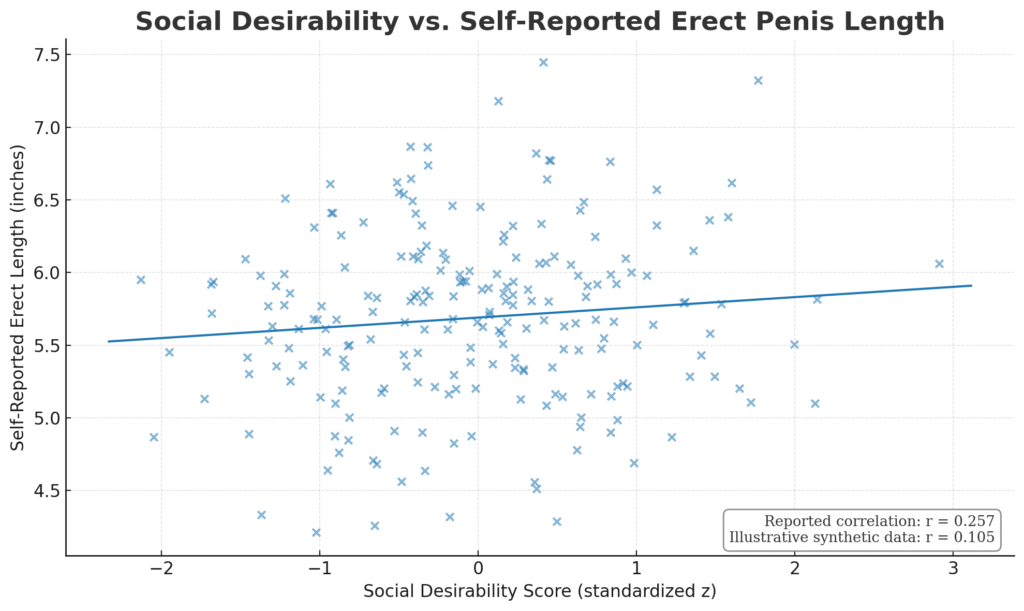
A study published in the Journal of Sex & Marital Therapy found a statistically significant positive correlation (r=To address these perceptions, it is crucial to consider how nutrition and obesity research may also play a role in body image issues among men..257) between participants’ social desirability scores and their self-reported erect penis length, meaning those more concerned with social approval reported larger sizes, reflecting the impact of reducing social desirability in their responses.
Another Danish study highlighted this by finding that self-reported size was 21.1% larger than the established population mean, a deviation far too large to be entirely unintentional.
Manifestation 2: Measurement Errors and “Wishful Thinking”
A more subtle manifestation is measurement error driven by wishful thinking, a form of self-deception where an individual might use improper techniques like not pressing to the bone or measuring from the bottom that naturally yield a larger, albeit inaccurate, number which they then accept as truth.
This behavior is linked directly to the “self-deception” type of bias, where the error is often unconscious or semi-conscious, particularly in self-reported sexual activities, which can skew the data on flaccid penis size.
Specific examples of measurement errors that lead to inflated numbers include using a flexible tailor’s tape measure along the curve of the penis instead of a rigid ruler for length, not starting at the pubic bone (a non-bone-pressed measurement), or measuring from the underside instead of the top surface.
Each of these non-standard methods can add fractions of an inch to the reported erect penis size, which a motivated individual may readily accept, but they are often influenced by social desirability tend. Recognizing how social desirability bias can shape self-reported penis size leads naturally to exploring how penis size influences sexual confidence.
Manifestation 3: Rounding Up to the Nearest “Good” Number
A common and often unconscious manifestation of “social desirability bias” is the tendency to round up a measurement, such as reporting a clinically measured 5.8 inches as a more socially desirable “6 inches,” which collectively skews survey data upwards.
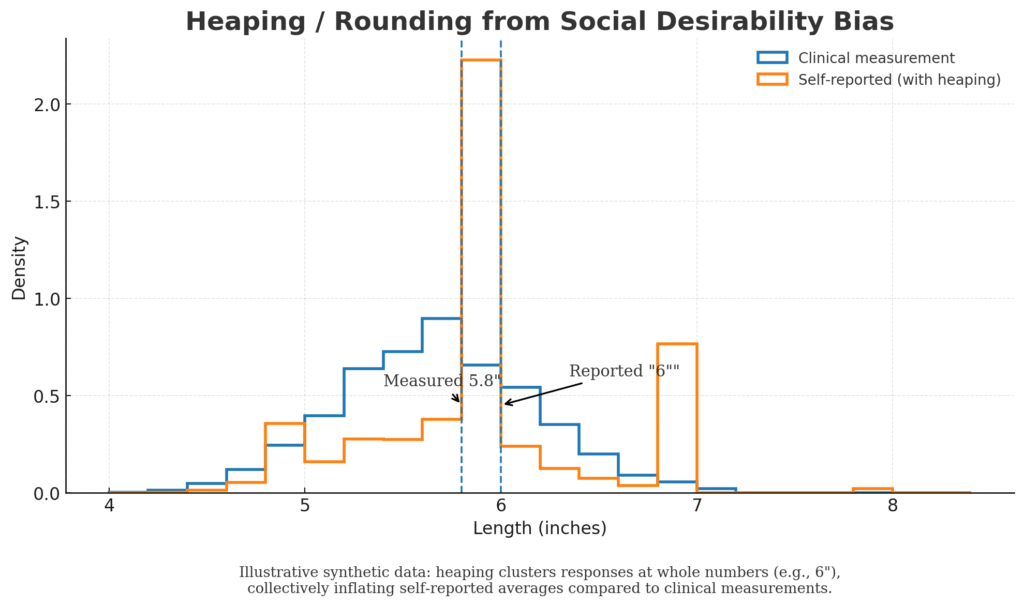
In survey research, this well-known phenomenon is known as “heaping” or “rounding,” where responses cluster around whole numbers or socially significant milestones.
The 5.8″ versus “6 inches” example clearly illustrates the point. This cognitive shortcut is driven by the desire to report a “better,” simpler number.
While a single instance of rounding up may seem minor, the cumulative effect of thousands of respondents doing this significantly inflates the average in self-reported surveys and contributes to the gap between perception and clinical reality.
Comparing Biased Self-Reported Data vs. Objective Clinical Measurement
| Attribute social desirability bias to the inaccuracies found in self-reported data on sexual activity. | Self-Reported Data (Affected by Socially Desirable Responding) can often misrepresent the true level of social desirability in responses, particularly in studies of penis length and circumference. | Clinical Measurement (Objective Data) is essential to counteract the biases inherent in relying on self-reported sexual behaviors. |
| Primary Goal is to enhance the accuracy of self-reported data by addressing social desirability bias. | To present a socially desirable image. | To obtain an accurate, repeatable measurement, one must minimize the influence of social desirability on sexual behavior. |
| Methodology must account for the influence of evidence of social desirability bias when analyzing self-reported data, especially in studies involving penile size. | Often inconsistent, non-standardized. | Strict, standardized protocol (e.g., BPEL). |
| Resulting Data | Consistently inflated; skewed towards larger sizes. | Reflects the true statistical average and range. |
| Psychological Driver significantly impacts how individuals respond to questions about their sexual behavior. | Ego, fear of judgment, and social pressure often lead to inflated self-reported height and weight among individuals. | Scientific objectivity is crucial in research to mitigate the effects of bias and social desirability on findings related to sexual health. |
What Are the Key Takeaways for Understanding Social Desirability Bias and Penis Size?
The key takeaways for understanding social desirability bias and penis size are to always question self-reported data, recognize the powerful psychological pressure to conform to perceived ideals, distinguish between conscious and unconscious bias, and trust only in data derived from clinical standards.
A Quick Checklist for Identifying the Bias’s Effect
Question Self-Reported Data: Always be skeptical of survey data on penis size that is not clinically measured, as self-reported behaviors can be compared to actual measurements with significant discrepancies.
☐ Recognize the Pressure: Understand that the desire to appear “better than average” is a powerful psychological force.
☐ Distinguish Conscious vs. Unconscious Bias: Know that the inaccuracy can be both a deliberate exaggeration (impression management) and an unconscious error (self-deception), which can affect the accuracy of self-reported data.
☐ Trust Clinical Standards: The only truly reliable data comes from studies using standardized, objective measurement techniques like Bone-Pressed Erect Length (BPEL) to avoid the pitfalls of socially desirable responding.
Conclusion
In conclusion, social desirability bias profoundly affects self-reported penis size by causing men to consciously or unconsciously inflate their measurements to align with a perceived social ideal, which is the primary reason scientifically measured averages are consistently smaller than those found in informal surveys.
This cognitive bias, evidenced by the prevalence of sexual myths, is the key driver of the inaccurate data that fuels social comparison and anxiety.
This bias explains the significant and persistent gap between clinical data and anecdotal or survey data on penis size.
At factbasedurology we prioritize clinical data and psychological understanding to provide the most accurate health information, especially in sexual behavior research.
Understanding this psychological bias is key to dismantling unrealistic expectations and focusing on factual, health-based information.