

The scientifically established average penis size is approximately 5.16 inches (13.12 cm) in erect length and 4.59 inches (11.66 cm) in erect girth, according to a major 2015 systematic review.
Compare your measurement: Use the evidence-based penis size calculator to estimate a length or girth percentile from clinician-measured reference data.
“What is the average penis size?” stands as one of the most common male Health questions. This query is surrounded by Myths and unreliable Data from non-scientific sources like Pornography, which can create significant Anxiety.
This guide provides the most current, scientifically-backed data on the average penis size from major urological studies. We will present the numbers for length and girth and, just as importantly, explain the context behind this data. A factual understanding of the numbers provides a healthy baseline and dismantles the fiction that fuels insecurity.
The discussion about average penis size should start with clinical evidence, not cultural fiction.
What Does Scientific Data Reveal About the Average Penis Size?
Scientific Data from large-scale studies reveals that the global average penis size is well-defined for both erect and flaccid states, providing a reliable benchmark that contrasts sharply with cultural myths and media portrayals.
The Global Average Erect Penis Length According to Major Studies
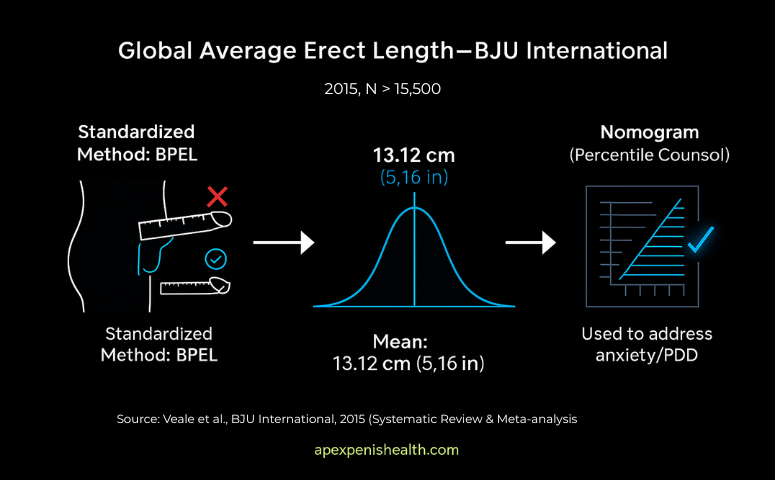
Major international studies, specifically the comprehensive 2015 BJU International systematic review and meta-analysis, place the global average erect penis length at 13.12 cm (5.16 inches)
when measured using the standardized bone-pressed method. The 2015 BJU International review by Veale et al., which analyzed Data from over 15,500 men, is the most authoritative source on this topic.
The purpose of this large-scale study wasn’t merely to record numbers. A key goal was to create nomograms, which are graphical calculating devices. These charts help Health professionals counsel men who experience significant Anxiety about having a small penis, often a symptom related to Body Dysmorphic Disorder.
The Global Average Erect Penis Girth (Circumference)
The Global Average Erect Penis Girth (Circumference)
Compare Yours To
Illustration of Mid-Shaft Measurement Point
Source: Veale, D., et al. (2015). “Am I normal?”. BJU International. (Mean: 11.66cm, SD: 1.10cm)
Visualization by factbasedurology.com
The widely cited global average erect penis girth, or Circumference, is 11.66 cm (4.59 inches), measured at the mid-shaft, according to the same landmark 2015 urological systematic review.
This measurement is the distance around the erect penis, typically taken at the middle of the shaft, as this provides a consistent point of reference. The data for both length and circumference originate from the same pool of research, ensuring consistency.
Understanding the Data on Average Flaccid Penis Size
While the average flaccid penis size is approximately 9.16 cm (3.61 inches) in length, this measurement is considered a highly unreliable indicator of erect size due to significant variations caused by factors like Temperature and arousal level. The average flaccid girth from the 2015 study is recorded at 9.31 cm (3.66 inches).
The reason flaccid penis length isn’t a focus of clinical attention is its variability. The phenomenon colloquially known as “growers vs. showers” illustrates this point perfectly; a smaller flaccid penis can grow substantially upon Erection, while a larger one might change less. For an accurate penis size measurement, medical and scientific focus remains on the erect state.
Average Penile Dimensions
| Measurement State | Average Length | Average Girth (Circumference) |
| Erect | 13.12 cm (5.16 inches) | 11.66 cm (4.59 inches) |
| Flaccid | 9.16 cm (3.61 inches) | 9.31 cm (3.66 inches) |
| Source: Veale, D. et al. (2015), BJU International. |
How Do Scientific Studies Determine the Average Penis Size?
Scientific studies determine the average penis size by adhering to strict clinical measurement protocols to ensure Accuracy and precision, primarily using measurements taken by health professionals and applying the standardized Bone-Pressed Erect Length (BPEL) methodology.
The Importance of Clinical Measurement for an Accurate Average Penis Size
Reliable studies on average penis size depend on clinical measurements taken by trained health professionals, as self-reported Data is notoriously inaccurate due to common measurement errors and psychological reporting Bias.
When asked to self-report, individuals may consciously or unconsciously inflate their numbers, a phenomenon known as social desirability bias, which makes such data scientifically invalid for establishing a true average.
Clinical measurements by urologists or researchers ensure a standardized, objective approach. This method minimizes observational error and provides the high-quality data needed for academic Research. The figures presented in this article are based on these more reliable clinical measurement studies.
The Standardized Methodology: Bone-Pressed Erect Length (BPEL)
The standardized methodology for measuring length in clinical studies to determine average penis size is the Bone-Pressed Erect Length (BPEL), which provides the most consistent and accurate measurement by creating a fixed starting point independent of Body mass index or Fat. The BPEL method involves measuring from the Pubis bone, not the Skin, to the tip of the Glans penis.
This method is the medical standard because it provides consistency by negating the variable of the pre-pubic Adipose tissue. A man with a higher body fat percentage may have a significant fat pad at the base of the penis, obscuring part of its length. The bone-pressed technique bypasses this, ensuring the measurement reflects the true length of the internal structure.
The Limitations of Current Data on the Average Penis Size
To provide a complete picture, it’s important to acknowledge the limitations of current Data on average penis size, as most major studies have been based on specific populations, with more Research needed to represent a fully diverse global average accurately.
Many foundational studies on penis size, including the BJU International review, have a preponderance of Caucasian or Middle Eastern participants. Data on other ethnic groups is less extensive.
This doesn’t invalidate the existing numbers, but it highlights an area for future research. While the current data is the best and most comprehensive available, more diverse global studies are needed for a more complete understanding of penile size variations.
Why is Context Important When Reviewing the Average Penis Size?
Context is critically important when reviewing the average penis size because the Average is merely a midpoint in a wide spectrum of normal, and factors like self-Perception and unrealistic media portrayals often create a distorted view of what is typical.
The “Normal” Range vs. The Average Penis Size
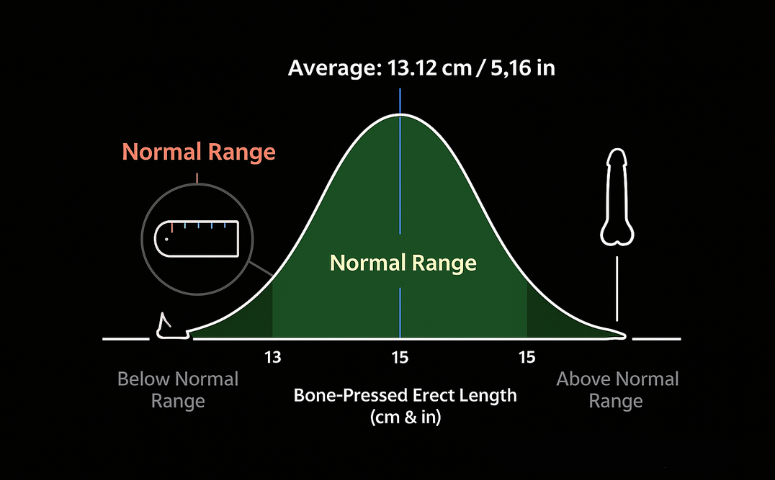
It’s crucial to understand the “normal” range versus the single number for average penis size. Like Height or Weight, penis size follows a bell curve where most men fall near the Average, but a very wide range is considered medically and functionally normal.
Thinking of the average as a “passing grade” is a fundamental error. Understanding that the average is just a midpoint on a spectrum reduces the focus on a single number and promotes a healthier body image. From a Health perspective, being within the broad “normal” range is what matters, not being exactly at the average.
Why Self-Perception of Penis Size is Often Inaccurate
Self-Perception of penis size is often inaccurate due to the “angle of observation” effect, where looking down at one’s own body from above creates a foreshortened perspective that can make the penis appear smaller than it actually is.
This is a simple optical illusion that can significantly affect body image. Compared to a side-on view in a mirror or a clinical measurement, this downward perspective can lead to an inaccurate self-assessment. This common perceptual error is one reason why many men feel unnecessary Anxiety about their size.
The Disconnect Between the Average Penis Size and Pornography
There is a significant disconnect between the average penis size and what is depicted in Pornography, as the adult entertainment industry deliberately selects for performers who are statistical outliers, creating a skewed and unrealistic Perception of what is typical.
Performers in adult films are often chosen specifically because their penile dimensions are well above average, making them completely unrepresentative of the general population. Comparing oneself to these statistical outliers is a primary source of Anxiety and is based on a false premise.
What Are the Key Facts to Remember About the Average Penis Size?
To maintain a healthy perspective, the key facts to remember about average penis size are to trust clinical Data over anecdotal sources, understand that the “Average” is just a midpoint in a wide normal range, and recognize that media portrayals are unrealistic.
A Healthy Perspective on Average Penis Size: Key Facts
- ☐ Focus on Clinical Data: Trust numbers from scientific studies, not anecdotes or media.
- ☐ Understand the “Average”: Remember that the average is just a midpoint in a wide and normal range.
- ☐ Recognize Measurement Matters: Know that scientific averages are based on specific, bone-pressed methods.
- ☐ Be Wary of Unrealistic Portrayals: Understand that media and pornography do not reflect the reality of the
average penis size.
Some studies suggest minor variations in average penis size among different ethnic groups, but the data isn’t comprehensive enough to draw definitive global conclusions.
For example, a 2016 study found that the average erect length for Asian men was around 11.7 cm (4.6 inches), while a different study showed an average of 14.2 cm (5.6 inches) for men of African descent.
However, the range of sizes within any single ethnic group is far greater than the small average difference observed between any two groups. The Research in the major systematic reviews is heavily weighted toward Caucasian participants.
Is it possible to increase penis size?
Most non-surgical penis enlargement methods are unproven and potentially dangerous. The American Urological Association (AUA) states that due to a lack of Evidence and the risk of injury, treatments like pills, creams, and vacuum devices are not advised. A consultation with a urologist is recommended for concerns about conditions like Peyronie’s disease, Micropenis, or a Buried penis, which are medical issues, not cosmetic ones.
Does penis size matter for sexual function or partner pleasure?
For sexual function and partner pleasure, size within the normal range is generally not a significant factor. A study by Lever, Frederick, and Peplau found that 85% of women were satisfied with their partner’s penis size. A healthy Erection, technique, communication, and emotional intimacy are far more important for a satisfying experience of Human sexual activity. Concerns about penis size often stem from psychological factors rather than functional limitations.
| Term | Definition |
| Bone-Pressed Erect Length (BPEL) | The medical standard for measuring erect penis length, taken from the top side by pressing a firm ruler against the pubic bone to the tip. |
| Systematic Review | A type of research that collects and critically analyzes multiple research studies or papers on a specific topic. |
| Meta-Analysis | A statistical procedure for combining data from multiple studies to arrive at a pooled estimate, often providing a more robust conclusion. |
| Micropenis | A rare, congenital medical condition where a penis is normally formed but is clinically defined as more than 2.5 standard deviations below the average size for age. |
| Nomograms | Graphical calculating devices used in medicine to estimate a statistical probability or outcome based on various variables. |
| Social Desirability Bias | The tendency for individuals in surveys to answer questions in a way that will be viewed favorably by others, rather than with complete honesty. |
Conclusion
The scientific Data on average penis size provides a factual baseline that primarily serves to dispel Myyths and manage expectations, reinforcing that for Health and function, the vast majority of men fall well within the wide spectrum of normal. The average erect penis length is approximately 5.16 inches with an average girth of 4.59 inches.
The purpose of knowing the true, scientific average penis size is to be informed and to counter self-criticism based on unreliable sources. At factbasedurology, we are committed to providing evidence-based health information that empowers individuals to build confidence based on facts, not fear. Focusing on overall Health, function, and realistic perspectives is more beneficial than fixating on a single number.
Once you understand the general averages, it helps to break them down by age group to see how size may vary over time.
3 Responses