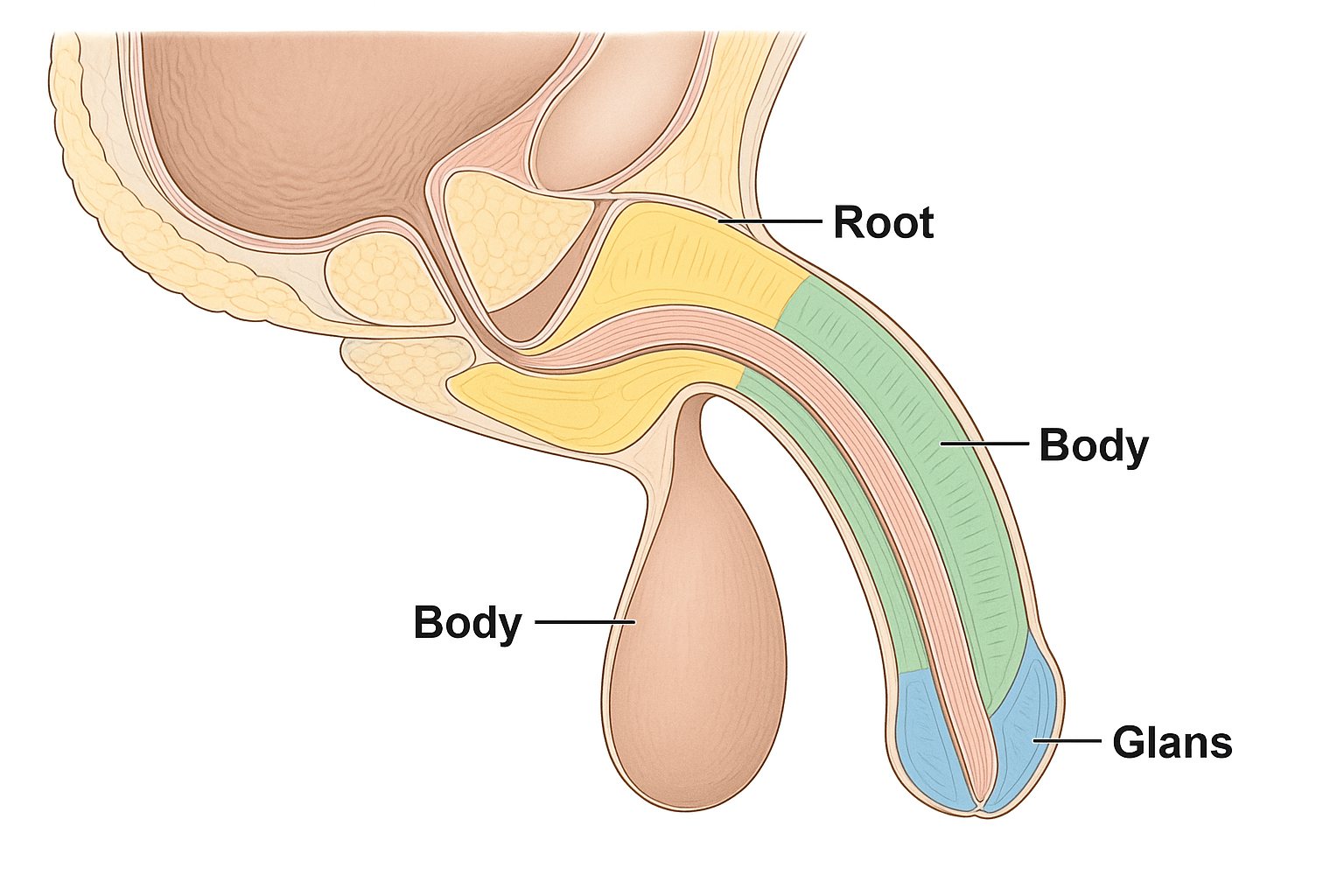
Peyronie's disease symptoms can appear suddenly or develop gradually. The most common signs include:
- Scar tissue (plaque): A hard lump or band of tissue that can be felt under the skin.
- Significant bend: A noticeable curve in the penis, typically during an erection.
- Erection problems: Difficulty getting or maintaining an erection (erectile dysfunction).
- Shortening of the penis: The penis might become shorter as a result of the condition.
- Pain: Penile pain, with or without an erection, especially during the acute phase.
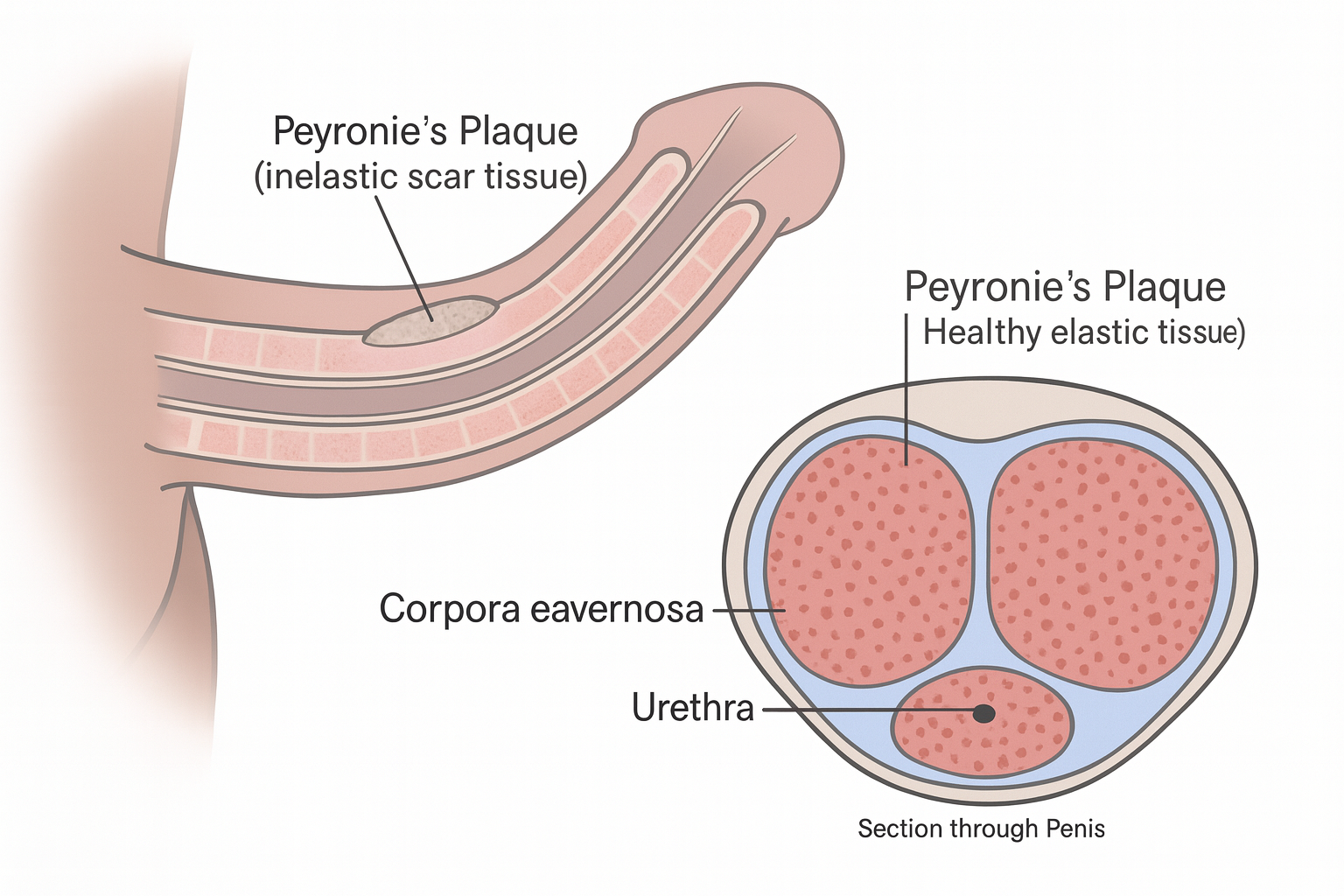
The exact cause is not fully understood, but it's believed to be related to repeated minor injury to the penis, often during sexual activity or from an accident. This can lead to improper wound healing and the buildup of scar tissue (plaque) in the tunica albuginea, the sheath that surrounds the erectile tissue. This inelastic plaque causes the penis to bend when it becomes erect.
Normal Anatomy

The tunica albuginea is healthy and elastic, allowing for even expansion.
With Peyronie's Plaque
An inelastic plaque forms, preventing that side from stretching, causing a bend.
The management of Peyronie's Disease is highly individualized, based on whether the disease is in the **acute (inflammatory)** or **chronic (stable)** phase. Surgery is only considered for stable disease that impairs sexual function. The data below is based on clinical trial evidence.
Non-Surgical / Minimally Invasive Options
Intralesional Collagenase (CCH / Xiaflex®)
The only FDA-approved medication. An enzyme is injected into the plaque to enzymatically break down collagen, combined with physical modeling exercises.
Mean Curvature Improvement (IMPRESS Trials)
Best For: Stable disease with curvature 30°- 90° and good erectile function.
Penile Traction Therapy (PTT)
A device applies sustained stretching force to the penis, promoting tissue remodeling. It is the only non-surgical therapy shown to improve penile length.
Mean Curvature Reduction (RestoreX® Trial)
Best For: Acute phase to potentially limit deformity and length loss. Can be combined with injections.
Surgical Options (For Stable Disease)
Surgery: Tunical Plication
Stitches are placed on the side opposite the plaque to shorten it, pulling the penis straight. Highly effective with low risk to erectile function.
Overall Condition Improved
Best For: Curvature <60°, good length and erections. Trade-off: High rate of *perceived* penile shortening (78% of patients).
Surgery: Plaque Incision & Grafting
The plaque is incised and the defect is filled with a graft. This preserves penile length but carries a higher risk of impacting erections.
Combined Functional & Anatomical Success Rate
Best For: Severe curvature >60° or complex deformity with excellent baseline erections. Trade-off: Higher risk of de novo ED.
Surgery: Penile Prosthesis Implantation
An inflatable device is implanted, providing rigidity for intercourse and physically straightening the penis. This is the gold standard for men with both PD and severe ED.
Patient Satisfaction Rate
Best For: Men with both PD and medication-refractory erectile dysfunction. Trade-off: Most invasive option; perceived shortening is a common complaint.
Other Investigated Therapies
- Oral Medications (Vitamin E, etc.): AUA/EAU guidelines do not recommend oral therapies for reducing curvature as clinical trials have shown them to be ineffective.
- Shockwave Therapy (ESWT): Not recommended for reducing curvature or plaque. May be considered for pain relief in the acute phase only.
- Stem Cells / PRP: These are considered investigational. There is not enough high-quality human trial data to validate their safety or efficacy for PD at this time.